 Skip to content
Your listing looks perfect. Great images, solid reviews, and a decent price point. You’ve optimized your bullets, stuffed your backend with keywords, and you’re running ads, yet you’re still left wondering why your Amazon listing is failing. But sales are crawling, and you’re burning money on PPC that barely converts.
Here’s what most sellers don’t realize: Amazon evaluates your listing through a diagnostic system that has nothing to do with what customers see on the front end. While you’re tweaking images and rewriting bullet points, Amazon’s algorithm is failing your listing at levels you never even check.
I’ve been selling on Amazon for over 12 years and currently manage my own brand that does $400,000+ monthly with listings that have generated over $1 million annually on single SKUs. The difference isn’t secrets or hacks—it’s understanding that Amazon isn’t a collection of tasks. It’s an ecosystem where everything connects, and most sellers are optimizing the wrong things.
Most agencies treat Amazon like isolated tactics: optimize listings here, run ads there, monitor performance somewhere else. But Amazon rewards ecosystem performance. When sellers focus on surface-level fixes while missing foundational failures, they end up in the Amazon seller graveyard, stuck in an expensive hamster wheel and paying rent on ads instead of building equity through organic ranking.
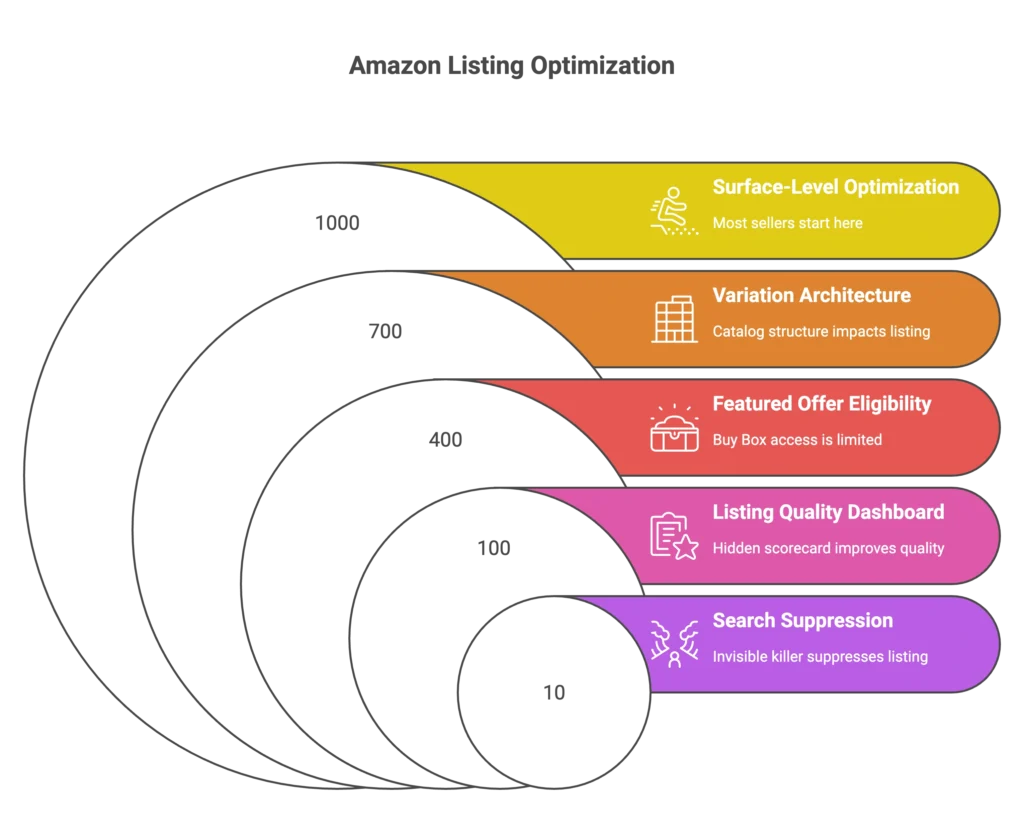
The Amazon Listing Failure Ladder (Most Sellers Start at Step 5)
Amazon evaluates your listing through a specific hierarchy. Most sellers jump straight to keyword optimization and ad management without checking if their listing even qualifies for visibility. Here’s the actual diagnostic path Amazon uses—and where your listing is probably failing.
Step 1: Search Suppression (The Invisible Killer)
Your listing might be suppressed, and you’d never know it from the front end. Amazon’s bots routinely change product classifications without notice, and these silent modifications can tank your organic rank overnight.
I’ve seen sellers lose rankings because Amazon switched their product from “Pajama Sets” to “Pajamas Sets”—a tiny change that completely derailed their visibility. The worst part? Everything looks fine on your product page, but in the backend, you’ve been categorized incorrectly.
The Suppression Audit Process:
Download your Category Listing Report from Seller Central monthly. This report reveals backend errors that most sellers never check. Look for inconsistent item type keywords, missing required attributes, and category mismatches that Amazon flagged but didn’t tell you about.
Cross-reference your item type keywords with the Browse Tree Guide (BTG) to ensure Amazon hasn’t reclassified your product into an irrelevant category. When Amazon bots fill in missing fields, they usually get it wrong, and you lose ranking power for your main keywords.
Most sellers have no idea this is happening. They see declining performance and throw more money at ads instead of fixing the foundational issue that’s preventing Amazon from showing their listing.
Step 2: Listing Quality Dashboard (The Hidden Scorecard)
Amazon grades every listing through quality metrics most sellers never access. The Listing Quality Dashboard shows exactly what Amazon thinks is wrong with your listing, but you have to know where to look.
Use the bulk attribute optimization feature to generate a complete report of missing or weak attributes across your catalog. Amazon gives you specific fields to fill, and most sellers either ignore them or fill them incorrectly.
Here’s what I do for every listing: maximize every available backend field with relevant keywords. Your backend description gets 2,000 characters—use all of them. Enhanced Brand Content alt text allows 100 characters per image—fill every line with longtail keywords, misspellings, and even Spanish terms. Ignoring these details is a major reason Why Your Amazon Listing Is Failing. Many sellers wonder Why Your Amazon Listing Is Failing when sales stall, yet they neglect these critical backend optimizations. Understanding Why Your Amazon Listing Is Failing comes down to mastering every field, keyword placement, and hidden content opportunity that influences Amazon’s algorithm.
I’ve audited competitor listings where they spam these fields with relevant variations, and it works. Amazon wants this information to understand and rank your product correctly. When you leave fields blank, you’re giving up free ranking opportunities.
Step 3: Featured Offer Eligibility (The Buy Box Gate)
No Buy Box means no sales, period. But Featured Offer eligibility isn’t just about having the lowest price—it’s about Amazon’s confidence in your ability to deliver.
The factors most sellers miss:
Stock distribution across fulfillment centers affects delivery promises. I’ve seen listings with plenty of inventory show 4-5 day shipping in certain regions because Amazon didn’t distribute stock properly. When customers see longer delivery times, conversions drop, and Amazon notices.
Your account health score impacts eligibility. Past performance issues, late shipments, or policy violations create invisible barriers to winning the Buy Box, even when your price and availability look competitive.
Inventory consistency matters more than total inventory. Amazon wants to see that you can deliver reliably. Having 30 units today and running out next week signals unreliability. I target 90 days of inventory because it tells Amazon you’re serious about consistent availability.
Step 4: Variation Architecture Failures (The Catalog Killer)
This is where clothing sellers especially get destroyed. Amazon treats each size and color as its own listing, but they’re connected through parent-child relationships. If you set this up wrong, your entire product family suffers.
When you sell out of your best-performing child ASIN—maybe your most popular size—the whole listing can crash. That top-ranking size was carrying your main keywords, and when it’s gone, Amazon doesn’t automatically promote another variation to take its place. Instead, your remaining sizes might be buried on page two for the same keywords, a common reason Why Your Amazon Listing Is Failing. Many sellers fail to anticipate this and wonder Why Your Amazon Listing Is Failing despite having great products. Understanding inventory and ranking interdependencies is key to preventing Why Your Amazon Listing Is Failing and maintaining consistent visibility.
I’ve seen this kill momentum during peak seasons. A listing doing great, one variation sells out, and suddenly the whole parent listing loses traction because the algorithm was ranking based on that specific child ASIN’s performance.
The fix: Proper catalog architecture from the start, and inventory management that treats each variation as its own business. Never let your MVP variation run out during growth phases.
Step 5: Surface-Level Optimization (Where Everyone Else Starts)
Keywords, images, bullet points—this is where most sellers begin, and it’s why they stay stuck. These elements matter, but only after you’ve cleared the foundational steps above.
The mobile-first reality: most customers never scroll past your title on mobile devices. Your main image and title need to convert in five seconds, not five minutes. Pretty listings that don’t convert quickly get buried by Amazon’s algorithm.
The Ecosystem Failure (Why Fixing One Thing Never Works)
Amazon isn’t a marketplace where you upload products and hope for sales. It’s a ranking system that rewards coordinated performance across every touchpoint. Most sellers fail because they optimize in isolation instead of understanding the connections.
The Chain Reaction Problem
Every element of your listing affects every other element. When I launch a product, I don’t just optimize keywords—I structure the entire ecosystem for momentum. Starting price affects conversion rates during the honeymoon period. Conversion rates affect how much I need to spend on ads. Ad performance affects organic ranking development.
Stock levels influence delivery promises, which impact conversion rates, which affect how Amazon evaluates your listing quality. It’s all connected, and Amazon’s algorithm is measuring all of it simultaneously.
I’ve built listings that rank for hundreds of keywords with high search volume specifically because I approach Amazon as an ecosystem, not a task list. When everything is aligned and working together, Amazon promotes your listing aggressively because they make more money when you succeed. Ignoring these ecosystem connections is a major reason Why Your Amazon Listing Is Failing. Many sellers wonder Why Your Amazon Listing Is Failing even with good products, simply because tasks are done in isolation. Understanding and managing every moving part is crucial to prevent Why Your Amazon Listing Is Failing and achieve consistent visibility and conversions.
The Honeymoon Period Reality
Everyone talks about the honeymoon period like it’s a 30-90 day window that suddenly ends. That’s not how it works. I’ve successfully relaunched listings that were over a year old and got them ranking in top positions for competitive keywords.
The honeymoon period doesn’t end—it gradually weakens. The first few weeks are strongest, the first few months are still powerful, but you can refresh momentum even after a year if you know how to approach it strategically.
The key is understanding that Amazon wants to see sales velocity and conversion performance. If you can demonstrate both during any period, Amazon will reward you with better rankings. The honeymoon period just makes it easier, not impossible later.
The Million-Dollar Listing Philosophy
I don’t believe in managing hundreds of mediocre listings. I believe in building fewer, stronger listings that each do serious revenue. I have listings generating over a million dollars annually on single SKUs, and that’s not because I know secrets others don’t—it’s because I treat each listing like a complete business.
Foundation Before Speed
Most sellers want to rank fast and scale quickly. But sustainable Amazon success requires building organic strength first. When I manage accounts, I focus on creating listings that can eventually succeed without constant ad spend.
My current brand demonstrates this approach. I’ve gone 90+ days with zero ad spend while maintaining top rankings and strong sales because the foundation was built correctly from the start. That doesn’t happen by accident—it happens through systematic ecosystem optimization.
The Mobile-First Reality
Here’s something most sellers miss: the majority of Amazon shopping happens on mobile devices, and most customers never scroll past your main image and title. If your listing doesn’t convert in those first five seconds, you’ve lost them.
I optimize everything mobile-first. Images need to tell the complete story in thumbnail size. Titles need to include the most important keywords and benefits upfront. The customer decision happens before they even read your bullets.
Strategic Inventory Management
Inventory isn’t just about having stock—it’s about having the right amount in the right places. I target 90 days of inventory because it signals reliability to Amazon’s algorithm and ensures consistent delivery promises across all regions.
When your stock gets low, Amazon can’t guarantee fast shipping in all areas, so they start showing your listing less frequently. Even if you’re not completely out of stock, low inventory levels hurt your organic rankings because delivery promises get longer in some regions.
FAQ: Solving Common Amazon Listing Failures
Q: How do I know if my Amazon listing is suppressed?
A: Download the Category Listing Report from Seller Central and check for backend errors, missing attributes, or category mismatches. If your impressions dropped suddenly without changes to your listing or ads, suppression is likely the culprit.
Q: What’s the real Amazon honeymoon period length?
A: It’s strongest for about 90 days but doesn’t end abruptly. The ranking boost gradually weakens over time, but you can refresh momentum even on older listings through strategic relaunches and proper ecosystem optimization.
Q: Why do my ads convert poorly even with optimized listings?
A: Poor ad conversion usually indicates backend optimization issues or ecosystem misalignment. Check your Featured Offer eligibility, verify proper categorization, and ensure your inventory levels support consistent delivery promises.
Q: How much inventory should I maintain for good Amazon rankings?
A: I recommend 60-90 days of projected sales. This ensures Amazon can distribute your inventory across fulfillment centers for consistent delivery times and signals reliability to the algorithm.
Q: Can you recover a failed Amazon listing after launch?
A: Absolutely. I’ve successfully relaunched listings over a year old to top ranking positions. The key is systematic ecosystem optimization—fixing suppression issues, rebuilding backend optimization, and creating proper momentum through strategic advertising.
The Real Solution: Stop Playing Defense
Most sellers are playing checkers while Amazon is playing chess. They react to problems instead of building systems that prevent them. They hire different agencies for different tasks instead of working with someone who understands how everything connects.
Amazon isn’t just another sales channel—it’s a ranking game where organic visibility determines long-term success. If you’re stuck in the cycle of constantly feeding ads to maintain sales, you’re paying rent on traffic instead of building equity in rankings, which is a big reason Why Your Amazon Listing Is Failing. Many sellers ask themselves Why Your Amazon Listing Is Failing while they keep pouring money into ads without fixing foundational issues. Recognizing these systemic problems is essential to understanding Why Your Amazon Listing Is Failing and taking corrective action to build sustainable organic growth.
The sellers who win long-term understand that Amazon rewards ecosystem performance. They build listings that convert, maintain inventory that signals reliability, and use advertising strategically to build organic strength rather than just generate clicks.
After 12 years of building brands and managing accounts, I’ve learned that precision beats tactics every time. It’s not about knowing more tricks—it’s about doing everything right with systematic precision.
If you’re serious about building a real business on Amazon instead of just surviving, the solution isn’t another agency managing isolated tasks. You need a partner who sees the complete picture and can help you optimize the entire ecosystem.
Most agencies check boxes. We solve what others can’t even see. Because on Amazon, what you can’t see is usually what’s killing your growth.
Ready to diagnose what’s really wrong with your Amazon listings? I work with a select number of serious brands who want to build dominant positions, not just survive. If you’re doing $1M+ in traditional retail or stuck at a plateau on Amazon, let’s talk about building listings that work without constant ad dependency.

