 Skip to content
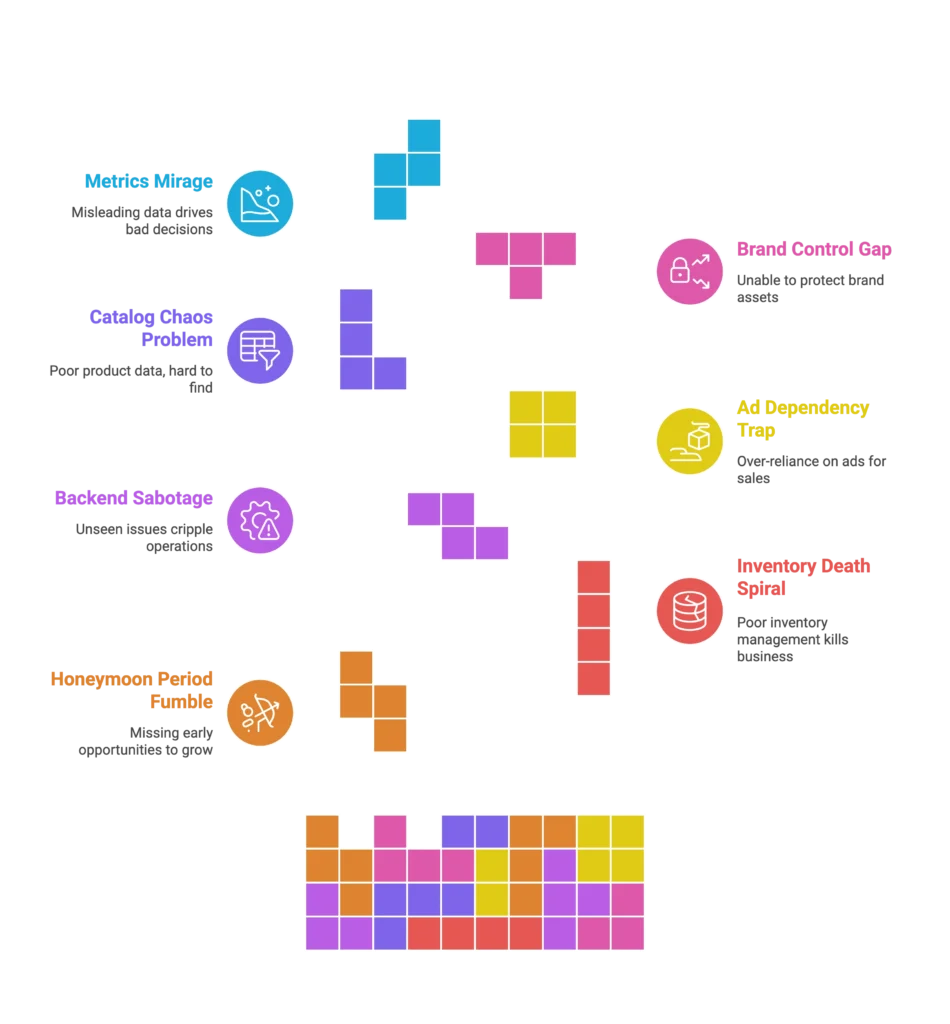
Most sellers end up in the Amazon Seller Graveyard. I’ve watched thousands fail—not because they lacked good products or capital, but because they fell into the same seven traps that kill profitable businesses before they even get started.
After 12+ years of selling on Amazon and currently building my own brand that’s doing $400K per month with zero ad spend, I’ve seen every mistake in the book. I’ve helped manufacturers realize their Amazon sales were weaker than my “nobody” brand, and I’ve watched established sellers get stuck in expensive hamster wheels because they treated Amazon like Google Ads instead of understanding it’s a ranking ecosystem.
Here’s the truth most agencies won’t tell you: Amazon isn’t a pay-to-play advertising platform. It’s a ranking game. Get that part right, and sales come to you—avoid ending up in the Amazon Seller Graveyard. Mess it up, and you’ll be paying expensive rent for temporary visibility while your competitors build sustainable organic businesses, leaving many in the Amazon Seller Graveyard. Sellers who ignore algorithmic strategy risk the Amazon Seller Graveyard, rather than building a thriving, resilient business on the platform.
Most sellers think Amazon is just another sales channel, like selling to retail stores. But it’s not. It’s its own business model with precision requirements—where poor catalog architecture or inventory gaps lead directly to Amazon ranking drops. Success requires every touchpoint—listing optimization, competitive pricing, inventory management, and PPC—working together as a single, unified system.
The seven pitfalls below aren’t isolated mistakes. They’re interconnected system failures that compound to destroy Amazon businesses. Let me show you exactly what kills profitability and how to avoid these traps.
The Amazon Seller Graveyard: Why Most Businesses Die
Amazon isn’t just another sales channel—it’s its own business model with its own rules. The biggest mistake I see manufacturers, wholesalers, and even established sellers make is treating it like traditional retail distribution. They upload listings, turn on ads, and wait for sales like they’re stocking shelves at Walmart.
But Amazon is an ecosystem where every element affects every other element. Your inventory positioning impacts delivery promises, which affects conversion rates, which influences organic rankings, and ignoring this can land you in the Amazon Seller Graveyard. When sellers try to fix these elements in isolation—hiring one freelancer for copy, another for images, a third for PPC—they create fragmented execution that wastes money, slows growth, and pushes many into the Amazon Seller Graveyard. Without a cohesive strategy, even experienced sellers risk the Amazon Seller Graveyard, losing the advantage to competitors who understand the interconnected nature of Amazon’s ecosystem.
The result? Sellers get stuck in what I call the “expensive hamster wheel.” They’re constantly feeding money into ads just to maintain sales, never building the organic foundation that creates sustainable growth. Their TACoS keeps creeping up, they’re reactive instead of proactive, and they feel like they’re treading water instead of scaling.
After helping brands across categories—from private label products to licensed goods like Levi’s, Champion, Russell, and Fila—I’ve identified the exact seven pitfalls that separate businesses that thrive from those that die.
Pitfall #1: The Honeymoon Period Fumble
The Mistake: Starting at target price (or higher) during the most critical ranking window.
Most sellers launch their products at the price they eventually want to charge. Big mistake. The honeymoon period—which I believe is strongest for 90 days, though it doesn’t end there—is when Amazon judges your listing’s potential. If you’re showing low conversions because your price is too aggressive for a new listing with few reviews, you’re programming the algorithm to treat your product as low-quality, risking placement in the Amazon Seller Graveyard. Many listings fail during this critical phase, sending them straight to the Amazon Seller Graveyard. Sellers who don’t strategically optimize pricing, conversions, and reviews during this window often end up in the Amazon Seller Graveyard, struggling to regain momentum later.
I’ve seen this kill listings permanently. When you launch with high prices and low reviews, you’re showing Amazon a terrible conversion rate during the window when they’re most willing to test your product. This does lasting damage that’s incredibly hard to reverse.
The Fix: Start aggressively below your competition. I’m talking prices that might feel uncomfortable—but only temporarily. Get those early conversions rolling, build your review base, establish organic ranking momentum, then gradually increase prices while monitoring conversion rates and organic position.
One of my personal listings launched this way. We started well below market price, got ranked for main keywords during the honeymoon period, then systematically raised prices as organic strength grew. The result? We can now maintain higher prices than competitors because our organic ranking and review foundation supports premium positioning.
The System: Price for conversions first, profit optimization second. Track organic rank movement weekly. If you’re not seeing organic improvement within 60-90 days, your foundation is broken and needs immediate attention.
Pitfall #2: The Inventory Death Spiral
The Mistake: Running low on stock without understanding how it secretly destroys rankings.
Here’s what most sellers don’t realize: Amazon treats each size or color of your product like its own listing. They’re parented together, but each child ASIN stands alone for ranking purposes. If one size ranks organically for a top keyword and you sell out of that specific variation, you don’t just lose inventory—you lose that ranking position, putting your listing at risk of the Amazon Seller Graveyard. Many sellers who ignore this nuance end up in the Amazon Seller Graveyard, struggling to regain lost visibility. Even experienced sellers can face the Amazon Seller Graveyard if child ASINs aren’t managed strategically across inventory, pricing, and advertising.
But it gets worse. When you’re running low on stock—even if you have 30-40 units left—Amazon can’t spread your inventory across all their fulfillment centers. Someone in New York might see two-day shipping while someone in California gets five-day delivery. That inconsistency kills conversions, and Amazon notices.
I learned this the hard way with my own clothing brand. We had one size perform incredibly well during our honeymoon period, ranking for major keywords and driving serious sales. When that one size sold out, our organic rankings dropped across the board, and we had to rebuild momentum from scratch.
The Fix: Maintain 60-90 days of stock across all variations. This isn’t just about avoiding stockouts—it’s about ensuring Amazon can promise consistent delivery times nationwide. When customers see fast, reliable shipping, conversion rates stay strong, which feeds the ranking algorithm.
The System: Track inventory at the child ASIN level, not just parent level. Plan for growth, not just current velocity. If you’re improving your listings and PPC performance, you’ll sell faster than historical data suggests. Build inventory buffers that account for acceleration, especially during Q4 and promotional periods.
Pitfall #3: The Backend Sabotage You Never See
The Mistake: Ignoring backend changes that Amazon makes without notification.
What if I told you Amazon could secretly change your product’s classification—like switching your item type keyword from “Pajama Sets” to “Pajamas Sets”—without any notice? This silent killer can tank your organic rank, force you to overspend on ads, and drain sales without you realizing why, pushing many listings into the Amazon Seller Graveyard. Sellers who don’t monitor backend changes closely risk the Amazon Seller Graveyard repeatedly. Even minor, unnoticed classification shifts can land your products in the Amazon Seller Graveyard, leaving you scrambling to recover visibility and sales.
The worst part? Everything looks fine on the front end, but Amazon’s bots might fill in missing fields with irrelevant data, completely wrecking your listing’s chances of success. I’ve seen sellers lose rankings overnight because Amazon “suggested” a category change that destroyed their keyword relevance.
The Fix: Monthly backend audits using Amazon’s Category Listing Report. Download it from Seller Central to uncover hidden issues. Verify your item type keywords and browse nodes match your category using the Browse Tree Guide. Fill out every optional field—if you don’t, Amazon’s bots will, and they usually get it wrong.
The System: Never let Amazon automatically update your listings. Reclaim control before it’s too late. Set monthly calendar reminders to audit backend data. When you see sudden rank drops or PPC performance changes, check backend classifications first before assuming it’s a competitive issue.
This isn’t paranoia—it’s protection. Amazon’s system is designed to be helpful, but their automation doesn’t understand your business like you do.
Pitfall #4: The Ad Dependency Trap
The Mistake: Treating ads as sales generators instead of ranking builders.
If you have to keep feeding ads to make sales, you’re not growing—you’re paying rent. Most sellers think the equation is ads = sales. That’s wrong. The equation should be ads = ranking.
I proved this with my own brand recently. During a major stock shortage, I had to cut ads completely. I expected a slowdown, maybe even a ranking drop. But sales kept rolling in, and organic rank held strong. Why? Because ads weren’t propping up the listing—they had built its foundation.
See, when you’re constantly spending just to maintain sales, your ads aren’t actually working. They’re buying you temporary placement. You’re stuck in a bidding war where someone can always outspend you, and the moment your budget runs out or you pause campaigns, sales disappear completely.
The Fix: Use PPC strategically to build organic rank, not just drive immediate sales. Track these metrics: Are organic sales increasing? Is TACoS decreasing? Is organic rank improving for target keywords? If not, you’re just spending, not scaling.
The Philosophy: High ACoS isn’t the enemy if the ad is building rank and driving sustainable growth. But if your business collapses when ads stop, you haven’t built a business—you’ve built an expensive advertising dependency.
The System: Every PPC campaign should either be profitable or improve organic position. Use tools that connect PPC performance to organic rank tracking. Set rules to automatically reduce spend on keywords where you’ve achieved strong organic positions, then reinvest that budget into new keyword opportunities.
Pitfall #5: The Catalog Chaos Problem
The Mistake: Spreading resources across too many SKUs instead of building dominant listings.
You don’t need hundreds of mediocre listings—you need a few dominant ones doing serious volume. I focus on building listings that can handle significant revenue, not managing catalogs that require constant attention without generating meaningful profit.
The fragmentation trap is real. Sellers launch 20, 50, even 100 SKUs thinking more options equal more sales. Then they spend their time in meetings discussing what’s not selling instead of optimizing what’s already working. They split inventory across too many variations, so nothing has enough stock to maintain consistent rankings. They can’t track keyword performance because there are too many products to monitor.
The Real Cost: When you’re managing catalog chaos, you lose focus on what actually pays your bills. You’re not building on your successes—you’re constantly fighting fires with underperforming products.
The Fix: Focus on your top revenue-generating parent ASINs. Build variations of successful products rather than launching new categories. If something isn’t working after a fair test, eliminate it. Your brain power, time, money, and team energy are finite resources—invest them where they generate returns.
The System: Identify which listings generate the most contribution profit. Allocate 80% of your optimization efforts there. Use the 90-day inventory rule per variation, not per parent. Track keyword rankings for your top performers weekly, not monthly.
Pitfall #6: The Brand Registry & Control Gap
The Mistake: Treating Brand Registry as optional instead of fundamental infrastructure.
Brand Registry isn’t just about brand protection—it’s about control, optimization capability, and review velocity. Without it, you’re fighting with one hand tied behind your back.
The biggest impact? Amazon Vine access. If you don’t have Vine enrollment capability, you’re advertising a listing with no reviews for months instead of weeks. You’re showing Amazon poor conversion rates during your honeymoon period because customers won’t buy products without social proof. This creates a vicious cycle: bad early metrics lead to poor algorithm treatment, which requires more ad spend to overcome, which eats into margins.
I’ve worked with brands that had exclusive distribution rights but couldn’t get owner permissions for Brand Registry. They spent thousands advertising listings that could have gotten 30 reviews within weeks through Vine. Meanwhile, their competitors with proper Brand Registry were building momentum faster and cheaper.
The Fix: Get Brand Registry sorted before you launch anything significant. If you’re working with licensed products, negotiate owner permissions as part of your distribution agreement. Don’t compromise on this—it’s not optional for serious Amazon businesses.
The System: Brand Registry unlocks Vine, enhanced content, storefront control, and advanced advertising features. It’s infrastructure, not an upgrade. Build your business on this foundation from day one.
Pitfall #7: The Metrics Mirage
The Mistake: Optimizing ACoS while ignoring the metrics that actually predict long-term success.
ACoS is a vanity metric if you’re not tracking what really matters: organic sales growth, TACoS trajectory, and ranking momentum. I see sellers celebrate improved ACoS while their organic sales stay flat and their TACoS creeps higher. They’re optimizing the wrong thing.
Here’s what you should be tracking instead: Is your organic sales percentage increasing week over week? Is your TACoS decreasing even as you scale spend? Are you ranking higher for target keywords without increasing bids? These metrics tell you whether you’re building a sustainable business or just running efficient ads.
When I manage client accounts, I keep them at low TACoS levels—like the account currently doing $700K in sales over 14 days at 7% TACoS. But the key isn’t the low percentage—it’s that organic sales are growing consistently, reducing overall advertising dependency.
The Fix: Track TACoS, not just ACoS. Monitor organic sales growth trends. Use keyword rank tracking to measure PPC effectiveness beyond immediate ROAS. Set up weekly reviews of these connected metrics, not monthly PowerPoint presentations about isolated KPIs.
The System: Your organic sales must increase week after week. Your TACoS should decrease week after week. This doesn’t mean ad spend needs to decrease, but the percentage should improve as organic momentum builds.
The Amazon Operating System: Beyond Pitfall Avoidance
These seven pitfalls aren’t random mistakes—they’re symptoms of not understanding that Amazon is a connected system. When you fix them in isolation, you miss the bigger picture. When you address them systematically, you build anti-fragile businesses that thrive regardless of algorithm changes or increased competition.
The Connected Approach:
- Listing optimization feeds PPC performance by improving conversion rates
- Strategic PPC builds organic rank by driving relevant traffic and sales velocity
- Proper inventory management ensures consistent delivery promises that maintain conversion rates
- Brand Registry and review systems compound conversion improvements over time
- Backend monitoring prevents algorithm changes from derailing progress
Building Long-Term Sustainability: The goal isn’t just avoiding these pitfalls—it’s building businesses that survive and thrive without constant intervention. My current brand maintains strong sales with ads turned off because we built organic strength during the foundation phase. That’s what proper Amazon strategy creates: businesses that compound, not subscription models for advertising platforms.
The Real Test: If you turned off ads today, what happens to your sales? If the answer is “they disappear,” you haven’t built a business—you’ve built an advertising dependency. That’s not sustainable, and it’s not scalable.
Frequently Asked Questions
Q: How long should I run ads before expecting organic growth?
A: Focus on organic rank improvement within the first 90 days, but track progress weekly. If organic sales aren’t increasing after 60 days of consistent advertising and optimization efforts, audit your listing fundamentals. Something in your foundation—conversion rate, keyword targeting, or listing quality—needs immediate attention.
Q: What’s the difference between ACoS and TACoS, and which matters more?
A: ACoS measures advertising efficiency for individual campaigns. TACoS measures total advertising cost as a percentage of total sales, including organic. TACoS should decrease as your organic sales grow—this indicates healthy business scaling rather than advertising dependency.
Q: How much inventory should I maintain to avoid ranking drops?
A: Maintain 60-90 days of stock across all variations. Amazon deprioritizes listings with low stock because they can’t distribute inventory evenly across fulfillment centers, creating inconsistent delivery promises that hurt conversion rates.
Q: Can I recover from a failed launch or major stockout?
A: Yes, but it requires strategic effort. The honeymoon period advantages diminish but don’t disappear completely. I’ve successfully relaunched year-old listings by treating them like new products—aggressive pricing, heavy optimization, and systematic rank building. It’s harder than getting it right the first time, but definitely possible.
Q: Why do my ads convert well but organic sales stay flat?
A:Your ads aren’t building organic rank, which means there’s a fundamental disconnect in your strategy. Check listing quality, keyword targeting alignment, and conversion rate sustainability. High ad performance without organic growth indicates your foundation needs work.
Your Amazon Audit Action Plan
Ready to diagnose which pitfalls are killing your Amazon growth? Here’s your monthly health check system:
Inventory Health Assessment:
- Verify 60+ days stock across all variations
- Check fulfillment center distribution in Seller Central
- Monitor IPI score trends
- Assess stockout risk for top-performing child ASINs
Listing Foundation Review:
- Download Category Listing Report for backend accuracy
- Complete missing attribute fields
- Verify Brand Registry ownership status
- Confirm Vine enrollment for new products
Performance Trajectory Analysis:
- Calculate organic sales growth percentage
- Track TACoS trends over 90-day periods
- Monitor top 10 keyword ranking positions
- Analyze conversion rates by traffic source
System Integration Check:
- Audit PPC campaign contribution to organic rank
- Review competitor gap analysis
- Assess review velocity and quality trends
- Evaluate pricing strategy effectiveness against market positioning
The Bottom Line
Amazon rewards businesses that understand its ecosystem, not sellers who try to hack individual components. After 12 years of building brands and helping companies avoid these exact traps, I know that sustainable Amazon success comes from treating it like the complex ranking algorithm it is, not the advertising platform most people think it is.
The seven pitfalls above aren’t just mistakes—they’re expensive lessons that can be avoided with proper strategy and systematic execution. The difference between sellers who build lasting businesses and those who get stuck paying advertising rent comes down to understanding these interconnected systems and building accordingly.
Every successful Amazon business I’ve helped build—whether my own brands or client accounts—follows the same principle: organic strength creates sustainable growth, and everything else supports that foundation. Get that equation right, and Amazon becomes the most powerful business-building platform on earth. Get it wrong, and you’ll join the graveyard of sellers who thought throwing money at ads was a business strategy.
Want to audit your Amazon business for these hidden pitfalls? I offer comprehensive account reviews that identify exactly where you’re losing money and rankings. After 12 years of building and scaling Amazon brands, I know how to spot the issues that kill growth before they become expensive problems. The businesses that survive and thrive are the ones that fix these systems before they break.

