 Skip to content
Most private label sellers think they have a listing problem. They don’t. They have a business problem disguised as a listing problem.
After 12 years of building Amazon brands—including my current brand doing $400K/month with ads turned OFF—I’ve learned that private label optimization isn’t about making listings look pretty. It’s about creating an ecosystem where every element works together to drive organic rank, sustainable sales, and real business growth without being tethered to a permanent ad spend.
This isn’t another checklist of “optimization tips.” This is the operating system I use to transform private label listings from ad-dependent sales machines into organic ranking powerhouses that compound growth month after month.
While others teach isolated tactics, I’ll show you the interconnected system that makes the difference between a $50K/year listing and a $1M+ listing. Because the truth is: Amazon isn’t a pay-to-play advertising platform—it’s a ranking game. And rankings are won through ecosystem optimization, not keyword stuffing. Failing to understand this interconnected nature is why so many promising brands end up in the Amazon seller graveyard, where high-potential products die because they relied on outdated hacks instead of a sustainable, ranking-first foundation.
The Private Label Optimization Crisis (Why Most Approaches Fail)
Most sellers treat Amazon like ‘just another sales channel’ instead of understanding it’s its own business model with its own rules. They upload listings and hope for sales, not realizing that effective private label optimization requires a strategic, coordinated effort across every touchpoint. Without this specialized private label optimization approach, the algorithm won’t recognize your brand’s authority, and your product will likely get lost in a sea of generic competitors.
The pain points I see repeatedly are telling:
The Ad-Dependency Trap: Sellers pour money into PPC but still fail to improve organic rank because their listings don’t convert once traffic arrives. They’re spending more to make the same amount, trapped in an expensive hamster wheel.
Isolated Optimization: They hire one person for copy, another for images, another for ads—but no one is optimizing the entire system. Amazon rewards momentum created by all elements working together, not individual perfect components.
The Foundation Problem: Their listings are weak—bad titles, unstructured bullets, no real SEO or storytelling—and then they wonder why ads don’t convert or organic rank never moves.
I don’t believe in having thousands of low, mediocre listings. I believe you can have a few very good listings doing serious money—I have listings that do over a million dollars a year on single SKUs. My current clothing brand has only two parent listings, with one generating $400K/month through rigorous private label optimization. That’s not theory; that’s the result of private label optimization applied systematically to ensure every SKU reaches its maximum market potential.
The Ecosystem Optimization Framework
How Amazon Really Works (Not How Gurus Say It Works)
Amazon operates on momentum, not isolated metrics. Understanding this changes everything about how you optimize.
The Momentum Chain Reaction works like this:
- Conversion rate affects organic rank
- Organic rank affects review velocity
- Reviews affect click-through rates
- Click-through affects Amazon’s confidence in showing you
- Amazon’s confidence affects ad efficiency
- Ad efficiency affects profitability
- Profitability affects inventory investment
- Inventory investment affects momentum
Break one link, and the entire chain suffers. Optimize the chain, and growth compounds.
The Mobile-First Reality
Here’s what most sellers miss: 70%+ of Amazon traffic is mobile, and most people never scroll past the title on mobile. Mobile optimization isn’t about responsive design—it’s about cognitive load and thumb-stopping power.
Your title structure needs mobile-first impact. Your first image needs scroll-stopping psychology. Your entire listing needs to sell in the first five seconds, not the first five minutes.
The Inventory Position Factor
This is the hidden optimization that 99% of sellers never consider: where your inventory sits affects conversion rates. If Amazon can’t promise fast delivery because your stock isn’t distributed properly across fulfillment centers, customers see longer shipping times. This lowers conversions and hurts organic rank—even when you have inventory.
I learned this firsthand when some of my sizes weren’t completely out of stock, but Amazon didn’t have enough inventory to place them in every warehouse. This breakdown in private label optimization meant customers in certain regions saw four-to-five-day delivery times, which slowed conversions. The moment stock levels improved and distribution normalized, our private label optimization efforts finally paid off as organic ranks and sales picked right back up.
The Optimization Operating System (Step-by-Step)
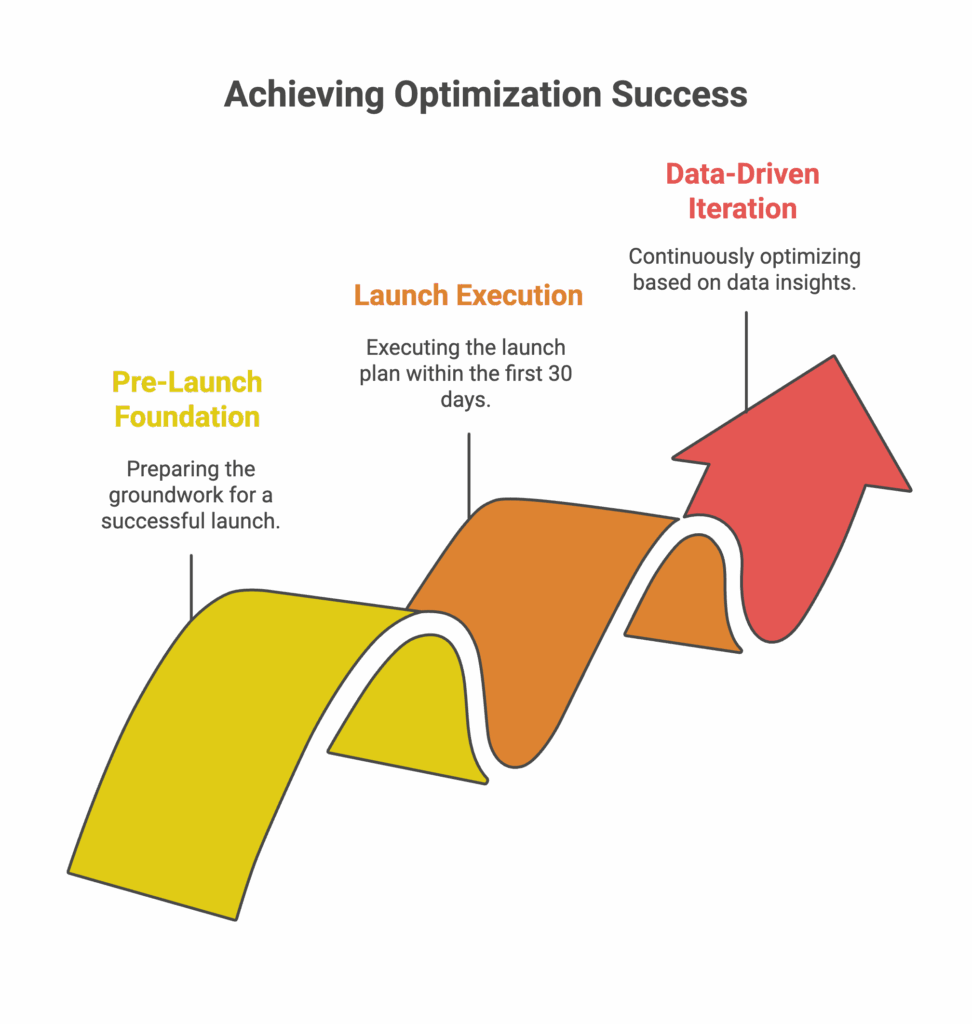
Phase 1: Pre-Launch Foundation (Honeymoon Readiness)
The honeymoon period is your most powerful window. Most sellers waste it because they don’t understand it’s a 90-day degradation curve, not a cliff.
I believe the honeymoon period is strongest in the first 90 days, but it doesn’t end there—it just gets progressively harder. While private label optimization is most effective in those initial weeks, the first few months are significantly stronger than the months that follow. However, you can still revive momentum with a targeted private label optimization strategy if you know how to re-trigger the algorithm’s favor.
Your pre-launch checklist should include:
Keyword Coverage Mapping: Use all 250 characters in backend search terms. Include misspellings, variations, Spanish translations, and long-tail combinations. Don’t repeat keywords from your title or bullets—that’s wasted space.
Catalog Architecture: Decide carefully on parent-child relationships. Wrong variation setups kill momentum. If you’re selling clothing with multiple colors and sizes, and you sell out of your MVP variation, the whole listing can crash because Amazon ranks you on child ASINs.
Phase 2: Launch Execution (First 30 Days)
Start with Aggressive Pricing: During the honeymoon period, price low so every keyword you advertise converts well. Amazon sees high conversion rates and wants to show you more. It’s an investment in momentum.
Auto Campaigns First: I always start with auto campaigns, not manual campaigns. When I optimize listings, I put in longtail, short tail, Spanish, misspellings—all different keywords that auto campaigns feed off of. Amazon’s algorithm tests terms I might not have thought of, generating data based on what they think my listing fits.
Amazon Vine Strategy: When you enroll in Vine, put your product at an aggressive price even though it’s free to reviewers. They leave reviews based on perceived value. A great product at a great price gets five stars. The same product at a high price might get four stars because they complain about small things. You want only five stars during launch.
Phase 3: Data-Driven Iteration (Monthly Optimization)
The Search Query Performance Loop: Monthly, I pull SQP data to identify leakage. Where are queries clicking but not converting? Where are clicks happening but not adding to cart? Then I adjust assets—title term order, first image overlays, A+ module emphasis—and re-measure.
Never Stop Testing: I do A/B testing on click-through rates for images to ensure when people search keywords, they click into our listing. I test prices constantly. Everything I’ve learned over 12 years gets applied systematically.
Here’s a simple hack that works: Change your price by one penny up or down. Everyone who has your product saved in their cart gets an alert that the price changed. They’re reminded about the item they forgot. It’s not about the penny—it’s about the reminder.
Advanced Catalog Strategies That Scale
The Million-Dollar Parent Approach
Focus beats dilution every time. Rather than managing hundreds of mediocre listings, I concentrate resources on fewer, stronger listings. My current brand proves this—two parent listings, one doing $400K/month.
The compound effect of optimizing fewer listings means:
- More resources per listing for images, copy, and advertising
- Better inventory management and stock distribution
- Cleaner data for optimization decisions
- Higher review density per listing
- Stronger organic rank consolidation
Variation Management for Sustained Growth
If you’re selling products with multiple variations, inventory management becomes critical. When your bestselling child ASIN sells out, Amazon might show a weaker variation for your main keywords. You drop from page one to page two, killing momentum.
The solution is maintaining 90 days of stock at all times per child, with special attention to your MVP variations. Track which variations drive your core keywords and never let those go out of stock.
The AI-Proofing Strategy
Amazon is evolving toward AI-driven product data extraction and standardization. To prepare:
Structure Your Content: Make it easy for AI systems to extract clean attributes, dimensions, and compliance data. Consistent formatting across title, bullets, and A+ content helps AI enhance rather than distort your positioning.
Focus on Attributes: Ensure your product attributes are complete and accurate. Amazon’s AI uses this data for product matching and category placement.
Schema-Friendly Approach: Structure your content so it’s easily machine-readable while remaining conversion-focused for humans.
Common Optimization Mistakes That Kill Growth
The Freelancer Trap: Hiring different specialists for copy, images, and ads creates disconnected optimization. No one sees the full picture or optimizes for the ecosystem effect.
The Launch-and-Pray Problem: Sellers think the honeymoon period “just happens.” They don’t systematically optimize during those crucial first 90 days when Amazon’s algorithm is most responsive.
The Data Ignorance Problem: Making changes based on opinion rather than conversion data. If you’re not tracking organic keyword rankings or analyzing Search Query Performance, you’re flying blind.
I treat every client account like my own business. That means monitoring the entire ecosystem—ads, organic rank, reviews, inventory, pricing—so nothing slips. When one part is off, everything suffers.
The Private Label Optimization Toolkit
Monthly Optimization Checklist:
- Pull Search Query Performance data and identify conversion leakage
- Track keyword ranking changes and trends
- Analyze conversion rates by traffic source
- Check inventory distribution across fulfillment centers
- Monitor competitor positioning and pricing
- Review review acquisition progress and address issues
Backend Search Terms Best Practices: Use all 250 characters, but avoid repeating keywords from title or bullets. Include misspellings, variations, Spanish translations, and long-tail combinations. Never use punctuation, stop words, or competitor brand names.
Mobile-First Title Framework: Position 1-2 should contain your primary keyword plus most important attribute. Position 3-4 should cover secondary benefits. Position 5-6 should include brand name and key differentiator. Everything else is additional attributes like size, color, quantity.
FAQ: Your Optimization Questions Answered
How long does private label listing optimization take to show results?
You’ll see initial improvements within the first 30 days during the honeymoon period, but sustainable organic growth typically develops over 90 days. The key is systematic optimization during those crucial first months when Amazon’s algorithm is most responsive.
Can you optimize an existing listing past the honeymoon period?
Absolutely. I recently relaunched a year-old listing in my clothing brand and successfully ranked it in top positions for main keywords. While the honeymoon period is easiest, you can refresh momentum through comprehensive optimization and strategic repricing.
What’s the biggest mistake private label sellers make?
Treating optimization as separate tasks instead of a connected ecosystem. Amazon rewards momentum created by all elements working together, not individual perfect components.
Should I focus on many listings or perfect fewer listings?
Perfect fewer listings. Focus beats dilution when it comes to Amazon optimization. Resource concentration on fewer, stronger listings delivers better long-term results than managing hundreds of mediocre ones.
The Path Forward for Serious Private Label Brands
Amazon isn’t a tactics game—it’s a system optimization challenge. The brands that win long-term understand that listing optimization is business optimization. Every element—from backend keywords to inventory distribution to pricing strategy—either builds momentum or destroys it.
You can continue treating Amazon like a collection of tasks to check off, or you can start treating it like the business ecosystem it actually is. You can keep hiring different specialists to work in isolation, or you can find partners who see the full picture and optimize accordingly.
The choice is simple: stay trapped in the ad-dependency hamster wheel, or build listings that generate sustainable organic growth month after month. After 12 years of doing this—for my own brands and my clients’ brands—I can tell you which approach wins.
If you’re ready to transform your private label business from ad-dependent to organically dominant, the system I’ve outlined here is your roadmap. This isn’t theory. It’s the precision optimization approach I use every day to build million-dollar listings, not manage hundreds of mediocre ones.

