 Skip to content
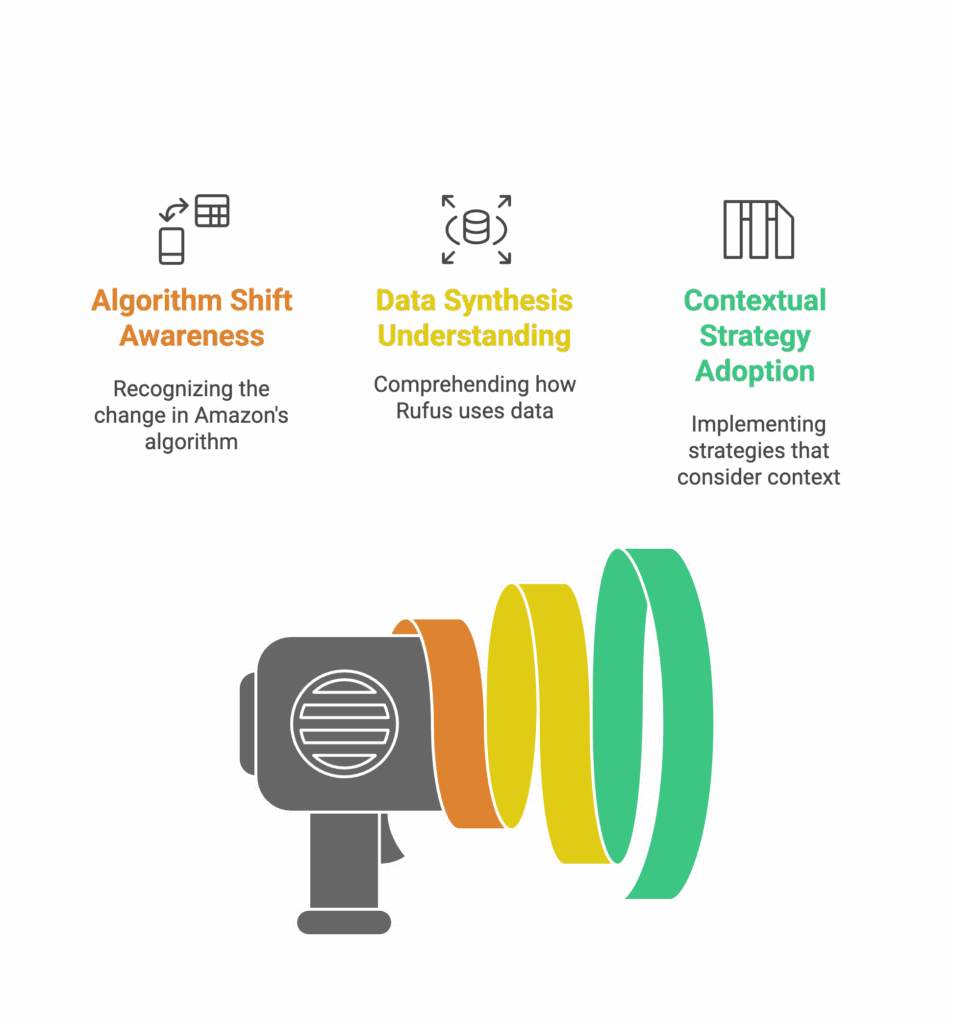
Most Amazon sellers are still optimizing for yesterday’s algorithm while Rufus quietly leads Amazon’s Hidden AI Revolution in how customers discover products. If you’re still keyword-stuffing titles and hoping for the best, you’re already losing ground to the high-level strategies driving Amazon’s Hidden AI Revolution across the entire search landscape.
After 12 years of building Amazon listings that generate millions in revenue, I’ve learned that every major algorithm shift separates the adapters from the laggers. Rufus isn’t just another feature—it’s a fundamental change in how Amazon understands and serves products to customers, which is why a strong Amazon Catalog Architecture has become even more critical for long-term visibility.
Unlike traditional A9 keyword matching, Rufus synthesizes data from listings, reviews, Q&A sections, and images to answer conversational queries. Most sellers are treating it like Google Ads instead of understanding it’s a ranking ecosystem where context matters as much as keywords.
I’m currently building my own brand that’s generating $400K per month using the strategies I’m about to share. This isn’t theory—it’s a proven system developed through hands-on testing and real client implementations.
Why Legacy Amazon Optimization Fails in the Rufus Era
The old A9 playbook is breaking down, and here’s why: Rufus launched in February 2024 and expanded to all U.S. customers by July 2024. Since then, I’ve watched countless sellers struggle as their keyword-stuffed titles perform worse and their traditional “spray and pray” strategies miss conversational intent entirely.
In my client work, I’ve tested this extensively. We’ll upload an image to see what AI can actually read, and often it tells us something completely different than what we think is obvious. This is a core part of Amazon’s Hidden AI Revolution, where visual data is treated as a ranking signal. If a computer can’t read your image clearly, you’re missing opportunities for both customer understanding and AI comprehension—the two pillars that drive success in Amazon’s Hidden AI Revolution.
The problem is that sellers are still thinking in terms of isolated tactics—optimize the title here, add some keywords there—while Rufus evaluates the entire information ecosystem
of your listing. Backend keyword fields alone are insufficient when AI is looking for comprehensive, contextual understanding across multiple data sources
Traditional approaches fail because they don’t account for how Rufus ingests multi-modal data. It’s not just reading your title; it’s synthesizing information from your catalog data, customer reviews, Q&A sections, and visual elements to provide intelligent responses to customer queries.
How Rufus Actually Works (What Amazon Won’t Tell You)
Here’s what I’ve discovered through real-world testing: Rufus operates as a multi-modal data ingestion system that processes conversational queries differently than traditional keyword matching.
During client calls, I’ve demonstrated how Rufus reads image text and infographics in real-time. We’ll ask questions like “What is the inseam length?” and watch Rufus scan the listing content, reviews, and even product images to find answers. When information is missing or unclear, Rufus responds with “The product does not provide specific inseam length”—a clear signal that your listing lacks essential data.
The AI doesn’t just look at your search terms anymore. I’ve seen it pull information directly from infographics, reading text overlays that say “moisture wicking” or “tag free” and using that data to answer customer questions. This means your images aren’t just for human eyes—they’re data sources for AI comprehension.
Rufus also integrates with Amazon’s Lens Live camera functionality, allowing customers to point their phone at products and get instant information. This visual-to-conversational pipeline is a core part of Amazon’s Hidden AI Revolution, changing how we need to think about image optimization entirely. Understanding how Amazon’s Hidden AI Revolution connects visual search to LLM-driven responses is now the baseline for staying competitive in 2026.
The connection between review highlights and Rufus responses is crucial too. AI-generated review summaries on product pages directly feed into how Rufus understands and presents your product’s strengths and weaknesses to potential customers.
The RUFUS-READY Framework: A 6-Step Systematic Approach
After implementing these strategies across multiple client accounts and my own brand, I’ve developed what I call the RUFUS-READY Framework. This isn’t guesswork—it’s based on documented results and real-world testing.
Step 1: Attributes First – Complete Your Product DNA
Start with your product attributes in Seller Central. Rufus feeds on structured data, so incomplete attributes cripple AI comprehension. Map every required and recommended attribute for your product type using Amazon’s Browse Tree Guide.
I treat this like building a foundation. If the backend isn’t solid, everything else crumbles. Fill every possible field, including ones that seem optional. When Amazon’s bots encounter missing information, they’ll fill it in automatically—and usually get it wrong, hurting your performance.
Download the Category Listing Report from Seller Central monthly to catch and fix hidden issues. Verify that your item type keywords and browse nodes match your category perfectly. These backend mistakes can destroy your rank and ad performance overnight.
Step 2: Intent-Plain Bullets – Write for Conversations
Transform your feature-heavy bullet points into conversational answers. Instead of listing specifications, address likely customer questions and use cases. Think about how someone would naturally ask about your product.
Rather than “100% Cotton Material Construction,” write “Made from 100% cotton for breathable comfort during all-day wear.” Rufus can better understand and respond to queries about comfort, breathability, and daily use with this approach.
Include contextual information that Rufus can synthesize. If customers commonly ask about sizing, durability, or specific use cases, make sure your bullets directly address these concerns in plain language.
Step 3: Q&A Seeding – Control the Conversation
Build a comprehensive question bank based on customer intent patterns. Proactively answer questions that Rufus is likely to encounter. When customers ask “Are these tag free?” or “What’s the inseam length?” you want authoritative answers already in place.
From my client work, I’ve seen how missing basic information like inseam measurements hurts listings in the AI era. If Rufus can’t find answers to common questions, it tells customers the information isn’t available—even when it might be implied elsewhere in your listing.
Monitor competitor Q&A sections to identify gaps you can fill. Provide detailed, factual answers that establish your listing as the authoritative source for product information in your category.
Step 4: Review Reality Check – AI Summary Management
AI-generated review highlights now appear prominently on product pages, serving as first-impression trust signals. These summaries directly influence how Rufus presents your product to potential customers.
Implement a monthly review audit process. Track which themes appear in AI highlights and correlate them with your return rates and customer service tickets. If AI summaries consistently highlight a negative aspect, address it through product improvements or listing adjustments.
Leverage positive review themes by reinforcing them in your listing content. If customers consistently praise specific features in reviews, ensure those elements are prominently featured in your AI-readable content.
Step 5: A/B Everything – Use Amazon’s Native Testing
Leverage Manage Your Experiments systematically. I recommend a prioritized testing backlog: Title optimization first, then main image testing, followed by A+ content comparison charts.
From my experience running tests on click-through rates and image optimization, data always wins over assumptions. Test until you reach statistical significance, and don’t make changes based on gut feelings.
Track how different variations perform with AI comprehension. Sometimes a title that looks better to humans performs worse with Rufus, and vice versa. Let the data guide your decisions.
Step 6: Visual Readiness for AI Discovery
Optimize images with clear, readable text overlays that AI can process. I’ve tested this extensively—images with clean, bold text perform better for both human customers and AI systems.
Ensure comprehensive product information is visible in your images. If key details like measurements, materials, or features aren’t clearly displayed, you’re missing opportunities for AI discovery through visual search.
Prepare for Lens Live camera-to-cart flows by making your images informative enough to stand alone. When customers point their camera at products in stores, your images need to provide instant, clear information that Rufus can process.
Common Rufus Optimization Mistakes (And How to Avoid Them)
The biggest mistake I see is sellers treating Rufus like traditional SEO. They focus on keyword density while ignoring the natural language flow that AI needs for comprehension. Conversational intent matters more than keyword stuffing.
Backend neglect is another critical error. Sellers optimize surface elements while leaving product attributes incomplete or miscategorized. This creates a disconnect between what customers see and what Amazon’s Hidden AI Revolution understands about your product. To bridge this gap, you must treat your backend data as the primary language of Amazon’s Hidden AI Revolution, ensuring every attribute is a clear signal for the machine to index.
Review management blindness hurts many listings. Sellers ignore AI review summaries as critical trust signals, missing opportunities to address common complaints or reinforce strengths in AI-readable content.
Don’t fall into the trap of optimizing for yesterday’s algorithm while Rufus quietly changes the rules. The sellers winning today understand that comprehensive information architecture beats isolated tactics every time.
Measuring Rufus Optimization Success
Track organic ranking improvements for conversational queries, not just traditional keywords. Monitor how your listings perform when customers ask natural language questions through Rufus.
Watch click-through rate changes in mobile search results. Since most customers browse on mobile, improvements here indicate better AI-customer matching. Use Amazon’s native reporting to monitor attribute completeness and ensure you’re not missing critical data points.
Correlate review sentiment with AI summary highlights. When AI consistently presents positive themes from your reviews, it indicates strong alignment between customer experience and AI comprehension.
The ROI comes from long-term organic growth, not just short-term ranking fluctuations. Sellers who implement the RUFUS-READY Framework systematically see sustained improvements in both visibility and conversion rates.
Frequently Asked Questions
Does Amazon Rufus replace traditional keyword optimization?
No, Rufus enhances traditional ranking factors by adding conversational understanding. Keywords remain important, but context and natural language become equally critical for AI comprehension. Think of it as evolution, not replacement.
How quickly can I see results from Rufus optimization?
Initial improvements typically appear within 2-4 weeks, with significant ranking changes visible after 6-8 weeks of comprehensive optimization. Results depend on competition level and implementation quality.
What’s the biggest mistake sellers make with Rufus optimization?
Treating Rufus like traditional SEO instead of understanding it’s a conversational AI that synthesizes multiple data sources. Sellers who only focus on keyword placement miss the bigger picture of comprehensive information architecture.
How does Rufus affect PPC campaign performance?
Rufus-optimized listings typically see improved Quality Scores and relevance ratings, leading to better ad performance and lower costs per click. The AI understanding enhances both organic and paid visibility.
Can I optimize for Rufus without changing my existing listings?
Partial optimization is possible through backend attribute completion and Q&A enhancement, but maximum impact requires comprehensive listing restructuring using the RUFUS-READY Framework.
Ready to Dominate the AI Era
Rufus represents the biggest shift in Amazon optimization since the platform’s inception. Sellers who adapt to this Amazon’s Hidden AI Revolution will dominate their categories, while those clinging to legacy tactics will fall behind. This Amazon’s Hidden AI Revolution isn’t just a minor update; it is a total overhaul of how customers discover products through conversational intent.
This isn’t theory—it’s a proven system developed through 12 years of hands-on Amazon experience and current testing on live, high-revenue listings. My own brand’s $400K monthly performance demonstrates these strategies work in competitive markets.
The RUFUS-READY Framework gives you the systematic approach needed to succeed in the AI era. Every step is actionable, every strategy is tested, and every recommendation comes from real-world implementation.
Amazon rewards listings that provide comprehensive, easily understood information to both customers and AI systems. The sellers implementing these changes now will be the ones setting the standard in their categories while competitors struggle to catch up.
Don’t wait for the competition to figure this out. The AI revolution in Amazon optimization is happening now, and the early movers will capture the biggest advantages.

