 Skip to content
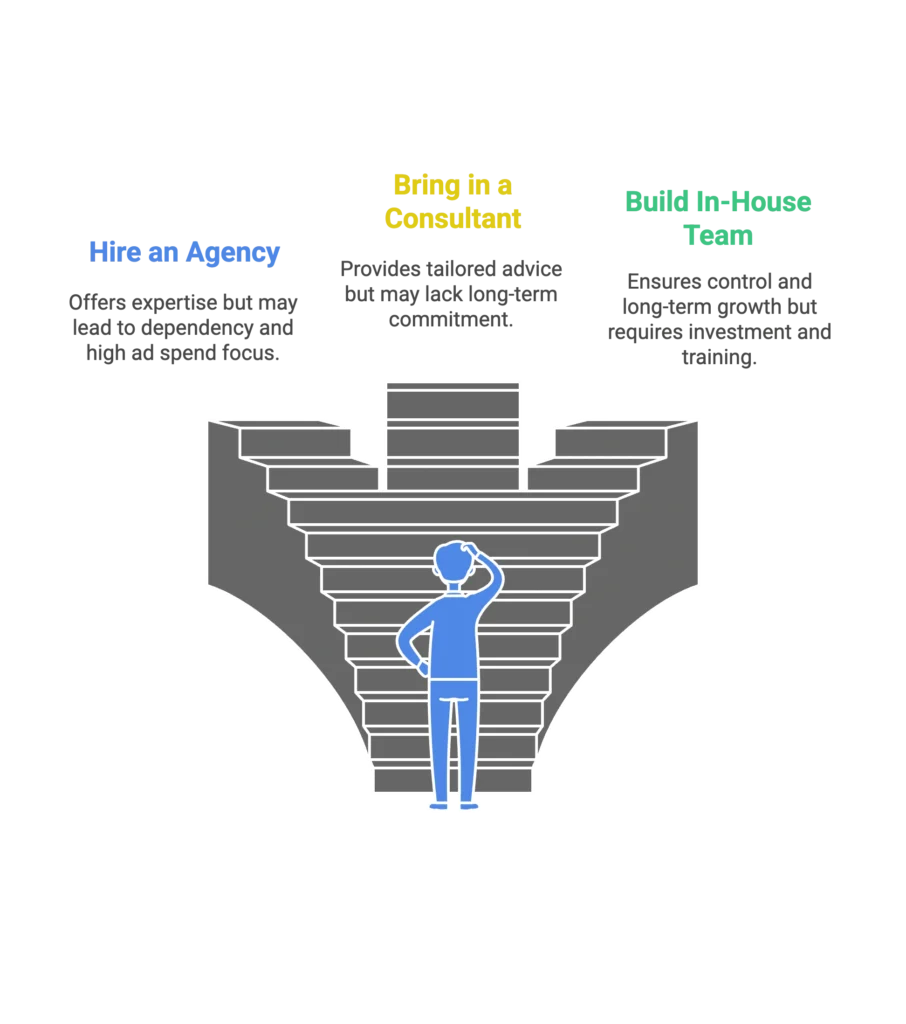
Every Amazon seller eventually faces the same crossroads when hiring Amazon help: Do I hire an agency, bring in a consultant, or build an in-house team?
Most make this decision based on budget alone. That’s backwards thinking.
After 12 years of building, selling, and managing Amazon brands—and currently working with manufacturers doing everything from inventory management to full account optimization—I’ve seen what works and what doesn’t. I’ve taken over accounts from agencies that optimized for high ad spend rather than building foundations. I’ve trained internal teams for companies transitioning from external management. I’ve watched businesses plateau because they treated Amazon like traditional retail instead of understanding it as its own ecosystem.
The truth? There’s no universal “right” answer. But there is a systematic way to make this decision based on your business maturity, control needs, and growth goals.
What you’ll discover in this guide:
- The real cost structures behind each option and how they drive behavior
- A 90-day blueprint for building your own Amazon operating system
- Hybrid approaches that give you the best of both worlds
- Decision frameworks tailored for manufacturers, wholesalers, and established sellers
- Why most agencies create dependency instead of sustainable growth
Whether you’re a manufacturer entering Amazon for the first time or a seller plateaued at multiple six figures, hiring Amazon help shouldn’t be a gamble. This guide will help you choose the path that builds lasting success—not just short-term sales—by ensuring that hiring Amazon help aligns perfectly with your specific brand goals and category requirements.
Understanding Your Three Options
Agency Management: The Full-Service Route
Agency management means handing over complete operational control to an external team. They handle your listings, run your ads, manage inventory, and execute optimizations based on their standardized processes.
I’ve seen brands give agencies complete access to Seller Central accounts, expecting results based on the agency’s existing playbook when hiring Amazon help. This works when the agency understands Amazon as an ecosystem—where ads build organic rank, inventory positioning affects conversion rates, and listing optimization drives long-term growth.
The challenge? Most agencies treat Amazon like a collection of tasks. They optimize listings OR run ads OR monitor accounts, but rarely connect all the pieces. That’s where sellers get stuck paying for mediocre results.
Consultant Approach: Strategic Guidance with Control
The consultant model keeps execution control in your hands while providing expert strategic direction. You get regular strategy sessions, process documentation, team training, and performance auditing—but you maintain ownership of the actual work.
I work with several clients who prioritize hiring Amazon help using exactly this approach. We hold weekly calls where I train their ad specialists, review their listings together, and identify what needs fixing. The whole team learns what to focus on, ensuring that hiring Amazon help results in building internal expertise while getting expert guidance.
This model works particularly well for companies wanting knowledge transfer. Instead of being dependent on an external team, you’re building capability that stays with your business.
In-House Team Building: Complete Internal Control
Building an in-house team means hiring dedicated internal staff to own your Amazon operations completely. This requires strategic hiring, documented processes, and enough budget to compete for experienced Amazon professionals.
Companies I advise often transition to this model after establishing strong foundations with external help. They’ve learned what good looks like, understand the complexity involved, and have the revenue to justify dedicated internal resources.
The advantage is complete control and knowledge retention. The challenge is that Amazon expertise spans multiple specialties—listing optimization, advertising strategy, inventory management, analytics, and more.
Pricing Models That Shape Outcomes
How you pay for Amazon help directly influences the results you get. Let me break down the most common models and what behavior they actually drive.
Flat-Rate Structures: Aligned Incentives
I charge $3,500 monthly for full account management, focusing on five parent ASINs. This includes complete listing optimization, strategic advertising that builds organic rank, inventory planning, and everything needed to treat your account like my own business.
Flat-rate pricing aligns incentives correctly. I succeed when you build sustainable organic growth, not when you spend more on ads. My focus stays on long-term ranking improvements and profitable growth strategies.
Companies paying flat rates typically see more strategic thinking, better process documentation, and optimization focused on reducing ad dependency over time.
Percentage-of-Ad-Spend: The Hidden Trap
Many agencies charge 15-25% of your monthly advertising spend. This creates a fundamental misalignment—they make more money when you spend more on ads, regardless of whether those ads are building organic rank or just buying temporary visibility.
I’ve taken over accounts where previous agencies optimized for high ad spend rather than organic ranking progress. The sellers were stuck in expensive cycles, paying more each month for the same results.
When agencies make money from ad spend, they rarely focus on the strategies that reduce ad dependency: proper listing optimization, conversion rate improvement, and organic ranking development.
Performance-Based Models: Complex but Promising
Performance-based pricing ties fees to actual growth metrics like organic ranking improvements, conversion rate increases, or sustainable revenue growth. The challenge is establishing clear attribution and baseline measurements.
This model works best for established accounts with clean data and defined growth targets. It requires sophisticated tracking and agreed-upon definitions of success.
Hybrid Approaches: Specialized Solutions
Hybrid models combine elements based on specific services. For example, a fixed rate for strategic consulting and listing optimization, plus a percentage for complex advertising management.
This allows you to maintain predictable costs for foundational work while paying for performance on specialized services that directly impact ad spend.
When Each Option Works (And When It Doesn’t)
Agency Success Scenarios
Agencies work best when you’re scaling rapidly and need immediate expertise across multiple functions. If you’re launching numerous products, managing multiple marketplaces, or your internal team lacks Amazon-specific knowledge, a full-service agency can provide the breadth and speed you need.
I’ve seen agencies succeed with complex catalog brands that launch dozens of variations and need sophisticated inventory management across multiple fulfillment centers.
Agency Failure Patterns
Agencies fail when you need custom approaches for specialized markets or when knowledge transfer matters more than immediate execution. They also struggle when your business model requires tight integration with existing operations systems.
The biggest agency failure I see? Treating every account the same way. Amazon success requires understanding your specific market, competition, and business model—not applying cookie-cutter strategies.
Consultant Sweet Spots
Consultants excel when you want to build lasting internal capabilities while getting expert strategic direction. This works particularly well for established businesses with capable teams that need Amazon-specific guidance and training.
I help companies develop their own Standard Operating Procedures, train their teams on organic ranking strategies, and build systems they can execute independently. The goal is making them successful without creating dependency.
Consultant Limitations
Consultants can’t help when you need immediate execution capacity or when your team lacks bandwidth for implementation. If you’re in rapid growth mode or facing urgent competitive threats, strategic guidance without execution support may not be enough.
In-House Advantages
In-house teams work best when Amazon represents significant revenue, you have budget for competitive salaries, and your business requires the level of coordination that comes with hiring Amazon help internally. Companies with complex inventory cycles or seasonal variations often need tight operational integration; in these cases, hiring Amazon help specifically for a dedicated in-house role ensures that your staff is fully aligned with your long-term growth goals.
The long-term knowledge building and intellectual property development make this model ideal for businesses treating Amazon as a core channel, not just another sales outlet.
In-House Challenges
Building in-house fails when you can’t afford experienced Amazon professionals or when hiring timelines don’t match business needs. Amazon expertise is expensive and competitive—finding and retaining good people requires substantial investment.
The 90-Day In-House Operating System
If you choose to build internally, here’s the foundation I help companies establish:
Phase 1: Foundation Building (Days 1-30)
Define Core Roles:
- Catalog Owner: Manages listing optimization, keyword research, backend optimization, and mobile-first improvements
- Ads Lead: Develops PPC strategy, manages campaigns, and tracks organic ranking correlation
- Operations Coordinator: Handles inventory planning, shipment creation, and maintains 90+ days stock per child ASIN
- Analytics Specialist: Tracks ranking changes, monitors competitor positioning, and reports performance
Week 1-2: Assessment and Baseline Start by auditing your current listings using a mobile-first optimization approach. Most people never scroll past the title on mobile, so your mobile presentation determines conversion rates. Document existing keyword rankings, map your inventory flow, and identify stock-out risks that could kill organic momentum.
Week 3-4: Process Documentation Create Standard Operating Procedures for inventory planning—maintaining 90 days of stock is critical because Amazon’s geographic distribution affects shipping times and conversion rates. Develop your listing optimization workflow with A/B testing protocols, and establish weekly performance review schedules.
Phase 2: System Implementation (Days 31-60)
Listing Optimization Protocol Focus on mobile-first optimization since that’s where most customers make decisions. Optimize backend keywords using Amazon’s expanded character limits—many sellers haven’t updated these fields and miss easy wins. Develop image testing workflows to improve click-through rates from search results.
Inventory Management System Build systems that track not just total inventory, but geographic distribution across Amazon’s fulfillment network. When you’re low on certain variations, customers in some regions see longer shipping times, which kills conversions and hurts organic rank.
Advertising Strategy Framework Track organic ranking progression alongside ad performance. The goal is using ads to build rank, not just generate clicks. During honeymoon periods, strategic ad spend helps establish positioning. Once ranked, you can often reduce ad dependency while maintaining sales.
Phase 3: Optimization and Scale (Days 61-90)
Performance Monitoring Track weekly organic rank changes for primary keywords. Monitor conversion rates by traffic source. Watch review velocity and competitor positioning. This data tells you whether your strategies are building sustainable growth or just temporary visibility.
Process Refinement Optimize workflows based on initial results. Consider advanced strategies like Seller Fulfilled Prime evaluation for specific products. Establish communication protocols between teams and create escalation procedures for inventory or performance issues.
Hybrid Strategies That Actually Work
Manufacturer Entry Strategy
Keep catalog structure, variation management, and inventory planning in-house. These require deep product knowledge and integration with your existing operations.
Outsource initial listing optimization, PPC setup during honeymoon periods, and brand registry processes. By hiring Amazon help for these specialized tasks, you ensure your launch is handled by experts while you focus on high-level growth. These are technical skills you can eventually bring in-house after 6-12 months with proper documentation, but hiring Amazon help in the early stages prevents the costly mistakes that typically tank new listings.
Established Seller Scaling
Maintain strategic planning, core listing management, and performance analysis internally. Keep decision-making and budget control in-house.
Outsource specialized services like DSP advertising, brand protection, or new marketplace expansion. These require specific expertise but don’t need daily integration with your core operations.
Seasonal Business Management
Handle seasonal inventory forecasting, core product optimization, and customer relationships internally. These require intimate business knowledge.
Use external support for peak season advertising management, temporary listing optimization for new launches, and specialized compliance support during busy periods.
Making Your Decision: A Practical Framework
Business Maturity Assessment
New to Amazon (0-12 months): Lean toward agency or consultant for knowledge transfer. You need to learn what good looks like before building internal capabilities.
Established but plateaued: Use a consultant for optimization strategies while selectively building in-house capabilities. This breaks you out of plateau thinking.
Scaling rapidly: Hybrid approach with strong in-house coordination. You need the speed of external expertise with the control of internal management.
Mature operation: In-house team with specialist consultants for specific needs. You have the knowledge and revenue to justify dedicated resources.
Resource and Budget Reality
Monthly Amazon revenue under $100K: Start with consultant or limited agency services. Focus on building foundations before scaling operations.
Revenue $100K-$500K: Choose between consultant or full-service agency based on your team’s capabilities and growth timeline.
Revenue $500K+: Consider hybrid or in-house approaches with specialist support. You have the revenue to justify dedicated expertise.
Multiple marketplaces: Agency or robust in-house team required. Managing Amazon, Walmart, and other channels requires significant coordination.
Control and Knowledge Requirements
If maintaining control and building internal knowledge matters, lean toward consultant or in-house models. If you prefer hands-off management with clear reporting, agency models work better.
For specialized industries or unique business models, consultant relationships often provide the customization that agencies can’t deliver.
The Bottom Line
The choice between agency, consultant, or in-house management isn’t permanent. The best Amazon sellers evolve their approach as their business grows and their understanding improves.
Start by honestly assessing your current Amazon knowledge and execution capabilities to determine if hiring Amazon help is the right move for your current growth stage. Once you define your control requirements and knowledge transfer needs, you can accurately evaluate your budget for both direct costs and the opportunity costs of different approaches. Ultimately, the goal of hiring Amazon help should be to move you from daily troubleshooting to high-level brand scaling.
Most importantly, remember that hiring Amazon help for long-term success isn’t about tactics—it’s about building systems that create sustainable organic growth. Whether you choose an agency, consultant, or in-house team, ensure they understand that Amazon is a ranking game, not just an advertising platform.
The goal isn’t just making sales today. It’s building a foundation that generates profitable growth for years to come. Choose the path that builds toward that vision, and be ready to evolve your approach as your business and expertise grow.
This framework comes from 12+ years of Amazon selling experience and current work with manufacturers and established sellers building sustainable Amazon businesses.
Related reading: what to look for when vetting an Amazon agency
Related reading: agency vs consultant: which one fixes your TACoS problem

