 Skip to content
Day 90. Still at $0 in ad spend. Still ranking. Still selling.”
Most sellers hit a specific Amazon seller plateau somewhere between $100K–$300K in monthly revenue. They’re spending more on ads but seeing diminishing returns; their TACoS keeps climbing while organic rankings stay flat. Sound familiar?
After 12+ years of building, scaling, and selling Amazon brands—plus currently managing my own $400K/month listing with zero ad spend—I’ve identified the exact system that breaks sellers out of this plateau trap. It’s not about spending more money on ads or hiring more agencies. It’s about understanding that Amazon is a ranking game that relies on a solid catalog architecture, not a pay-to-play advertising platform.
This isn’t theory from a whiteboard consultant. This is a battle-tested framework for any Amazon seller plateau from someone actively building brands while helping established sellers scale past seven figures. You’ll discover the four-phase “Plateau Breaker Operating System” that sequences diagnosis, stabilization, scaling, and defense to overcome a stagnant Amazon seller plateau and create sustainable growth.
What you’re about to learn: the exact diagnostic matrix to identify your bottleneck, the PPC-to-organic transition strategy that builds momentum without burning budget, and why most sellers are stuck because they treat Amazon like Google Ads instead of the ecosystem it actually is.
Why Most Amazon Sellers Hit the Plateau (And Stay There)
The Ad Dependency Trap
Here’s the uncomfortable truth: if you have to keep feeding ads to make sales, you’re not growing—you’re paying rent.
Most sellers get caught in what I call the “hamster wheel effect”. Every year, more competitors enter your space, bidding on the same keywords. Ad costs keep climbing while organic rankings stagnate. You’re working harder but not getting ahead.
I see this constantly with new clients. They come to me spending $30,000+ monthly on ads, seeing diminishing returns, and wondering why their organic rankings haven’t budged in months. They’re treating Amazon like Google Ads—throwing money at keywords and hoping for the best.
But Amazon isn’t Google Ads. It’s an ecosystem where organic ranking drives long-term success. When you understand this fundamental difference, everything changes.
The Fragmented Operations Problem
The second major issue? Most sellers patch together multiple vendors with no unified strategy. They hire one agency for PPC, another for listings, a freelancer for images, and a separate service for reviews. Each vendor optimizes their little silo, but nobody connects the dots.
After selling on Amazon for over 12 years, I’ve learned that Amazon is a chain reaction engine. Ads affect rank. Rank affects reviews. Reviews affect conversion. Conversion affects ad efficiency. If one part is off, the entire system suffers.
Most agencies look at Amazon as a collection of tasks. They offer listing optimization, or they run ads, or maybe they monitor your account—but no one pulls all the threads together. This fragmented approach keeps sellers stuck at the plateau.
Weak Fundamentals That Kill Conversion
The third plateau trap is weak fundamentals. I regularly audit accounts where sellers have messy catalog structures—split parents, wrong variation setups, duplicate child ASINs—that prevent proper scaling.
Even worse, many sellers ignore backend optimization entirely. Amazon expanded character limits, yet sellers haven’t updated their backend keywords in years! These are easy wins that boost PPC performance, improve conversion rates, and strengthen organic rank.
Then there’s inventory management. Here’s something most sellers don’t realize: even when you have stock, Amazon’s warehouse distribution affects delivery promises and conversion rates. I learned this lesson with my own brand when some variations weren’t completely out of stock, but Amazon didn’t have enough inventory in every warehouse. Customers in certain regions saw four to five-day delivery times, which crushed conversions, hurt organic rankings, and ultimately led to a frustrating Amazon seller plateau.
Understocking doesn’t just cost you sales today—it costs you rankings, momentum, and long-term growth.
The Plateau Diagnostic Matrix: Identifying Your Bottleneck
Before you can break through the plateau, you need to diagnose what’s actually holding you back. Most sellers guess at their problems instead of systematically identifying the root cause.
Traffic Issue Diagnosis
Start with sessions per ASIN. If traffic is declining, you are likely hitting an Amazon seller plateau caused by suppressed listings, keyword ranking deterioration, or both. Use tools like Helium 10 to track your positions—if you’re not tracking where you are, you’ll never identify the data needed to break through an Amazon seller plateau.
Look for patterns: Are you losing rank on your main keywords? Have any listings been suppressed due to compliance issues? Is your traffic concentrated on a few ASINs while others get no visibility?
Conversion Issue Analysis
Next, examine your Unit Session Percentage—your conversion rate health indicator. If traffic is steady but conversions are dropping, the problem is usually in your listing presentation or competitive positioning.
Your listing has to convert, and it can’t just be the same as your competitors. You need beautiful images that make people want to click, competitive pricing (not cheapest, but not most expensive), and copy that tells a compelling story.
Most importantly, optimize mobile-first. Most people never scroll past the title on mobile, so your listing needs to convert from the very first impression.
Availability and Inventory Problems
This is where many diagnostics fail. Sellers assume inventory is binary—you either have stock or you don’t. But Amazon’s algorithm considers delivery promises, warehouse distribution, and stock levels when determining rankings.
Check your Buy Box percentage and delivery time consistency across regions. If customers in some states see longer delivery windows, your conversion rates suffer, and Amazon notices.
Calculate your weeks of cover for each variation. I learned the hard way that you need 30+ days of inventory to keep rankings stable. Anything less, and Amazon starts favoring competitors with better stock positions.
The 4-Phase Plateau Breaker Operating System
Once you’ve diagnosed your bottleneck, here’s the systematic approach that’s worked for my own brands and dozens of client accounts.
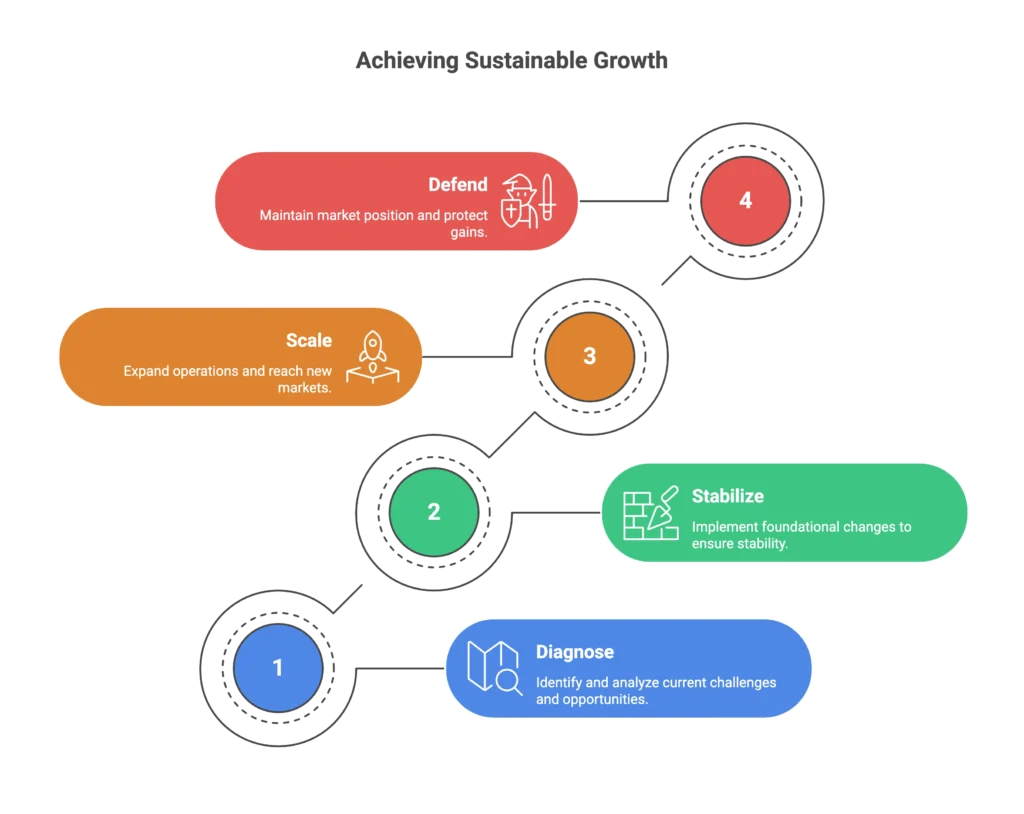
Phase 1 – Diagnose (Month 1)
Start with a complete mobile-first listing audit. Most sellers focus on desktop presentation, but mobile is where conversions happen. Your title, main image, and price need to convert from the first scroll.
Next, expand your backend keywords using Amazon’s increased character limits. I’m amazed how many sellers haven’t touched these fields in years. This single change can boost PPC performance and improve organic indexing.
Review your catalog structure for proper variation hierarchy to break through an Amazon seller plateau. Clean up split parents, consolidate duplicate ASINs, and ensure your product family makes sense to both Amazon’s algorithm and human shoppers to prevent a long-term Amazon seller plateau.
Finally, establish your baseline scorecard with four key metrics: TACoS trending (business-level advertising cost), Unit Session Percentage (conversion health), Buy Box Percentage (competitive position), and Weeks of Cover (inventory continuity).
Phase 2 – Stabilize (Months 2-3)
Foundation building is crucial. Your listing needs to be beautiful—not just functional. Invest in images that outdo your competitors and copy that converts. Remember, if you’re getting traffic but not converting, Amazon won’t want to show you for those keywords.
Fix your catalog structure completely. As I tell clients, we audit everything—listings, ads, backend, images, keywords, pricing, ranking—and connect the dots. This precision work separates plateau-breakers from perpetual strugglers.
Establish review velocity through legitimate means. You don’t need thousands of reviews—you need a good review average and consistent growth. Quality beats quantity every time.
Stay compliant with 2025 title rules and suppression prevention. Many sellers ignore compliance until they get suppressed, which kills momentum completely.
Phase 3 – Scale (Months 4-9)
Now comes the growth engine activation. This is where most sellers get it wrong—they think PPC is just about generating clicks. But strategic PPC builds organic rank.
I always start with auto campaigns because when I’m building a listing, I put in longtail keywords, short tail, Spanish, misspellings—everything. Auto campaigns feed off this foundation and discover terms I might not have considered.
Here’s the key insight: if my conversion rate on a term is high, I should be spending heavily because it’ll bring up my organic rank. Most people avoid spending on expensive keywords, but if you’re getting to the top spot and building organic momentum, it’s an investment in your listing’s future.
The goal is transitioning from PPC dependency to organic strength. Monitor both ad sales and organic sales growth—they should move together. If organic sales are growing while ad sales plateau, that’s actually a good sign that you’re building sustainable momentum.
Phase 4 – Defend (Months 10-12+)
Once you’ve broken through the plateau, defense becomes critical. Optimize your Buy Box percentage through competitive pricing and reliable inventory management.
Build price architecture that protects profitability while maintaining competitive positioning. Plan inventory buffers that prevent rank drops during restock periods.
Most importantly, maintain the systems that got you here. I’ve seen sellers scale to $1M+ monthly, then get complacent and lose everything because they stopped monitoring the fundamentals.
The PPC-to-Organic Transition Strategy
The transition from ad-dependent to organically-strong is the most critical skill plateau-breakers must master. Here’s exactly how it works.
Understanding the Conversion Rate Connection
Amazon’s algorithm rewards listings that convert well on targeted keywords. When you achieve high conversion rates through PPC, you signal to Amazon that your listing deserves higher organic placement for those terms.
This is why I focus heavily on conversion rates rather than just keeping ACOS low. If you’re converting well and climbing organically, you’re investing in your listing’s future. If you’re not making money and organic rank isn’t improving, there’s no point—we don’t want to sell at a loss.
The Auto Campaign Foundation
I like to always start listings with auto campaigns. Amazon looks at your backend keywords and lets their algorithm decide which terms to test. It’s like having Amazon’s massive data set working for your discovery.
Auto campaigns run forever, continuously generating new terms based on what Amazon thinks your listing fits. Once I see something relevant with decent search volume and high conversion rates, I move it to manual campaigns for more aggressive targeting.
The Ad Spend Withdrawal Method
Here’s where it gets interesting. After 90 days of zero ad spend on my main listing, I’m still ranking top five for competitive keywords, sitting at 4,000 BSR, and generating thousands of organic sales.
But this didn’t happen by accident. I spent months building the foundation—ensuring I never ran out of stock on strong variations, maintaining above 30 days of inventory, running strategic deals, and focusing on the right keywords with strong conversion rates.
The key question every seller should ask: were you just chasing low ACOS, or were you building organic rank on main and relevant terms? Were you being cheap with ads and afraid to scale? Every decision matters, and all these factors make a huge difference.
Common Plateau-Breaking Mistakes to Avoid
The “More Products” Trap
Many sellers think the solution is launching more products. They spread resources across dozens of mediocre listings instead of building dominant ones.
I’m not interested in helping brands manage 50 average listings. I want to build listings doing $1M+ each. Focus beats fragmentation every time.
The Agency Fragmentation Problem
Hiring multiple specialists who don’t coordinate strategy is a recipe for plateau perpetuation. You don’t need 10 agencies doing different things. You need one partner who sees the full picture and can help you dominate.
The Short-Term Thinking Mistake
Amazon rewards long-term thinking. Building organic rank takes time, but once established, it compounds. PPC is great, but organic strategy wins the long game. If your only strategy is throwing money at ads, you’ll be stuck in the hamster wheel forever.
Breaking Free: Your Next Steps
Breaking the Amazon seller plateau isn’t about spending more money or hiring more agencies. It’s about understanding that Amazon rewards listings that deliver consistent value through the entire ecosystem—conversion rates, organic rankings, inventory management, and customer satisfaction.
The four-phase Amazon seller plateau Breaker Operating System gives you a systematic path from diagnosis through sustainable growth. But here’s the reality: most sellers need someone who’s been in the trenches, building real brands, making real decisions, and getting real results.
You can keep patching together vendors and hoping for different results, or you can work with someone who treats your account like their own business. After 12+ years of building and scaling Amazon brands—including my current $400K/month listing running without ads—I know what separates plateau-breakers from perpetual strugglers.
The choice is yours. Are you ready to stop paying rent and start building equity?
FAQ: Breaking Through Amazon Seller Plateaus
How long does it take to break through an Amazon seller plateau?
Expect 6-12 months for sustainable breakthrough using systematic approach. Quick fixes don’t exist, but proper foundation-building creates compounding results that last for years.
Can you scale Amazon sales without increasing ad spend?
Yes, but only after building strong organic foundation first. My 90-day zero ad spend case study proves it’s possible, but requires months of strategic PPC investment to build organic momentum initially.
What’s the biggest mistake sellers make when trying to scale past $100K monthly revenue?
Treating Amazon like Google Ads instead of understanding it as an ecosystem. They optimize individual elements (ads, listings, reviews) separately rather than connecting them into a growth system.
How do you know if your plateau is caused by inventory issues?
Check delivery time consistency across regions and calculate weeks of cover by variation. Even with stock, poor warehouse distribution creates longer delivery promises that kill conversions and rankings.
What TACoS level indicates you’re breaking free from ad dependency?
Focus on TACoS trending direction rather than absolute numbers. Healthy progression shows organic sales growing alongside or faster than ad sales, indicating sustainable momentum rather than pure ad dependency.

