 Skip to content
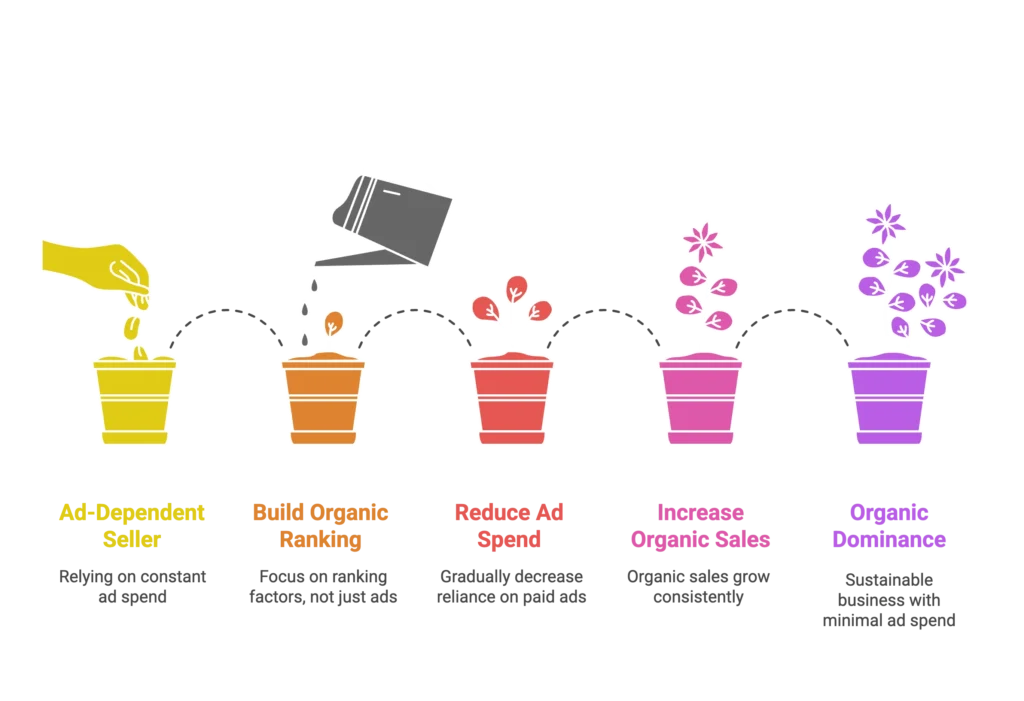
Most Amazon sellers are stuck paying rent for visibility instead of building equity in their rankings. They think success means constantly feeding ads to maintain sales—but that’s not building a business, that’s buying temporary placement. The real shift happens when you focus on building Amazon brands without ads, turning your listings into self-sustaining assets that dominate search results through organic authority rather than a constant drain on your margins.
Here’s the uncomfortable truth: if your sales collapse the moment you pause ads, you don’t have a sustainable business. You have an expensive habit.
What if you could build Amazon brands that thrive without constant ad spend? Where organic sales increase weekly while ad dependency decreases? This isn’t theory—it’s a proven system I’ve developed over 12 years of hands-on Amazon selling experience.
As someone who currently runs brands generating hundreds of thousands monthly with minimal ad spend, I’ll show you the exact framework that builds sustainable Amazon businesses focused on organic dominance. My own clothing brand recently hit $400,000 in monthly sales with zero ads running, and I’ve helped clients achieve similar results by breaking Amazon seller plateau constraints with a systematic approach to organic growth.
The key insight that changed everything for me: Amazon isn’t a pay-to-play advertising platform—it’s a ranking game. Master the ranking game, and sales come to you.
The Amazon Ecosystem Reality Check
Amazon operates as an interconnected ecosystem where ads affect rank, rank affects reviews, reviews affect conversion, and conversion affects ad efficiency. When one piece breaks, everything suffers.
This is where most sellers get it wrong. They treat Amazon like a collection of isolated tactics—hiring one agency for ads, another for listing optimization, maybe a freelancer for images. But nobody’s connecting the dots.
I’ve seen this repeatedly over my 12 years managing accounts. A client comes to me spending heavily on ads but seeing flat organic growth. Their listings look decent on the surface, but when I dig deeper, I find:
- Backend fields are either empty or incorrectly filled
- Inventory distribution is creating inconsistent delivery times
- Images aren’t optimized for mobile click-through rates
- Pricing strategy ignores conversion psychology
- They have no systematic way to track organic rank improvement
The result? They’re stuck in what I call the “PPC hamster wheel”—constantly spending to maintain the same level of sales instead of building compound growth.
Amazon rewards consistency and conversion across the entire funnel. When sellers focus only on ads while ignoring listing conversion, inventory management, and catalog structure, they’re fighting the algorithm instead of working with it.
Here’s a client example: they were doing over $2 million in sales but spending heavily on ads with a scattered approach. By focusing on building Amazon brands without ads through restructuring their catalog architecture and optimizing for mobile conversion, we got their TACoS down to 5% while maintaining growth. The difference? We started treating Amazon like an ecosystem, proving that building Amazon brands without ads is possible when you prioritize organic foundation over advertising.
The Honeymoon Period: Your 90-Day Window
Every new listing gets a 90-day honeymoon period where Amazon actively tests its viability. This window determines your long-term organic potential, yet most sellers waste it with poor strategy.
During this period, Amazon is asking one crucial question: “Do people want this product?” Your job is to give them an overwhelming “yes” through strategic execution.
The Strategic Launch Framework:
Start with aggressive pricing to demonstrate conversion potential, then gradually increase prices while maintaining rank position. I’m not talking about giving products away—I’m talking about pricing for conversion during the period when Amazon is most willing to test your listing.
For my own brand launches, I typically start 15-20% below where I want to end up, then raise prices incrementally as organic rank improves. Amazon sees the conversion strength, rewards it with better positioning, and by week 8-10, I’m at target pricing with strong organic rank.
The honeymoon period isn’t just about getting initial traction—it’s about proving to Amazon that your listing deserves long-term visibility.
Stock consistency during this window is critical. If you run low on inventory during your honeymoon period, you’re essentially telling Amazon, “We can’t reliably serve customers.” Recovery from that signal takes months.
But here’s what most people don’t realize: the honeymoon period doesn’t end completely after 90 days. It just gets progressively harder to revive rankings. I’ve successfully relaunched year-old listings back to top positions using honeymoon period principles.
One of my own products was sitting in the 35th position for a high-volume keyword. After implementing a strategic relaunch—optimizing conversion elements, ensuring stock distribution, and refreshing the listing approach—I proved that building Amazon brands without ads is entirely possible as it climbed to the #1 position within weeks. This case study is the perfect blueprint for building Amazon brands without ads while maintaining high profit margins.
The longer you wait, the harder it gets, but it doesn’t mean it’s over. Even aged listings can be revived with the right systematic approach.
Catalog Architecture: The Foundation Most Miss
Here’s something that trips up even experienced sellers: each variation functions as its own listing within Amazon’s algorithm. If your top-performing child ASIN sells out, you lose that ranking position—Amazon doesn’t automatically promote another variation.
I learned this lesson the hard way while building Amazon brands without ads for my clothing business. One size was dominating a high-traffic keyword, sitting in the top 3 positions; however, when that size sold out, the entire listing’s performance dropped. It proved that building Amazon brands without ads requires understanding that each variation must build its own ranking momentum to sustain organic visibility.
This means you need to think about inventory management at the individual ASIN level, not just the parent level. Treat each variation like its own business.
Inventory Distribution Strategy:
I maintain 60-90 days of inventory specifically because of how Amazon’s fulfillment network operates. When you have adequate stock, Amazon distributes it across multiple fulfillment centers. This means customers in New York get 2-day shipping, customers in California get 2-day shipping, and everyone’s happy.
But when you drop below 30 days of stock, Amazon restricts distribution. Suddenly, someone in New York sees “2-day shipping” while someone in California sees “5-day shipping.” That delivery time difference kills conversions in certain regions, which Amazon interprets as decreased demand, which hurts your organic rank.
I’ve tracked this pattern across multiple accounts. The moment inventory levels improve and delivery times normalize, organic rankings recover. It’s not about having millions of units—it’s about having enough for consistent fulfillment.
Backend Structure That Actually Works:
Most sellers leave backend fields blank or let Amazon fill them automatically. Big mistake. Amazon’s bots frequently get it wrong, and those errors compound over time.
I use the Browse Tree Guide to ensure item type keywords and browse nodes align perfectly with the category, which is the secret to building Amazon brands without ads. I also fill out every optional attribute because leaving them blank gives Amazon permission to guess—and as a specialist in building Amazon brands without ads, I know they usually guess wrong.
Monthly backend audits catch Amazon’s automatic changes before they become problems. Just because Seller Central suggests a change doesn’t mean it’s right. Stay in control of your listing data.
The Organic Ranking Operating System
Building sustainable organic growth requires treating ranking like an operating system with consistent inputs and measurable outputs.
Amazon’s Native Data Tools:
Instead of relying on expensive third-party tools, I use Amazon’s own data sources for building Amazon brands without ads to identify and fix ranking issues. The Category Listing Report reveals hidden problems that kill performance; it is a vital tool for building Amazon brands without ads because it shows exactly where your catalog structure is failing.
I also leverage Search Query Performance data to track which keywords are generating impressions but not converting. This reveals conversion leaks at the query level—invaluable data for optimization priorities.
The Weekly Ranking Audit:
Every week, I track three core metrics:
- Organic sales trend (should be increasing)
- TACoS trend (should be decreasing)
- Organic rank positions for target keywords (should be improving)
If organic sales aren’t increasing while TACoS decreases, the foundation needs work. If TACoS is rising despite good organic rank, there’s a conversion problem. The data tells the story—you just need to read it correctly.
When to Pull Back on Ads:
Ads should build rankings, not maintain them indefinitely. Once you’re ranking organically in strong positions for key terms, you can strategically reduce ad spend on those keywords.
My own brand is the perfect example. After building strong organic positions during the honeymoon period, I stopped running ads completely for over six weeks. Not only did sales continue, but organic rankings actually improved. Why? Because the listing was converting well enough to maintain momentum without artificial support.
The key insight: if you have to keep feeding ads to make sales, you’re not growing—you’re paying rent.
Mobile-First Optimization
Most shoppers never scroll past the title on mobile devices. Your listing must convince them to buy within seconds of landing on the page.
This reality drives everything I do with listing optimization. The title, hero image, and price need to work together to create instant conversion intent.
Title Strategy for Mobile:
With Amazon’s current 200-character limit and restricted rules, your title is the first step in building Amazon brands without ads. I focus on benefit-driven language that creates buying intent while incorporating the most critical search terms, ensuring your titles do the heavy lifting when building Amazon brands without ads.
The title isn’t just for Amazon’s algorithm—it’s the first thing potential customers see. Make it count.
Image Testing That Moves Rankings:
I A/B test hero images specifically for click-through rate improvement from search results. When someone searches for your target keyword, your image needs to stand out enough to generate the click. Higher click-through rates signal relevance to Amazon, which directly impacts organic ranking.
Most sellers set their images once and forget them. I treat image optimization as an ongoing conversion tool that feeds the ranking algorithm.
The Inventory-Ranking Connection
Amazon’s algorithm considers fulfillment speed when determining rankings. Products with slower delivery times in certain regions lose conversion opportunities and organic position.
I’ve seen this pattern repeatedly: when inventory drops below 30 days, Amazon restricts warehouse distribution. This creates inconsistent delivery times across different regions, which hurts conversion rates, which Amazon interprets as decreased product demand. If you are focused on building Amazon brands without ads, this inventory health is non-negotiable; without the “crutch” of paid traffic to force visibility, your organic ranking depends entirely on maintaining the high conversion rates that come from consistent, nationwide availability.
The 30-Day Danger Zone:
When inventory hits 30 days or less, I pause ads immediately to focus on building Amazon brands without ads. Why? Because Amazon can’t promise consistent delivery times, which means conversion rates drop and organic rank suffers—proving that building Amazon brands without ads during low-stock periods is the only way to protect your long-term ranking.
It’s better to maintain strong organic momentum with limited inventory than to damage your ranking foundation by pushing traffic to a listing that can’t convert consistently.
Stock Strategy for Sustained Growth:
Maintaining proper inventory levels isn’t just about avoiding stockouts—it’s about preserving the ranking momentum you’ve built through organic growth. Every time you let inventory drop too low, you’re essentially pressing reset on months of ranking development.
I’ve watched sellers lose top 10 positions simply because they couldn’t maintain consistent fulfillment speeds. The recovery time is always longer than the downward slide.
Advanced Backend Optimization
Beyond basic search terms, several backend elements contribute significantly to discoverability.
Alt text can include 100 characters of additional keywords including misspellings, Spanish terms, and variations that don’t fit in front-facing copy. Amazon’s Rufus AI reads this text for search relevance, making it more valuable than most sellers realize.
I fill alt text with keywords, common misspellings, and even partial competitor brand names (like “Lulu” instead of “Lululemon”) to capture broader search intent.
Browse node accuracy prevents Amazon from mis-categorizing your products. Using the Browse Tree Guide, I ensure item type keywords align perfectly with the intended category. Mismatches here can completely limit organic potential.
Monthly backend audits catch problems early. Amazon makes automatic changes to listings, and Seller Central suggestions aren’t always helpful. I’ve seen well-ranking products lose position because sellers accepted Amazon’s “suggestions” without understanding the implications.
Fill out every field. If you skip optional attributes, Amazon’s bots will fill them in—and they usually get it wrong. Stay in control of your listing data.
From Ad-Dependent to Organic-Dominant
The transition from ad dependency to organic strength requires strategic execution, not arbitrary budget cuts.
The Framework:
Phase 1: Use ads strategically during honeymoon period to build initial ranking momentum Phase 2: Monitor organic rank improvement and conversion strength
Phase 3: Gradually reduce ad spend on keywords where organic position is strong Phase 4: Reinvest ad budget into new keyword expansion or new product launches
Measuring What Matters:
Track organic units, TACoS trends, and rank positions weekly. If organic sales aren’t increasing while TACoS decreases, you have a healthy growth pattern. If TACoS is rising despite good sales, you have a conversion problem that ads can’t solve long-term.
The goal isn’t to eliminate ads entirely—it’s to build a business that doesn’t collapse when ads are paused.
FAQ: Your Organic Growth Questions Answered
Q: How long does it take to build organic rankings without ads? The honeymoon period provides the fastest path—90 days of strategic execution can establish strong organic foundation. However, even aged listings can be revived with proper relaunching techniques that refresh Amazon’s assessment of your product’s viability.
Q: Can you really compete without constant ad spend? Absolutely, but only with proper foundation work. Ads should build rankings initially, then organic strength should sustain growth. Permanent ad dependency indicates structural problems with your listing, pricing, or catalog architecture.
Q: What’s the biggest mistake sellers make with organic growth? Treating Amazon like Google Ads instead of understanding it’s an ecosystem. Every element—from inventory levels to image click-through rates—affects organic ranking. Most sellers optimize in isolation instead of connecting all the pieces.
Q: How do you know if your organic strategy is working? Track three metrics weekly: organic sales increasing, TACoS decreasing, and rank positions improving for target keywords. If all three aren’t trending positively, adjust your strategy before continuing.
Q: Is this approach suitable for new sellers? The honeymoon period advantage actually favors new listings, making this the ideal time to implement organic-focused strategies rather than starting with ad dependency. New sellers have a significant advantage if they understand the system from day one.
The Reality About Building Real Amazon Businesses
Most sellers will continue paying rent for visibility because building organic equity requires precision, patience, and understanding Amazon as an ecosystem. They’ll chase the latest ad strategy or optimization hack instead of building systematic, sustainable growth.
But those who master this approach build businesses that compound value over time. When your organic sales increase weekly while ad costs decrease, you’ve built something real—not just a temporary revenue stream.
Amazon rewards listings that convert consistently without artificial support. The algorithm wants to show products that customers actually want to buy, not products that can only generate sales through paid placement.
After 12 years of building and scaling Amazon brands, I’ve learned that the sellers who win long-term are the ones who understand that Amazon is a ranking game, not an advertising game. Master the ranking fundamentals, and everything else becomes easier.
Your 90-Day Organic Growth Action Plan
Weeks 1-2: Foundation Setup
- Audit and optimize all backend fields using Browse Tree Guide
- Implement mobile-first title strategy under 200 characters
- Ensure inventory covers 60-90 days to maintain distribution
- Set strategic pricing for honeymoon period conversion
Weeks 3-6: Momentum Building
- Monitor organic rank positions weekly for target keywords
- Test hero images for improved click-through rates from search
- Track delivery time consistency across different regions
- Adjust pricing based on conversion performance data
Weeks 7-12: Optimization & Testing
- Conduct monthly backend audits to catch Amazon’s automatic changes
- Test A+ content elements that impact conversion rates
- Monitor competitor positioning and adjust strategy accordingly
- Begin strategic ad reduction on keywords where organic rank is strong
Weeks 13+: Sustained Growth Management
- Focus on organic unit growth vs. total revenue metrics
- Maintain inventory levels that preserve warehouse distribution
- Continue weekly ranking audits and optimization cycles
- Scale successful patterns to additional products in catalog
The Partner Approach vs. Vendor Mentality
Building sustainable Amazon businesses requires treating every element—listings, ads, inventory, pricing—as part of a coordinated strategy, not isolated tasks.
Most agencies look at Amazon as a collection of tasks. They offer listing optimization, or they run ads, or maybe they monitor your account—but no one pulls all the threads together. That’s the fundamental problem.
I don’t operate like a typical agency. My company is built to actually grow Amazon businesses with a full-service approach that connects everything driving sales and organic rank. When something’s wrong with your listing, ads, stock, pricing, or backend structure, I know it before you do.
This isn’t about managing hundreds of accounts with cookie-cutter approaches. It’s about going deep with select clients and treating their accounts like my own business. Because I’m actively building and scaling my own brands, I practice everything I recommend.
The ecosystem approach means:
- Ads fuel organic growth instead of just generating clicks
- Listing optimization considers mobile conversion and backend compliance
- Inventory management preserves ranking momentum
- Pricing strategy balances conversion and profitability
- Everything connects to build compound growth over time
Why This Approach Works When Others Fail
The difference between sellers who build sustainable businesses and those stuck in the ad hamster wheel comes down to understanding Amazon’s fundamental motivation: they want to show products that customers actually want to buy.
When you optimize for organic ranking, you’re optimizing for the same thing Amazon wants—genuine customer satisfaction and conversion. This alignment creates compound growth because you’re working with the algorithm instead of trying to game it.
My own results prove this approach works. My clothing brand maintains strong organic positions even when ads are completely paused, proving that building Amazon brands without ads is not just a theory, but a viable long-term strategy. Client accounts achieve sustainable growth with decreasing ad dependency because the framework scales on Amazon’s core principles, not temporary tactics.
But here’s the reality: this approach requires precision, systematic execution, and understanding Amazon as an interconnected ecosystem. Most sellers prefer the apparent simplicity of “just spend more on ads” rather than doing the foundational work that builds real equity.
That’s actually good news for those willing to do it right. While your competitors stay trapped in the PPC hamster wheel, you’ll be building a business that generates sales whether ads are running or not.
The choice is yours: keep paying rent for visibility, or start building equity in organic rankings that compound over time. Amazon is still the best place on earth to build a brand—if you understand how the game actually works.

