 Skip to content
Most manufacturers think Amazon is just another Walmart—upload your products, wait for orders, and collect checks. That’s the fastest way to burn through six figures and blame “Amazon” for not working.
I’ve been selling on Amazon for over 12 years, and during that time, I’ve developed a comprehensive Amazon wholesale strategy that most sellers completely overlook. I started before it was trendy, before aggregators existed, and before every agency started calling themselves an expert. I’ve built and sold brands, and I’m currently launching another brand of my own—one listing alone is doing $400,000 per month with zero ad spend. This isn’t theory from a whiteboard; it’s a field-tested private label success strategy from someone who practices what he preaches.
The truth is, most wholesalers and manufacturers fail on Amazon because they bring the wrong playbook to the wrong game. In a proper Amazon wholesale strategy, success comes from understanding how Amazon’s algorithm actually works. They think Amazon works like traditional retail distribution, where success comes from buyer relationships and shelf placement negotiations. But Amazon isn’t a relationship game—it’s an algorithm game. Without a clear Amazon wholesale strategy, sellers keep throwing money at a system that doesn’t respond to traditional wholesale tactics.
Let me show you exactly where wholesalers go wrong and what it takes to actually win on Amazon.
The Wholesale Mindset vs. The Amazon Reality
What Wholesalers Think Amazon Is
When most manufacturers approach Amazon, they see it as just another retailer to sell through. They think they can upload their product catalog, price competitively, and wait for the distribution magic to happen. This makes perfect sense if you’re used to B2B relationships where you’re selling to buyers who already understand your product and market.
In the wholesale world, success comes from relationships, volume commitments, and placement agreements. You present your line, negotiate terms, and rely on the retailer’s existing customer base to discover and purchase your products. The retailer handles the marketing, positioning, and customer education.
What Amazon Actually Is: An Ecosystem Game
Amazon operates on completely different principles. It’s not just a marketplace—it’s a ranking algorithm wrapped in a shopping experience. Every single touchpoint affects your visibility and sales potential. Most decisions happen in under five seconds on mobile devices, which means your listing needs to sell immediately, not inform gradually.
Here’s what most wholesalers miss: Amazon treats each size and color of your product like its own separate listing. In an effective Amazon wholesale strategy, understanding how variations perform individually is critical for ranking and visibility. Yes, they’re grouped under a parent ASIN, but each child variation stands alone in the algorithm. If one size ranks for a keyword, it doesn’t mean the others will. In fact, one size could dominate page one while another sits buried on page three—something a smart Amazon wholesale strategy must account for.
Your inventory positioning across Amazon’s fulfillment centers directly impacts conversion rates. If customers in New York see two-day shipping while customers in California see five-day shipping, guess which region converts better? Amazon notices this difference and starts favoring listings that consistently deliver fast shipping across all regions.
This is why Amazon is an ecosystem game. Listings, pricing, ads, reviews, keywords, images, inventory positioning—everything needs to be dialed in and working together with precision.
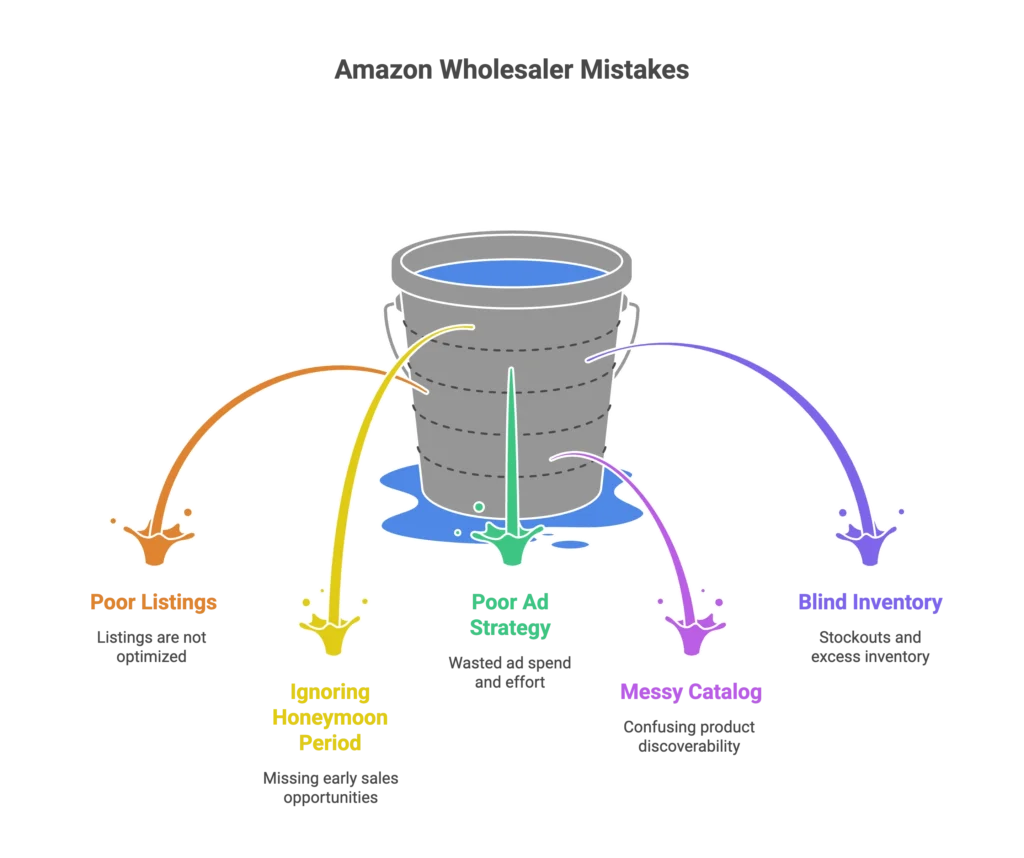
The 5 Deadly Mistakes Wholesalers Make on Amazon
Mistake #1: Treating Listings Like Product Catalogs
Your wholesale customers already know your product—Amazon customers don’t. Your listing needs to sell in five seconds on mobile, not inform in five minutes on desktop.
Most wholesalers upload the same product descriptions they use for retail buyers. These descriptions assume product knowledge, focus on specifications, and completely ignore consumer psychology. But Amazon shoppers are making split-second decisions while scrolling on their phones during lunch breaks.
Your backend keywords are probably empty or filled with irrelevant terms. Your main image might look great in a catalog but fails to grab attention in search results. Your bullet points read like technical specifications instead of benefit-driven sales copy.
The fix isn’t just better copywriting—it’s understanding that Amazon customers are in a completely different buying mindset than B2B buyers.
Mistake #2: Ignoring the Honeymoon Period
This is where I see the most money wasted. The first 90 days after launching a new ASIN represent your strongest opportunity to build organic ranking. Amazon gives new listings preferential treatment during this honeymoon period, but most wholesalers completely waste it.
They launch with conservative pricing, minimal ad spend, and hope for gradual growth. In a strong Amazon wholesale strategy, the early launch phase is critical for gaining momentum. Then they wonder why their listings never gain traction. Meanwhile, sellers who understand the honeymoon period use strategic pricing and coordinated ad spend to capture those critical early rankings—something every effective Amazon wholesale strategy should prioritize.
I’ve seen this play out hundreds of times. A listing that builds strong organic ranking in the first 90 days can maintain that momentum for years. My own brand proves this—I can turn off ads completely and still maintain $400K monthly sales because the organic foundation was built correctly from day one.
But if you miss that honeymoon window, climbing to top positions becomes exponentially harder and more expensive.
Mistake #3: Running Ads Without Ranking Strategy
Here’s where most wholesalers get trapped in an expensive cycle. They run ads like Google AdWords—focusing on low cost-per-click and immediate return on ad spend. But Amazon ads should build organic rank, not just generate clicks.
I regularly see accounts spending thousands monthly on ads while organic sales remain flat. That’s not scaling—that’s paying rent for temporary visibility. The moment you pause ads, sales collapse because you never built sustainable ranking.
The relationship between ads and organic ranking is critical to understand. In a well-planned Amazon wholesale strategy, advertising is not just about immediate sales but about building long-term organic visibility. Strategic ad spend during the honeymoon period builds the conversion signals and keyword relevance that Amazon’s algorithm needs to rank you organically. However, a successful Amazon wholesale strategy requires coordinated effort across pricing, inventory, and targeting—not just throwing money at keywords.
After 90 days of strategic ad spend on my own brand, I was able to turn ads off completely. Sales not only continued but actually increased as organic rankings improved. That’s what proper Amazon strategy looks like.
Mistake #4: Messy Catalog Architecture
Most wholesalers upload products without understanding how Amazon’s catalog structure affects ranking and discoverability. They create messy parent-child relationships, split variations that should be grouped, or group variations that should be separate.
This isn’t just about organization—it directly impacts your ability to rank and scale. If you’re selling clothing with multiple colors and sizes, and your bestselling variation sells out, your entire listing can lose momentum. Amazon treats each child ASIN separately for ranking purposes, so losing your top performer can crash visibility for the whole group.
I’ve rebuilt countless catalogs where simple architectural changes resulted in dramatic improvements in organic ranking and ad performance. Getting the structure right from the beginning prevents expensive problems later.
Mistake #5: Inventory Positioning Blindness
This might be the most overlooked factor in Amazon success. Where your inventory sits in Amazon’s fulfillment network directly affects your conversion rates and organic ranking.
I built a custom tool to track exactly where my inventory is distributed across Amazon’s fulfillment centers. In an effective Amazon wholesale strategy, understanding inventory distribution is essential for maximizing conversions. Why? Because customers in different regions see different shipping promises based on inventory proximity. If someone in Texas sees five-day shipping while someone in New York sees two-day shipping, the New York customer converts at a much higher rate—something a smart Amazon wholesale strategy must take into account.
Amazon notices these conversion differences and adjusts your organic ranking accordingly. Regions with faster shipping get better visibility, while regions with slower shipping get deprioritized.
Most wholesalers send inventory to Amazon and hope it gets distributed properly. But if you’re only carrying 30 days of stock, Amazon can’t spread your inventory efficiently across their network. You need 60-90 days of inventory minimum to ensure consistent shipping speeds nationwide.
The Amazon Ecosystem Approach for Wholesalers

Success on Amazon requires thinking in systems, not tactics. Every element needs to work together to build sustainable organic ranking.
Foundation Layer: Catalog & Listing Architecture
Start with strategic parent-child variation setup. Group related products properly, but don’t force unrelated items together just for convenience. Each variation should make logical sense to customers and Amazon’s algorithm.
Optimize your backend search terms with actual customer language, not industry jargon. In a strong Amazon wholesale strategy, using real customer search behavior helps improve discoverability and relevance. Use a mobile-first image and copy strategy because most purchasing decisions happen on phones. Your main image needs to grab attention in search results, and your bullet points need to sell benefits, not just features—an important principle in any effective Amazon wholesale strat
Momentum Layer: Honeymoon Period Execution
The first 90 days determine your long-term success potential. In a well-executed Amazon wholesale strategy, the launch phase is crucial for building strong ranking signals. Start with aggressive but strategic pricing to maximize conversion rates. Amazon wants to see that customers love your product, and high conversion rates during the honeymoon period signal quality to the algorithm—an important factor every Amazon wholesale strategy should leverage.
Coordinate your ad spend with organic ranking goals. Don’t just bid on keywords—build keyword relevance through strategic targeting and budget allocation. Track organic ranking improvements, not just immediate ad performance.
Plan your inventory distribution carefully. Send enough stock to ensure Amazon can spread it across multiple fulfillment centers for consistent shipping speeds nationwide.
Sustainability Layer: Organic Rank Development
The goal is moving from ad-dependent to organic-driven sales. As your organic rankings improve, you can gradually reduce ad spend while maintaining or increasing total sales volume.
Focus on long-term keyword ranking maintenance through consistent performance signals—conversion rates, customer satisfaction, inventory availability, and competitive pricing.
Build reviews naturally through excellent customer experience, not gimmicks or manipulation. Amazon’s algorithm heavily weights authentic customer feedback in ranking decisions.
The Wholesale-to-Amazon Operating System

Week 0-4: Foundation Setup
Audit your catalog structure and fix any issues before launching. Ensure your Node-Item-Search classification is accurate—small mistakes here can destroy your ranking potential.
Develop your inventory placement strategy targeting 60-90 day stock levels across all variations. Plan your initial pricing to maximize conversion rates during the critical honeymoon period.
Set up pricing governance that respects your MAP agreements while optimizing for Amazon’s conversion-focused algorithm.
Week 1-8: Controlled Launch Sequence
Implement strategic ad campaigns aligned to organic ranking goals, not just immediate sales. Target keywords where you can realistically achieve top 10 organic positions within 90 days.
Monitor delivery speed across different regions and adjust inventory distribution as needed. Faster shipping equals higher conversion rates equals better organic ranking.
Optimize conversion rates through A/B testing images, pricing, and copy elements. Small improvements in conversion rate create significant improvements in organic ranking over time.
Month 3+: Organic Momentum Capture
Gradually transition from paid to organic traffic as rankings improve. Don’t cut ads abruptly—scale back systematically while monitoring organic performance.
Expand successful variations and discontinue poor performers. Focus resources on listings with proven organic ranking potential rather than spreading efforts across marginal products.
Use organic success as proof-of-concept for catalog expansion. Build new products around proven keyword themes and customer preferences.
Why Most Amazon Agencies Fail Wholesalers
The biggest problem with most Amazon agencies is the silo approach. They offer listing optimization OR advertising management OR inventory planning, but no one connects the dots between all these elements.
Worse, most agencies don’t understand wholesale business models. They apply the same tactics to everyone regardless of business structure, market position, or growth goals. They treat Amazon like a digital advertising platform instead of the complex ecosystem it actually is.
The difference with a full-service approach is treating your Amazon business like an owned brand, not just another client account. This means making decisions based on long-term organic growth potential, not short-term ad performance metrics.
It means understanding how your wholesale margins and volume commitments affect pricing strategy on Amazon. It means coordinating inventory planning with your existing supply chain constraints. It means building sustainable competitive advantages, not just managing campaigns.
Frequently Asked Questions
How long does it take for wholesalers to see Amazon results?
The honeymoon period provides the strongest opportunity in the first 90 days, but sustainable growth requires 6-12 months of strategic ecosystem building. Quick wins are possible, but lasting success takes systematic effort across all ranking factors.
Can you succeed on Amazon without huge ad budgets?
Absolutely. My own brand demonstrates $400K monthly sales with zero current ad spend—but only after building strong organic foundation through strategic initial investment. The key is using ads to build ranking, not just generate immediate sales.
What inventory levels should wholesalers maintain for Amazon?
Target 60-90 days of inventory across all variations. Understocking below 30 days triggers algorithm deprioritization and destroys organic ranking momentum. Amazon needs sufficient inventory to distribute across fulfillment centers for consistent nationwide shipping.
How is Amazon different from selling to retail chains?
Retail focuses on buyer relationships and negotiated shelf placement; Amazon rewards algorithm optimization and customer satisfaction metrics. Every listing element affects visibility, conversion, and long-term organic ranking in ways that don’t exist in traditional wholesale.
Should wholesalers list all their products on Amazon?
Focus on fewer, dominant listings rather than catalog dumping. Better to have one listing doing $1M+ annually than dozens doing mediocre numbers. Start with your strongest products and expand based on proven success, not theoretical market coverage.
Ready to Play the Real Amazon Game?
Amazon isn’t just another sales channel—it’s a completely different business model requiring ecosystem thinking, not wholesale tactics. The wholesalers who succeed understand this fundamental difference and adapt their approach accordingly.
The opportunity is massive, but so is the learning curve. Most wholesalers either give up too quickly or waste resources on tactics that don’t build sustainable growth. The difference between success and failure usually comes down to understanding Amazon as a ranking game, not a relationship game.
After 12+ years of hands-on experience building brands on Amazon, I’ve seen what works and what doesn’t. The strategies I use for my own brands—the ones generating $400K monthly with no ad spend—are the same ones that work for serious wholesale businesses ready to dominate their categories.
If you’re tired of treating Amazon like a side project and ready to build dominant listings that generate sustainable growth, let’s talk about what you’re actually missing. Because the difference between “trying” Amazon and winning on Amazon is bigger than most people realize.

