 Skip to content
Most Amazon “case studies” you read are fabricated fairy tales, but true private label success isn’t found in hockey-stick charts with mysterious percentages. It’s found in the battle-tested private label Amazon strategy that survives inventory disasters and ranking collapses—the messy reality that most gurus want to hide from you.
Here’s what they don’t show you: the inventory disasters, the ranking collapses, the expensive mistakes that nearly killed entire brands before they figured out what actually works.
I’m Hymie Zebede. I’ve been selling on Amazon for 12 years, built and scaled my own clothing brand to achieve private label success with hundreds of thousands in monthly sales, and helped take a client from $3 million to $24 million in annual revenue. I’m not here to impress you with fake screenshots; I’m here to share the blueprint for private label success that actually works in today’s competitive marketplace.
Instead, I’m going to walk you through real case studies—the messy, complicated, expensive lessons that taught me Amazon isn’t a pay-to-play advertising platform. It’s a ranking game. And most sellers are playing it completely wrong.
If you’re stuck in the ad-spend hamster wheel, convinced you need to burn through budgets to grow, this will challenge everything you think you know about scaling on Amazon. These aren’t theoretical frameworks or consultant playbooks. These are battle-tested strategies that work when your own money is on the line.
The $3M to $24M Case Study: Why Most Scaling Strategies Fail
Let me tell you about one of my biggest achievements—taking a client from $3 million to $24 million in annual sales over two years. This wasn’t some unicorn product or perfect market timing. This was a clothing brand making every mistake sellers make when they treat Amazon like traditional retail.
The Inventory Disaster That Changes Everything
This company was stuck in a vicious cycle. They’d launch with multiple colors and sizes, one variation would take off, then they’d run out of stock on their best performer. “No problem,” they thought, “we have other colors.”
Here’s what they didn’t understand: Amazon ranks each product ASIN individually. If you have one color killing it for a top keyword, it doesn’t mean the other colors will rank there too. In fact, one size could be at the top of Page 1 while another is buried at the bottom.
When that MVP variation sells out, your entire listing crashes. It doesn’t stay in position just because you have other colors available, which is a common hurdle for private label success. Amazon treats each size and color like its own separate business—because that’s exactly what it is. If you aren’t managing your top-performing SKUs with this level of granularity, achieving long-term private label success becomes nearly impossible.
This client was running out every few months, restocking, then watching their rankings collapse again. Amazon doesn’t like that. Amazon wants reliability, not something that performs well then disappears for months.
When I told them they needed to air freight inventory to stay in stock, they resisted. “We’re going to lose money on each unit,” they said. “It’s not worth it.”
But here’s the reality: those few dollars per unit they’d lose on air freight? That was nothing compared to the ranking momentum they were destroying every time they went out of stock. Once we implemented proper inventory planning—treating each child ASIN as a separate business with its own stock requirements—the compound growth effect was dramatic.
The brand went from cyclical stockouts and ranking crashes to consistent organic growth that supported their 8x revenue increase over two years.
The Honeymoon Period Advantage Most Sellers Waste
Most sellers don’t realize Amazon gives every new listing a testing period. If they see strong performance early, they want to show your product across the entire platform, which is the foundational period for private label success. But if you waste this window with weak conversions or stockouts, you’ll spend months trying to recover that momentum and jeopardize your long-term private label success.
There’s a specific strategy that works during this critical period:
- Start at a low price to maximize conversion rate and show Amazon there’s demand
- Monitor organic ranking improvements for your target keywords
- Gradually increase price while maintaining ranking position
- Build sustainable organic foundation before scaling ads aggressively
The honeymoon period isn’t about running the cheapest ads possible; it’s the foundational phase for private label success. It’s about proving to Amazon’s algorithm that your product deserves to be seen. When you nail this phase, the organic momentum ensures long-term private label success that carries you forward for months or even years.
The 90-Day Zero-Ad Experiment: What Happens When You Turn Off PPC
Here’s something that will challenge everything you think you know about Amazon advertising: I recently completed a 90-day experiment running one of my own products with $0 in ad spend.
The results? The product maintained top 5 rankings for competitive keywords, held a 4,000 BSR position, and generated thousands of organic sales with zero ad dependency.
But before you think this means you should immediately turn off all your ads, understand this: this only works if you’ve built genuine organic strength first.
Case Study: My Own Brand’s Ad-Free Growth Period
I paused all ads on November 27th and watched what happened. Day 90 marked three full months with zero advertising spend, and the listing was still ranking and selling consistently.
This wasn’t luck or some perfect product. This was the result of understanding what actually drives Amazon success: organic ranking momentum built through strategic conversion optimization and treating Amazon like the ranking ecosystem it is. This experiment is the ultimate proof of why building Amazon brands correctly from day one allows you to eventually stop renting traffic and start owning your niche.
But here’s the crucial part most sellers miss: just because you have inventory in FBA doesn’t mean Amazon is showing your product with fast shipping. If your stock isn’t properly distributed across fulfillment centers, Amazon deprioritizes your listing.
During my experiment, some sizes weren’t completely out of stock, but Amazon didn’t have enough inventory distributed to show consistent 2-day shipping nationwide. Customers in certain regions saw 4-5 day delivery times, which killed conversions and hurt organic rankings.
The moment stock levels improved and distribution normalized, rankings and sales picked right back up. This had nothing to do with turning off ads—it was purely an inventory logistics issue.
The Hidden Inventory Factors That Kill Rankings
Most sellers think inventory management is simple: don’t run out of stock. But there are hidden factors that destroy rankings even when you technically have inventory:
The 30-60-90 Day Rule: I aim for 60-90 days of inventory because running low triggers Amazon’s deprioritization algorithm. If you’ve only got 30 days of stock, Amazon sees that as risky and won’t push your product as aggressively in search results.
The Distribution Problem: Low stock means Amazon can’t spread your inventory evenly across warehouses. Someone in New York might see 2-day shipping while a customer in California sees 5-day delivery. That extra wait time kills conversions, and Amazon notices when competitors are getting more sales due to faster delivery options.
The Compound Effect: Understocking doesn’t just cost you sales today—it costs you rankings, momentum, and long-term growth. Each child variation needs to be treated like its own business with independent inventory planning.
The Backend Optimization Case Studies Nobody Talks About
While everyone’s focused on PPC optimization and listing copy, there’s a silent killer destroying rankings that most sellers never think to check: backend classification errors.
The Silent Listing Killers
Amazon’s bots love to make changes without telling you. One day your product is categorized correctly, the next day it’s been switched to something completely irrelevant. I’ve seen products go from “Pajama Sets” to “Pajamas Sets”—a tiny change that tanked organic rank, PPC performance, and visibility.
Here’s what most sellers don’t know: Seller Central suggestions aren’t always helpful. Just because Amazon suggests a change doesn’t mean it’s right. Accepting these changes blindly can lead to costly mistakes that take months to discover and fix.
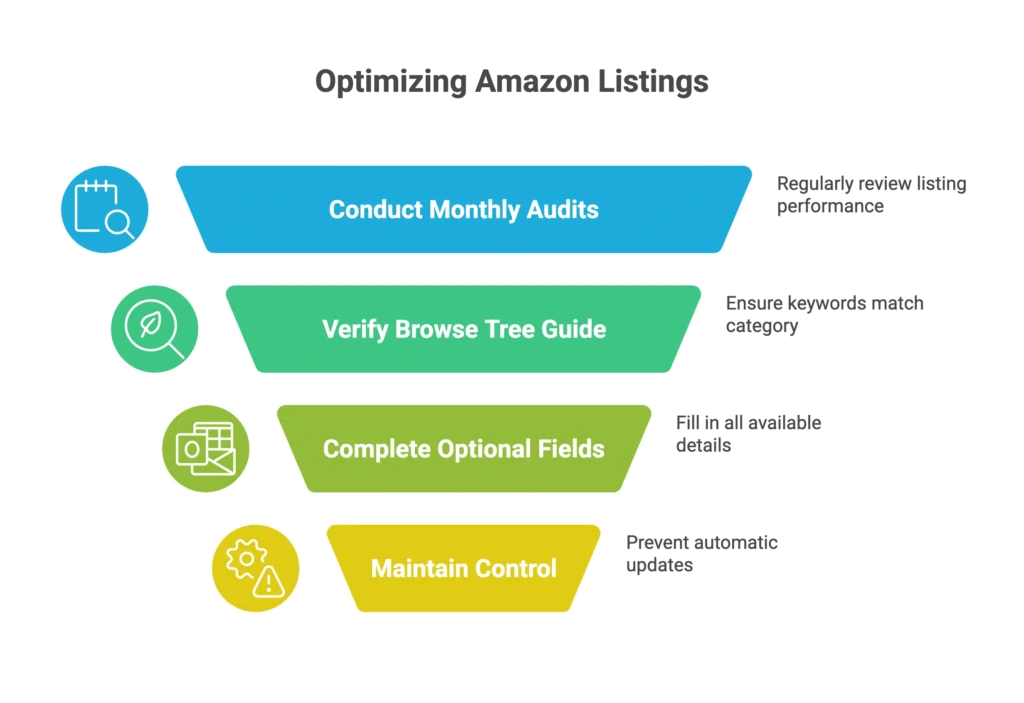
The solution is systematic:
- Monthly backend audits using the Category Listing Report from Seller Central
- Browse Tree Guide verification to ensure item type keywords match your category
- Complete every optional field because if you don’t, Amazon’s bots will fill them in—usually incorrectly
- Never let Amazon automatically update your listing—always maintain control
I recently helped a client discover their products had been silently reclassified months earlier. Their rankings had mysteriously dropped, their PPC performance was terrible, and they couldn’t figure out why. One backend audit revealed the problem, and within weeks of fixing it, their organic performance recovered.
The Million-Dollar Backend Mistakes
Wrong browse nodes crush PPC performance. Incomplete attributes let Amazon’s bots make incorrect assumptions about your product. Poor variation architecture destroys keyword coverage across child ASINs.
These aren’t sexy topics that get discussed in Facebook groups or Amazon conferences, but they’re often the difference between brands that scale and brands that plateau at a few hundred thousand in annual sales.
Why Every “Case Study” You’ve Read is Wrong
Most Amazon case studies focus on the wrong metrics entirely. They obsess over ACoS improvements and celebrate lowering ad spend without understanding the bigger picture.
The ACoS Obsession That’s Killing Your Growth
Stop obsessing over ACoS—it’s not always the right KPI. A low ACoS doesn’t always mean success, and a high ACoS doesn’t always mean failure.
I recently worked with a brand where 82% of their sales were attributed to marketing. That sounds terrible, right? But the real problem wasn’t the attribution—it was that they had no organic foundation. They were essentially renting all their traffic instead of building owned visibility.
Compare that to successful brands I manage where TACoS (Total Advertising Cost of Sale) runs around 5%. The difference isn’t better ad management—it’s understanding that PPC should build organic rankings so you spend less over time, not trap you in permanent ad dependency.
Sometimes a higher ACoS is part of a bigger strategy—boosting organic rank, locking in key positions, or building market share during competitive windows. What matters is total profitability and long-term organic visibility, not hitting arbitrary ACoS targets.
The Organic vs PPC Balance Nobody Understands
I have another brand tracking toward $45 million this year, up from $23 million last year. Part of this growth came from strategic shifts like moving heavy items to Seller Fulfilled Prime. Before we even received the Prime badge, just offering premium shipping options gave sales a noticeable lift.
But the bigger lesson is about optimization holistic thinking. Spending on ads alone doesn’t create sustained growth. Backend keywords, fulfillment optimization, catalog structure, inventory distribution—these all work together as one system.
Amazon success isn’t about pulling one lever perfectly. It’s about understanding how every piece connects and optimizing the entire ecosystem for long-term organic growth.
The Catalog Architecture Secrets That Scale Brands
Here’s something most sellers get completely wrong: they think more products equal more opportunity. The reality is you don’t need hundreds of mediocre listings—you need a few dominant ones doing significant volume each.
The Parent/Child Strategy That Changes Everything
Proper variation strategy was crucial to the $3M to $24M case study success. Most sellers randomly group variations without understanding how this affects keyword coverage, social proof distribution, and ranking potential.
The key decisions are:
- When to split vs merge variations based on search behavior and keyword mapping
- How to preserve social proof during catalog restructuring
- Backend keyword coverage optimization across child ASINs
- Mobile-first variation presentation for maximum conversion
Getting catalog architecture right supports everything else you do. Poor structure makes great products invisible. Great structure makes decent products discoverable and scalable.
The Million-Dollar Listings Philosophy
Focus beats diversification in Amazon’s ranking game. Deep market penetration with a few dominant listings outperforms wide coverage with dozens of weak ones. The goal isn’t managing a catalog—it’s building organic moats that competitors can’t easily attack.
This philosophy guided the client success stories I’ve shared. Instead of spreading efforts across hundreds of products, we focused on making their best performers truly dominant in their categories.
Taking Action: What This Means for Your Brand
If you’re stuck in the ad-spend hamster wheel, convinced you need bigger budgets to grow, these case studies should change how you think about Amazon entirely.
The path to genuine private label success isn’t about advertising genius or secret tactics. It’s about understanding Amazon as the ranking ecosystem it is, not the pay-to-play platform most sellers think it is.
Success comes from strategic inventory management, proper catalog architecture, backend optimization, and using PPC to build organic strength rather than replace it. These principles work whether you’re launching your first product or trying to break through a multi-million dollar plateau.
The brands that scale don’t just spend more on ads. They build systems that make advertising more effective while reducing long-term dependency on paid traffic. That’s the difference between renting success and owning it.

