 Skip to content
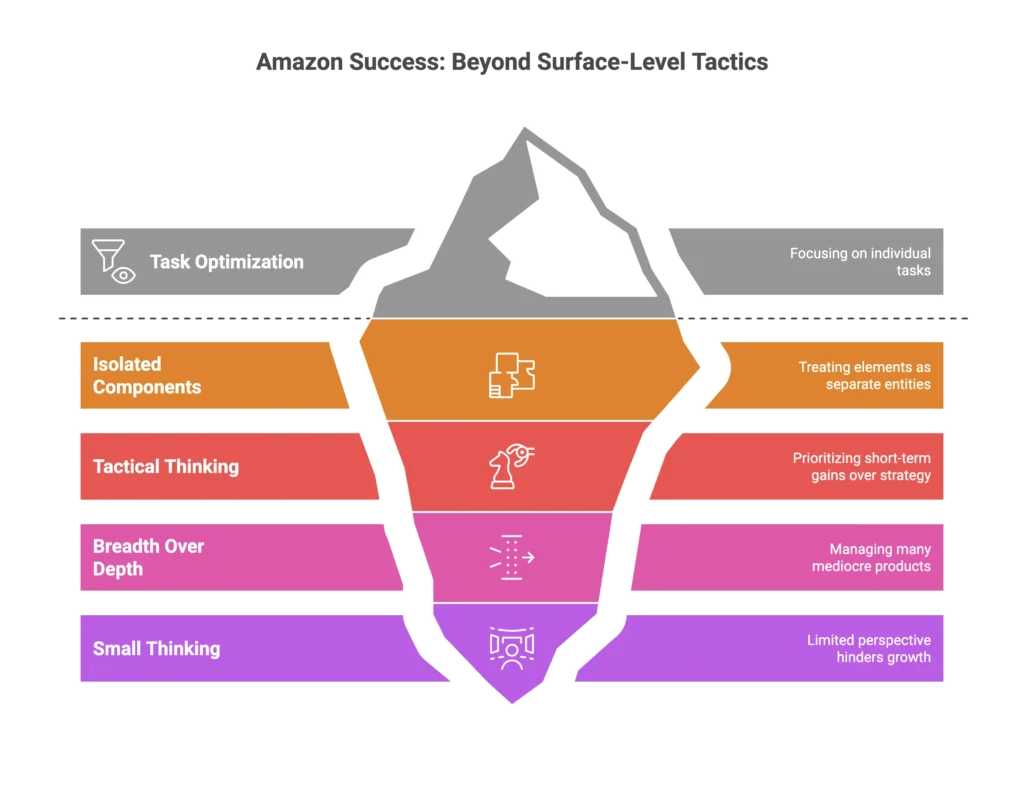
Most Amazon sellers are trapped in small thinking. They obsess over optimizing individual tasks—tweaking a keyword here, adjusting a bid there—while missing the fundamental truth that Amazon isn’t a collection of separate systems. It’s one interconnected ecosystem where every decision creates a chain reaction.
After 12 years of building, scaling, and selling Amazon brands, I’ve watched countless sellers get stuck because they approach Amazon like it’s a traditional retail channel. They treat listings, advertising, inventory, and reviews as isolated components instead of understanding how each piece amplifies or destroys the others.
“The result? They plateau at ‘decent’ performance while burning through ad budgets, never building the organic foundation that creates true leverage. This common Amazon seller mindset causes brands to think tactically when Amazon rewards strategic thinking. They focus on managing more products when the platform rewards depth over breadth. Shifting your Amazon seller mindset to prioritize a margin-first playbook is the only way to escape the pay-to-play cycle and build a business that scales without constant ad dependency.”
The sellers who break through—who build million-dollar SKUs instead of managing hundreds of mediocre ones—understand that success on Amazon starts with a completely different mindset. It’s not about perfecting individual tactics. It’s about orchestrating an entire system where organic ranking becomes your competitive moat, not your advertising budget.
This isn’t another “mindset matters” motivational post. This is about translating the right mental framework into specific operating rules that compound over time. Because on Amazon, small thinking keeps you small. And the platform rewards sellers who think like ecosystem architects, not task managers.
The Chain Reaction That Most Sellers Miss
Amazon operates on interconnected feedback loops that most sellers completely misunderstand. When I talk about the “chain reaction,” I’m referring to how listings → organic rank → reviews → conversion rates → ad efficiency all feed into each other in an endless cycle.
Here’s what this looks like in practice: Your listing quality affects your conversion rate. Your conversion rate affects your organic ranking. Your organic ranking affects your review velocity. Your review velocity affects your conversion rate. Your conversion rate affects your ad efficiency. And your ad efficiency affects how much you can spend to improve your organic ranking.
Break any link in this chain, and the entire system suffers.
I learned this lesson the hard way with my own clothing brand. We had successfully launched and were doing strong numbers—went from zero to $69,000 in sales in just a few months. Our organic rank was climbing beautifully across major keywords. Everything looked perfect.
Then we ran out of one size variation. Just one.
The entire listing crashed. Our keyword rankings plummeted because Amazon’s algorithm saw our bestselling child ASIN go out of stock. Even though we had inventory in other sizes, the momentum died instantly. Sales dropped from $69,000 to $34,000, then to $20,000 the following month.
That’s the power of the chain reaction—and why inventory management isn’t just about having products to sell. It’s about protecting months of ranking work.
Most sellers don’t realize that Amazon ranks products based on child ASINs for many keywords. Adopting a professional Amazon seller mindset means understanding that your main child ASIN might rank in the top 10 for a critical keyword, but if that specific variation sells out, Amazon might show your secondary variation on page two for the same search term. The algorithm doesn’t just switch seamlessly—your momentum gets killed. Developing this high-level Amazon seller mindset is what separates those who struggle with stockouts from those who build bulletproof, ranking-first inventory strategies.
This is especially critical given that over 70% of Amazon browsing now happens on mobile. Mobile shoppers make quick decisions. They don’t scroll through multiple pages or wait for you to restock. They see your competitor delivering faster or having better availability, and they’re gone.
The chain reaction works in reverse too. When everything clicks—strong listing, good organic rank, positive reviews, competitive pricing—each element amplifies the others. Your organic sales increase, which reduces your Total Advertising Cost of Sales (TACoS), which gives you more budget to invest in growth, which improves your market position.
Why Your Catalog Structure Is Killing Your Growth
Most sellers think more products equal more opportunities. This is backward thinking that keeps you perpetually struggling. Amazon rewards focused catalogs with deep penetration in specific categories, not scattered product portfolios with weak market positions.
I don’t believe in having thousands of low-selling or mediocre listings. The successful Amazon seller mindset is built on the belief that you only need a few high-performing listings to generate significant wealth. I have listings that do over a million dollars a year on single SKUs, and there’s no secret to it. It is simply a shift in Amazon seller mindset—moving away from volume-based guessing and toward a data-driven strategy where every SKU is built to dominate.
This isn’t just philosophy—it’s practical business sense. Every product in your catalog requires attention, optimization, inventory investment, and ad spend. Spreading your resources across dozens of weak performers means none of them get the focused effort needed to dominate their market.
The One-In/One-Out Principle
Here’s how I approach catalog decisions: for every new product you want to launch, something else has to go. This forces you to be strategic about what deserves your limited resources.
Before adding any product, it must pass three tests:
- Moat Potential: Can this product be easily copied? Does it have patent protection, complex sourcing, or unique design elements that create barriers for competitors?
- Market Size: Is the Total Addressable Market (TAM) large enough to support significant revenue? Can this category sustain $500K+ annual sales per listing?
- Repeat Business: Are customers likely to reorder? Consumable products with repeat purchase patterns create compound growth that one-time purchases can’t match.
If a product can’t clear all three hurdles, it doesn’t belong in a serious Amazon catalog.
The Honeymoon Period Framework (That Most Sellers Waste)
The 90-day honeymoon period isn’t just about getting initial traction—it’s about building the foundation for long-term organic dominance. Yet most sellers approach it with completely wrong priorities.
They launch without proper preparation, waste their strongest ranking window on poor listings, or give up before the compounding effects kick in. The honeymoon period is real, and it’s your best opportunity to establish market position.
Phase 1: Foundation Setting (Days 1-30)
This phase is about setting up all the infrastructure for success. Your listing must be dialed in before you start pushing traffic to it.
Most sellers get this backward. They launch with ‘good enough’ listings and plan to optimize later, but a professional Amazon seller mindset dictates that you must be optimized before the first click. Amazon is testing your conversion rate during this critical window. Send traffic to a weak listing, and the algorithm concludes your product isn’t relevant for those keywords. Shifting to an Amazon seller mindset focused on Day 1 excellence prevents you from teaching the algorithm that your product is a low-converter.
Mobile-first optimization is non-negotiable. Most people never scroll past the title on mobile. Your main image, title, and price need to tell the complete story above the fold. Everything else is supplementary.
Backend keyword structuring matters more than most sellers realize, especially now that Amazon has expanded character limits. Yet many sellers haven’t updated their backend fields in months or years. These updates directly impact both PPC performance and organic discoverability.
Price positioning during this phase requires strategic thinking. You’re not optimizing for profit margins yet—you’re optimizing for conversion rate and sales velocity to build organic momentum.
Phase 2: Momentum Building (Days 31-60)
This is where strategic PPC spend creates lasting value. The goal isn’t just immediate sales—it’s climbing the organic rankings for your most important keywords.
I track organic rank obsessively during this phase. If I see a keyword where I’m getting ad sales but my organic position isn’t improving, something’s wrong. Developing a professional Amazon seller mindset means recognizing that ads are a tool for ranking, not just immediate profit. Either my listing isn’t converting well enough, or I need to increase spend to generate more sales velocity. Without this specific Amazon seller mindset, you’ll likely overspend on traffic that never translates into long-term organic dominance.
PPC during the honeymoon period has to make you money OR improve your organic rank. If it’s doing neither, shut it down. But if you’re losing money on ads while climbing organically for high-value keywords, that can still be worth it.
Phase 3: Compounding Setup (Days 61-90)
By this phase, you should see organic momentum building. Your goal shifts from pure growth to optimization and sustainability.
This is where most sellers make their second big mistake. They see success and immediately try to scale too fast, running out of inventory or diluting their focus with new launches. Instead, this phase should consolidate your gains and prepare for sustained growth.
The honeymoon period doesn’t end abruptly at 90 days, but its strength definitely diminishes over time. I believe it gets progressively weaker—the first week is stronger than the second week, the first month stronger than the second month. It doesn’t disappear, but you have to work harder for the same ranking improvements.
The Real Mindset Shift: From Ads to Ecosystem
Stop Paying Rent, Start Building Equity
The biggest mindset shift successful Amazon sellers make is understanding that PPC should build organic ranking, not just generate immediate sales.
If you have to keep feeding ads to make sales, you’re not growing—you’re paying rent.
I proved this with my own brand recently. We faced major stock issues that forced us to cut ads completely for 90 days. Not a full stockout, but running low enough that we had to pause advertising to preserve inventory for organic sales.
I expected a slowdown. Maybe a dip in sales. Maybe even a drop in organic rank.
But sales kept rolling in. Organic rank held strong. Why? Because ads weren’t there to prop up the listing—they were there to build its foundation.
Most sellers think ads equal sales. That’s the wrong equation. Ads should equal ranking. If you’re constantly spending just to maintain sales, your ads aren’t actually working. They’re just buying you temporary placement. You’re paying Amazon rent for shelf space.
During my 90-day no-ads period: organic units kept growing, PPC costs dropped to zero, and sales kept climbing. That’s what a strong organic rank foundation delivers.
The Ecosystem Monitoring System
You can’t manage what you don’t measure, but most sellers track the wrong metrics or track them in isolation.
Here’s what I monitor as one unified dashboard:
Organic Sales Percentage: For mature listings, this should be 60% or higher. If you’re not hitting this, your organic foundation is weak.
Core Keyword Rankings: Track your top 10-15 most important keywords daily. Ranking changes often predict sales changes.
Conversion Rate Trends: Not just overall conversion rate, but conversion rates by traffic source. Organic traffic should convert better than PPC traffic.
Review Velocity: Not just total reviews, but the rate of new reviews. Slowing review velocity often signals declining organic momentum.
Inventory Days: Never let any variation drop below 30 days. When you hit that threshold, pause ads immediately to preserve organic sales.
These metrics create one story about your ecosystem health. Watching them in isolation misses the connections that drive performance.
10 Operating Rules for Amazon Success
Transform mindset into actionable decision-making criteria:
Rule 1: Moat-First Product Selection Only launch products with defensible advantages: patents, complex sourcing, or unique design elements that delay competitive copying.
Rule 2: TAM and Repeat Validation Validate real market demand and reorder potential before investing in inventory and ranking efforts.
Rule 3: Focused Catalog Discipline Implement one-in/one-out policy to prevent catalog bloat and maintain resource focus.
Rule 4: A-to-Z Ownership Approach Never silo PPC management from listing optimization, pricing, or inventory management. Everything affects everything.
Rule 5: Honeymoon Period Planning Plan 90-day launch sequences with specific goals for each 30-day phase.
Rule 6: Intentional Spend Principles Every advertising dollar must have clear objectives: ranking improvement, data collection, or profitable scaling.
Rule 7: Chain Reaction Monitoring Track system health, not just individual metrics in isolation.
Rule 8: Brand Registry Early Secure brand protection and advanced tools before scaling advertising efforts.
Rule 9: Mobile-First Optimization Design all listing elements for mobile browsing behavior first.
Rule 10: Inventory Buffer Management Maintain minimum 30-day inventory buffer to protect organic ranking momentum.
Why This Approach Works (And Why Most Agencies Miss It)
Most agencies look at Amazon as a collection of tasks. They offer listing optimization, or they run ads, or maybe they monitor your account—but no one pulls all the threads together. Adopting a true Amazon seller mindset means moving beyond these silos to see the business as a unified ecosystem where every decision impacts organic rank. Without this high-level Amazon seller mindset, you’re just checking boxes instead of building a dominant, long-term brand.
I’m not a marketing guy who decided to sell on Amazon. I’m a seller who built brands, sold them, launched others, and now manages accounts from the inside out. I know what it’s like to be stuck. I know what it’s like to lose rank, to fight for reviews, to get bad ad data, to watch competitors pass you.
That’s why everything I do focuses on precision and real performance. We don’t just optimize listings—we rebuild them from the ground up with mobile-first thinking and search intent architecture. We don’t just run ads—we use advertising to fuel organic growth with every dollar serving a strategic purpose.
Amazon is a chain reaction engine. Ads affect rank. Rank affects reviews. Reviews affect conversion. Conversion affects ad efficiency. If one part is off, everything suffers. Most sellers and agencies optimize pieces in isolation. We monitor and manage the entire ecosystem so nothing slips.
The Path Forward
If you’re ready to stop thinking small, start by auditing your current approach against these operating rules. Adopting a long-term Amazon seller mindset means asking yourself: Are you building organic equity or just paying advertising rent? Are you treating Amazon as one system or a collection of separate tasks? Transitioning to this high-level Amazon seller mindset is what separates those who scale to millions from those who eventually disappear into the seller graveyard.
The sellers who win on Amazon understand that it’s not about doing more things—it’s about doing the right things in the right sequence with the right strategic thinking. It’s about building dominant market positions rather than managing scattered product portfolios.
Amazon is still the best place on Earth to build a brand. There’s no faster way to get your product seen, tested, and loved by customers around the world. But success requires ecosystem thinking, not task management.
The platform rewards sellers who understand that small thinking keeps you small. And the biggest opportunities belong to those who think like ecosystem architects, not tactical optimizers.
Stop paying rent. Start building equity. Your future self will thank you.

