 Skip to content
I’ve seen hundreds of Amazon sellers hit the same wall: they reach $100K/month and suddenly everything breaks. Sales flatten. TACoS explodes. Organic rankings nosedive. Sound familiar?
After 12+ years of hands-on Amazon selling experience and helping scale brands from $3M to $24M in sales, I can tell you this isn’t another beginner’s guide filled with recycled tactics. This is the advanced playbook that reveals why most sellers hit an Amazon private label plateau and the exact system to break through to consistent seven-figure growth. Understanding this stagnation is the first step in scaling private label brands beyond the “ad-spend hamster wheel” that keeps most businesses stuck at mediocre revenue levels.
Here’s the uncomfortable truth: Amazon isn’t a pay-to-play advertising platform—it’s a ranking game. Most sellers hitting an Amazon private label plateau are trapped in an expensive hamster wheel because they treat Amazon like Google Ads instead of understanding it’s an ecosystem where organic ranking drives everything. To break through an Amazon private label plateau, you don’t need hundreds of mediocre listings—you need a few dominant ones doing $1M+ each.
The Real Reason Behind the $100K Plateau
Why Traditional Amazon Advice Fails at Scale
Most agencies treat Amazon as isolated tasks rather than an integrated system. They’ll optimize your listings, run your ads, or monitor your account—but no one connects the dots, which is why so many sellers hit an Amazon private label plateau. This fragmented approach works fine until you hit scale, then it becomes your biggest liability and the primary reason you can’t break through an Amazon private label plateau.
The conventional wisdom tells you to spend more on ads, launch more products, and hire more agencies. But here’s what actually happens: your TACoS climbs toward 30%+, your organic rankings depend entirely on ad spend, and you’re stuck managing a dozen different moving parts with no unified strategy.
I’ve managed accounts doing $2M+ monthly revenue with 5% TACoS because we treat Amazon like the ecosystem it actually is. Every action affects everything else: ads influence rank, rank affects reviews, reviews drive conversion, and conversion improves ad efficiency. When one part breaks down, the entire system suffers.
The ‘more products = more revenue’ myth is particularly destructive at scale, often leading directly to an Amazon private label plateau that stalls growth. I’ve watched sellers dilute their focus across dozens of weak listings instead of building dominant positions in their core categories. The math is simple: one listing doing $1M annually is infinitely more valuable than ten listings doing $100K each, yet many sellers hit an Amazon private label plateau because they prioritize catalog size over market authority.
The Hidden Cost of Ad Dependency
Here’s the reality most sellers discover too late: building your business on Amazon ads is like building on quicksand. Platform dependency becomes exponentially more dangerous as you scale because Amazon controls every variable that affects your profitability.
When I launched my own clothing brand, I invested heavily in ads during the first year to build momentum. But the end goal was always organic dominance. Today, that brand maintains $400K/month in sales with ads completely turned off. The difference? I built sustainable organic ranking strength instead of temporary ad-driven visibility.
The key metric most sellers ignore is the relationship between TACoS and organic growth. If your TACoS isn’t declining over time while maintaining growth, you’re not building a business—you’re renting sales from Amazon. True scaling happens when advertising becomes optional, not essential.
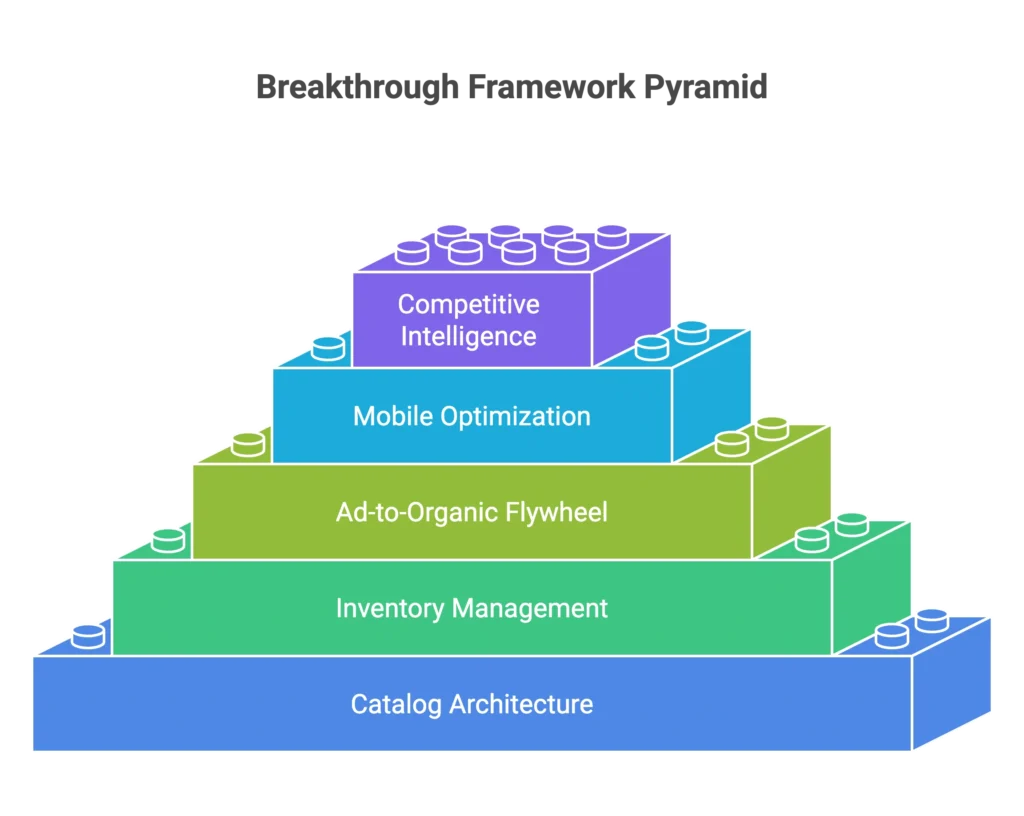
The 5-System Breakthrough Framework
System 1: Catalog Architecture That Scales
Amazon ranks each product variation separately, which most sellers completely misunderstand. I learned this lesson working with a clothing company that was stuck in perpetual stockout cycles. They had multiple colors and sizes, but when their best-performing variation sold out, their entire listing crashed—despite having other variations in stock.
The solution required restructuring their catalog architecture with strategic parent-child relationships that consolidated reviews while maximizing discoverability. We also implemented variation-specific inventory forecasting because treating all colors and sizes as interchangeable was killing their rankings.
Your backend structure needs to support both PPC discovery and organic ranking signals to overcome the common Amazon private label plateau. This means strategic keyword placement based on search intent, proper categorization that aligns with Amazon’s browse tree guide, and mobile-first optimization since most purchasing decisions happen in five seconds or less on mobile devices. If you fail to synchronize these technical elements, your brand’s growth will likely hit an Amazon private label plateau despite having a quality product.
System 2: Strategic Inventory Management
Stock levels aren’t just about avoiding stockouts—they directly impact your organic rankings and ad eligibility. Amazon wants predictable, reliable inventory partners, not brands that disappear for months then suddenly reappear.
I recommend maintaining 60-90 days of inventory because running low triggers Amazon’s risk-averse algorithms. When stock gets thin, Amazon stops distributing your products evenly across fulfillment centers. This creates a cascading problem: customers in some regions see longer shipping times, conversion rates drop, and Amazon interprets this as reduced customer satisfaction.
The clothing client I mentioned earlier was losing millions in potential revenue because they treated inventory as a cost center instead of a ranking strategy. We implemented air freight for critical restocks, which initially hurt margins but created the consistency Amazon rewards with better organic positioning.
System 3: The Ad-to-Organic Flywheel
The goal of Amazon advertising should be building organic strength, not permanent dependency. I use a systematic approach that measures true organic lift through Search Query Performance analysis rather than vanity metrics like impressions or clicks.
When I turned off ads on my clothing brand after building strong organic positions, sales actually increased in some cases because the organic conversion rate was higher than ad-driven traffic. This isn’t magic—it’s the result of strategic ad spend that builds genuine ranking momentum rather than artificial visibility.
The key is understanding which keywords drive organic ranking improvements versus which ones just generate expensive clicks. Search Query Performance reports reveal this data, but most sellers never analyze it systematically. We track organic keyword progression independent of ad spend to measure true ecosystem health.
System 4: Mobile-First Optimization Psychology
Most Amazon optimization advice was written when desktop shopping dominated, but today’s reality demands mobile-first thinking. Your title, images, and bullet points need to convert within seconds on a small screen with limited attention spans.
I’ve restructured hundreds of listings around mobile psychology: lead with emotional benefits in titles, sequence images for thumb-scrolling behavior, and structure bullet points for scan-reading. The difference in conversion rates between mobile-optimized and traditional listings can be 20-30% or more.
Backend optimization has become even more critical as Amazon expanded character limits in fields most sellers ignore. We regularly audit Category Listing Reports to catch hidden issues that destroy performance, like incorrect browse nodes or missing attributes that Amazon’s algorithms fill incorrectly.
System 5: Competitive Intelligence and External Traffic
The most successful brands I work with don’t just optimize their own listings—they systematically monitor competitor weaknesses and time their aggressive moves around competitor stockouts or ranking drops.
External traffic through Amazon Attribution and Brand Referral Bonus programs can amplify organic ranking signals, but only when integrated properly with your existing Amazon strategy. The math has to work: external traffic costs need to factor in the Brand Referral Bonus and long-term organic ranking improvements, not just immediate conversion rates.
Case Study: From $3M to $24M in 24 Months
Let me walk you through the most dramatic transformation I’ve documented. A clothing company came to me stuck in destructive stockout cycles that were destroying their momentum every few months.
The Initial Problem: This company treated their color variations like interchangeable inventory. When their best-selling color sold out, they’d simply promote another color, not understanding that Amazon’s algorithm treats each variation as a separate entity for ranking purposes. Their top-performing variation would crash from page one to page ten overnight, taking the entire listing’s momentum with it.
The Strategic Intervention: We implemented the complete 5-System Framework, starting with catalog restructuring and inventory forecasting by individual variation. The hardest part was convincing them to invest in air freight to prevent stockouts, even though it initially hurt per-unit margins.
The Results: Over 24 months, revenue grew from $3M to $24M annually. More importantly, they achieved this growth while building organic strength that reduced their advertising dependency. What started as a crisis became their competitive advantage because we solved the root cause instead of treating symptoms.
The key insight: they were willing to sacrifice short-term margins for long-term organic dominance. Most sellers aren’t willing to make this trade-off, which is why they stay stuck at the plateau.
Breaking Free from the Amazon Hamster Wheel
The $100K/month plateau isn’t a revenue problem—it’s a systems problem. While most sellers focus on adding more products or spending more on ads, successful brands focus on building organic dominance through systematic optimization of every element that drives Amazon’s ranking algorithm.
The Implementation Reality: Breaking through the plateau typically takes 6-12 months when implementing the complete system approach, compared to years of struggle with fragmented tactics. The timeline depends on your existing catalog structure and inventory position, but the framework is consistent.
The Investment Mindset: This isn’t just about monetary investment—it’s strategic commitment to building organic dominance rather than ad dependency. Most successful scaling requires reinvesting profits into inventory depth and strategic air freight for consistency.
The Measurement Framework: You’ll know you’re succeeding when your TACoS trends downward while maintaining growth, organic keyword rankings improve independent of ad spend, and sales remain strong during ad pause periods.
The difference between sellers who break through and those who stay stuck isn’t access to secret tactics or unlimited budgets. It’s understanding that Amazon rewards brands that treat the platform as an integrated ecosystem rather than a collection of isolated tactics.
The Opportunity: Right now, while most sellers are stuck in the ad-spend hamster wheel, there’s a massive opportunity for brands willing to implement systematic organic growth strategies. The sellers who make this shift in the next 12 months will dominate their categories for years to come.
The framework exists. The case studies prove it works. The only question is whether you’re ready to stop treating Amazon like a collection of tasks and start building it like the ecosystem it actually is. Your future self—and your profit margins—will thank you for making this shift before your competitors figure it out.
Ready to break through your revenue plateau? The systematic approach to Amazon growth isn’t about spending more or launching more products—it’s about building sustainable organic dominance that makes advertising optional, not essential.

