 Skip to content
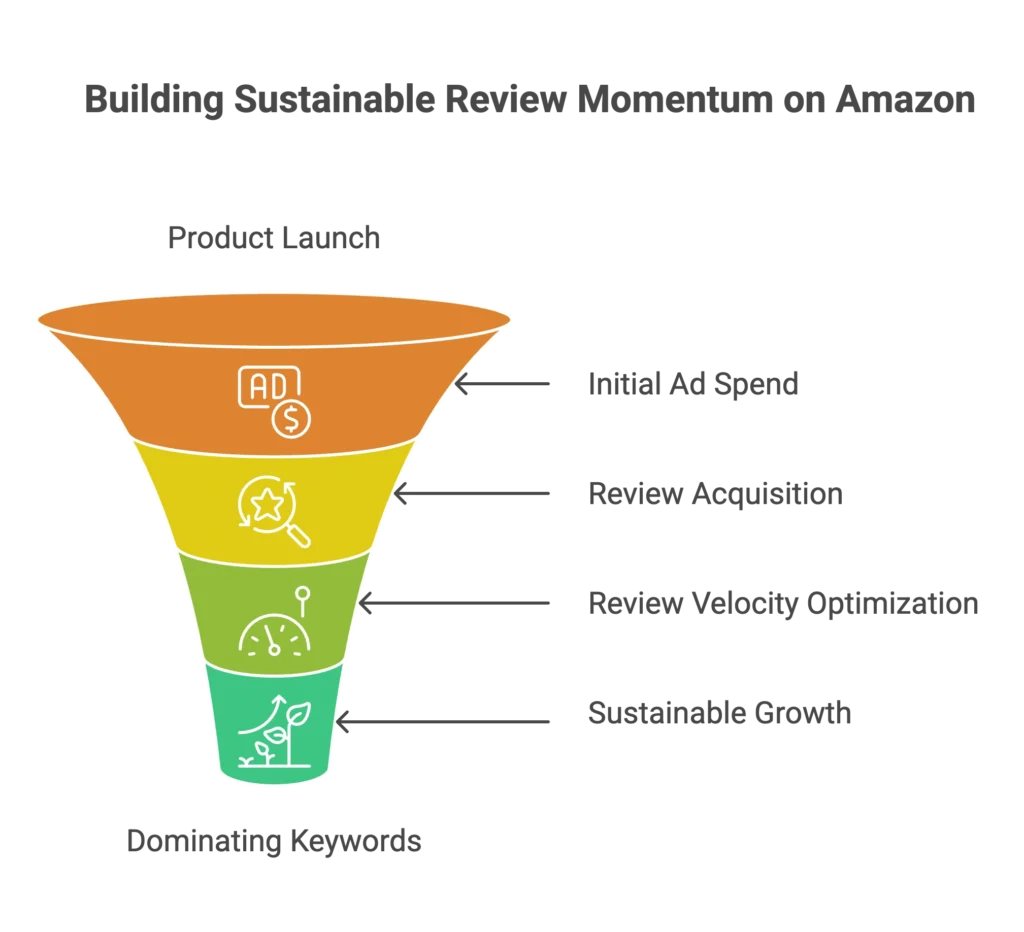
Most Amazon sellers are stuck in the same deadly trap: launching products with zero reviews, burning thousands on ads for listings that never convert, then watching helplessly as competitors with better Amazon review velocity dominate their keywords. They focus on traffic when they should be focusing on trust and momentum.
After 12 years of building Amazon brands and managing accounts, I’ve seen this pattern destroy promising products countless times. Sellers either move too slow on reviews and get buried by competitors, or they move too fast and trigger Amazon’s increasingly sophisticated review manipulation detection. Understanding why your Amazon listing is failing usually comes down to this imbalance between aggressive growth and platform compliance.
There’s a science to building review momentum—what I call “review velocity optimization.” It’s not about gaming the system or buying fake reviews (which will destroy your business). It’s about understanding the Amazon review velocity ecosystem and using their own tools—Request-a-Review, Amazon Vine, and compliant customer service—to build sustainable review momentum that compounds over time. When you master these internal levers, you create a natural increase in Amazon review velocity that signals to the algorithm that your product is a high-quality, trusted choice for customers.
This isn’t theory from a consultant who’s never sold on Amazon. I’m currently building my own brands while managing clients—my main clothing listing hit $400,000 in monthly sales recently, with ads turned off and prices raised. I practice what I preach, in real-time.
Why Review Velocity Matters (And Why Most Sellers Get It Wrong)
The Conversion Reality Check
Reviews don’t just provide social proof—they’re the foundation of Amazon’s conversion algorithm. I’ve seen people advertising listings with 4-star reviews, essentially spending thousands on ads to show customers how bad their product is.
Here’s what 12 years of experience has taught me: 200 reviews at 4.5 stars will outperform 10,000 reviews at 4 stars every single time. When people see that half-star missing, they visualize a defect with the product. You can clearly see the difference in conversion rates and ACoS between a listing with 4.5 stars filled out versus 4 stars.
The Velocity vs Volume Misconception
Most sellers focus on total review count instead of consistent review flow. The real game is different—Amazon rewards listings that maintain steady, authentic review momentum, especially during the critical honeymoon period.
I recently relaunched the same clothing product I was selling 12 years ago. Within the first two months, we went from zero to $15,000 in month two, then $60,000 in month three—with minimal ads. That’s the power of proper velocity during launch.
What Amazon Actually Rewards
Amazon rewards listings that maintain strong conversion rates and fast shipping. Reviews directly impact these metrics by building buyer confidence, which increases conversion rates, which improves organic visibility. It’s a compounding effect.
But here’s where most sellers mess up: they don’t understand that inventory distribution affects review opportunity volume. I had stock recently, but Amazon couldn’t promise fast delivery in all regions because some sizes weren’t distributed properly across warehouses. Customers saw 4-5 day delivery times, which lowered conversions and ultimately stalled my Amazon review velocity—proving that poor organic rank often has nothing to do with shutting off ads.
The Compliance-First Foundation (Read This Before You Do Anything)
Amazon’s Review Policy Red Lines
Before we talk strategy, let’s talk survival. I know sellers who were doing over $100 million that got suspended for reviews. Amazon doesn’t care—if one seller goes down, another takes their spot with a very similar product. Amazon’s not losing money.
Here’s what will destroy your business:
- Incentivized reviews in any form
- Biased language in review requests
- Multiple requests per order
- Off-platform review solicitation
- Product inserts asking for specific star ratings
The Real Cost of Policy Violations
When Amazon catches fake reviews, they suspend the account and hold funds. Then they tell you: “If you want us to reactivate your account and release your funds, provide us with a list of everyone you purchased reviews from.”
If you’re smart, you comply. But now Amazon has a list of incentivized reviews, and they check what else those reviewers reviewed. It’s a domino effect—everyone gets nailed eventually. I’ve seen people get caught years later.
The Policy Framework You Must Follow
Amazon’s Customer Reviews Policy has zero tolerance for manipulation. Their Communication Guidelines state that proactive messages must be sent within 30 days of order completion. These aren’t suggestions—they’re the boundaries of your business survival.
The 4-Lever Review Velocity Framework
Lever 1: Strategic Launch Pricing + Amazon Vine
My proven strategy with Vine: always enroll at a lower price. Here’s why most people get this wrong—Vine reviewers are reviewing for the shopper, evaluating value perception.
If you have $30 headphones but price them at $50 during Vine enrollment, reviewers will say “This is something I’d expect to pay $15 for.” But if you start at $15 and they’re getting it free anyway, you’ll get 5-star reviews saying it’s great value.
The requirements:
- Brand Registry (non-negotiable)
- Owner permissions if you’re not the brand owner
- Current cost: $200 per parent ASIN
If you can’t enroll in Vine, I feel bad for you. You’ll spend thousands advertising a listing with no reviews—it’s a killer waste of money. Get one bad review as your first review, and it’s over.
Lever 2: Request-a-Review Automation
Use Amazon’s Request-a-Review button for every order. You can do this manually, but that’s crazy. Get extensions that automatically request reviews on all your orders within Amazon’s 30-day communication window.
The key is one request per order, timed 5-30 days after delivery. Never multiple requests—Amazon tracks this. It’s not hard to get reviews legally these days if you follow their system.
Lever 3: Customer Service Integration
You can have warranty cards where if people have issues, they reach out to you for immediate resolution. But you have to be careful—you can’t tell them “I’m refunding you but leave me a review.”
Gemini said
The strategy: excellent customer service that resolves problems before they become negative reviews. When someone takes the time to scan your QR code and email you about a broken product, they were probably angry enough to leave a bad review. Resolve their issue properly, and they often become your best reviewers, saying things like “Great customer service, took care of me immediately.” This high-touch support is the most sustainable way to protect your Amazon review velocity during a product launch. By turning a potential complaint into a success story, you ensure that your Amazon review velocity stays positive and reflects the true quality of your brand.
Lever 4: Inventory Distribution Optimization
This is where most sellers lose without realizing it. Maintain 90-day stock levels across Amazon’s fulfillment centers. If Amazon can’t promise fast delivery in all regions, your conversion rate drops, which hurts organic ranking and reduces review opportunity volume.
Stock distribution matters more than most people realize. Even with inventory, if Amazon can’t distribute it properly to promise 1-2 day delivery everywhere, you’ll see conversion rate drops that kill your velocity.
Amazon Vine Deep Dive: When and How to Use It
Vine Requirements and Strategy
To qualify for Vine, you need Brand Registry and owner permissions. For people with exclusive distribution rights, it’s annoying because you have to ask the brand owner for permissions.
Current cost is $200 per parent ASIN. When you enroll, put it at a very aggressive price—even though reviewers get it free, they’re still evaluating value for other shoppers. You want bulletproof 5-star reviews during launch.
I’ve seen people launch products, enroll in Vine at regular price, get one bad review, and it’s a disaster. Now they have to advertise bad reviews to get sales while waiting for good reviews to come in.
When Vine Makes Sense
Vine should be the strategy for every new item launch, especially during the honeymoon period. The $200 cost is nothing compared to spending thousands on ads for a listing with no reviews.
Recent platform changes have affected newer ASINs created after certain dates, but even if you’re only enrolling 30 units in Vine, you’re giving them away anyway—might as well get the reviews.
Operational Excellence for Sustainable Velocity
Launch Strategy Integration
My complete launch strategy combines all elements: start at a very low price where you’re getting many sales (this builds organic rank for keywords as an investment in your listing), enroll in Vine at that low price to achieve healthy Amazon review velocity, then use Request-a-Review on all those sales you’re generating. By aligning aggressive pricing with automated follow-ups, you create a feedback loop that sustains high Amazon review velocity and pushes your listing ahead of stagnant competitors.
You’ve got to build it up quick on Amazon. You can’t go slow—there are competitors working harder than you to do it faster, and it’s very hard to catch back up once they speed past you.
Timing and Automation
Set up event-based automation: delivery confirmation triggers appropriate delay periods, then one compliant request per order. Use Amazon’s tools or compliant extensions—never manual processes that invite human error.
The 5-30 day post-delivery window is your sweet spot for response rates while staying within Amazon’s communication guidelines.
Customer Service SOPs
Train your team on rapid issue resolution. When someone contacts you about a problem, resolve it immediately. These customers often become your best organic reviewers because they experienced excellent service recovery.
But remember—you can’t incentivize or directly ask for reviews in exchange for problem resolution. The reviews come naturally from satisfied customers.
Monitoring and Risk Management
Velocity Anomaly Detection
Watch for patterns that look unnatural: sudden review spikes, unusual reviewer behavior, or competitive attacks claiming fake reviews. Amazon’s enforcement is getting more sophisticated, and they actively monitor for manipulation.
Stay plugged into the Amazon ecosystem—I’m constantly in group chats with big sellers, watching YouTube podcasts for updates. You need to know about policy changes, enforcement patterns, and platform updates before they affect your business.
Platform Changes and Adaptation
Amazon’s interface changes regularly. The legacy Customer Reviews monitoring area is being deprecated—you need backup monitoring systems. Stay current on:
- Seller Central UI changes
- Policy interpretation updates
- New enforcement patterns
- Fee structure changes
The Long-Term Velocity Strategy
Beyond Launch Period
Maintaining momentum after the honeymoon period requires consistent execution across all four levers. My current brand maintains strong sales with ads turned off because we built that foundation properly during launch.
Focus on fewer listings with dominant performance rather than spreading resources across many mediocre products. I work with clients on 5 parent ASINs maximum—we go deep rather than wide.
Scaling Across Your Catalog
Use successful listings to support new launches. Build brand-level review momentum by consistently delivering excellent products and customer service across your catalog.
The goal isn’t hundreds of listings—it’s dominant positions in your core categories. Better to have one listing doing $400K/month than 20 listings doing $20K each.
Your Next Steps
Building Amazon review velocity that survives algorithm changes, policy updates, and competitive pressure isn’t about shortcuts—it’s about precision execution within Amazon’s framework. When you focus on a sustainable strategy, you ensure that your Amazon review velocity becomes a compounding asset that drives long-term organic ranking and customer trust.
The strategies I’ve shared aren’t theory. They’re the exact methods I use for my own brands and select clients. When you build it correctly—following Amazon’s rules while maximizing their tools—you create a level of Amazon review velocity that carries your listings even when you reduce ad spend. This momentum is what separates a flash-in-the-pan product from a long-term brand.
Ready to build review momentum that drives sustainable growth? This framework works, but execution matters. If you’re serious about long-term Amazon success and want to apply these strategies to your brand, let’s discuss how we can work together.
The difference between sellers who build lasting businesses and those who burn out isn’t access to information—it’s proper execution of proven systems. Choose your path wisely.

