 Skip to content
Every year, Amazon changes its interface. New tools emerge. “Gurus” announce algorithm updates. But after 12 years of selling on Amazon—building multiple listings that do over $1 million annually—I’ve learned something most sellers miss: The fundamentals never change. These core Amazon success principles are the bedrock of any business doing $400,000 per month, serving as the “north star” when regional ranking drops or logistics glitches happen.
While everyone chases the latest hack or worries about “A9 vs A10,” successful sellers focus on principles that have worked since Amazon’s early days. These aren’t theories from someone who’s never run their own listings. These are battle-tested strategies I’ve used to build brands from scratch and help clients achieve sustainable organic growth.
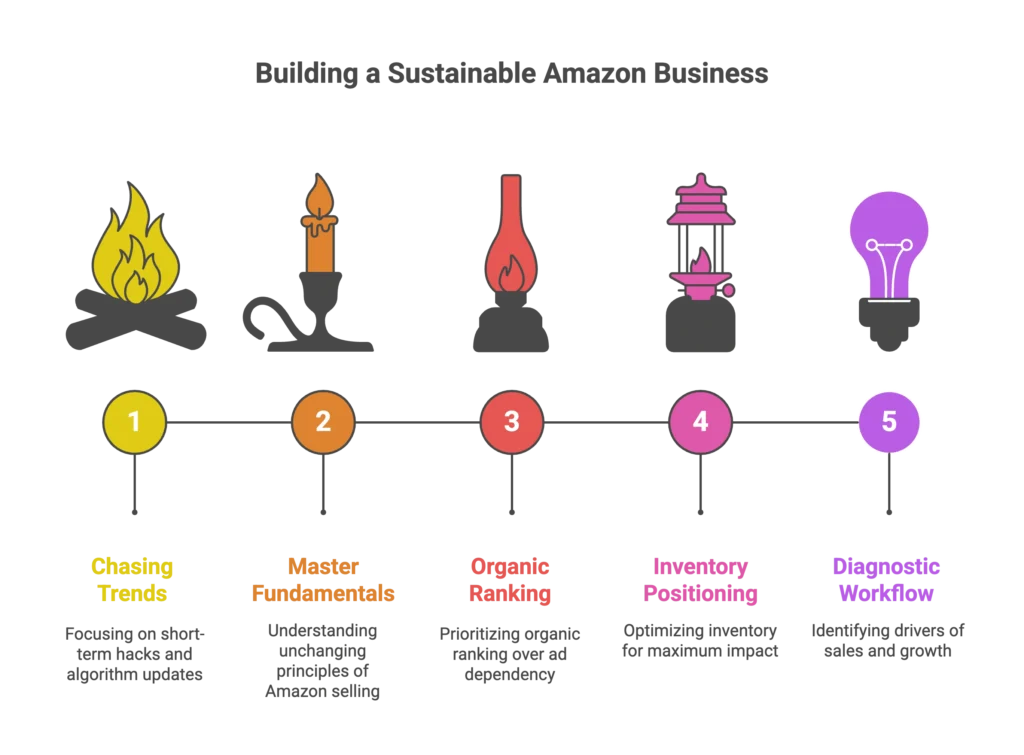
In this guide, you’ll discover the unchanging fundamentals that separate million-dollar listings from struggling accounts. You’ll learn why organic ranking beats ad dependency, how inventory positioning affects everything, and the exact diagnostic workflow I use to identify what’s actually driving sales.
This isn’t about quick wins. It’s about building a business that grows stronger over time.
The Reality Check: Why Most Amazon Strategies Fail
Most Amazon advice focuses on tactics, not principles. Sellers get caught in endless cycles of chasing new “algorithm secrets” every few months, throwing money at ads without understanding their true purpose, managing dozens of mediocre listings instead of building dominant ones, and reacting to ranking drops instead of preventing them. To scale to a $400,000 per month brand, you have to pivot toward core Amazon success principles that prioritize structural health over short-term “hacks.”
The Problem: Amazon isn’t just another sales channel. It’s an ecosystem where every element—from inventory positioning to backend keywords—works together.
I’ve seen manufacturers with strong retail businesses fail on Amazon because they treated it like wholesale distribution. I’ve watched established sellers plateau because they confused busy work with strategic work. The solution starts with understanding what actually drives long-term success.
The 5 Amazon Success Principles That Never Change
Principle 1: Organic Ranking is Everything
Amazon isn’t Google Ads. It’s a ranking game disguised as an advertising platform.
Here’s what I mean: When you advertise on Google, you pay for every click. When you stop paying, traffic stops. On Amazon, ads should build organic ranking so you eventually spend less on ads over time.
From my own experience: I recently went 90 days with zero ad spend on one of my main listings. Sales not only continued—they grew. Why? Because the ads had done their job: they built sustainable organic ranking.
The diagnostic: Track organic units alongside total units. If organic sales aren’t growing, your ads aren’t working—they’re just buying temporary visibility.
Key insight: Each child ASIN (size, color, variation) ranks independently. If your best-selling variation goes out of stock, Amazon doesn’t automatically promote another. You lose that ranking position entirely.
Principle 2: Inventory is Your Foundation
Most sellers treat inventory as an afterthought. But on Amazon, inventory positioning affects conversion rates, search visibility, and organic ranking more than most people realize.
The 60-90 Day Rule: I maintain 60-90 days of inventory for every variation. Why? Because when you drop below 30 days, Amazon’s algorithm deprioritizes your listing. They can’t promise fast shipping to all regions, which kills conversion rates.
What happens with low inventory:
- Amazon doesn’t distribute stock across all fulfillment centers
- Some customers see 5-day shipping while others see 2-day
- Lower conversion rates signal Amazon to show competitors instead
- Your organic ranking drops even if you’re not technically “out of stock”
The hidden cost: When one variation sells out, the entire parent listing loses momentum. I’ve seen accounts lose thousands in monthly revenue because one size went out of stock.
Principle 3: Retail Readiness Beats Everything
Amazon rewards listings that behave like profitable retail products. This means having a perfect listing foundation built on core Amazon success principles: a title optimized for both search and conversion, images that tell a complete story, and backend keywords that fill every available character. Beyond the aesthetics, you must ensure proper category and browse node classification, as these Amazon success principles dictate whether the algorithm even gives you a chance to compete in your target niche.
Price Strategy: During the honeymoon period (first 90 days), start with aggressive pricing. Amazon needs to see high conversion rates to build organic ranking. You can raise prices later.
Review Strategy: When enrolling in Amazon Vine, set prices low even though items are free. Vine reviewers judge value perception, not just product quality.
Principle 4: Strategic PPC Integration
Most sellers run ads to generate sales. Smart sellers run ads to build organic ranking.
The difference: If your sales drop the moment you turn off ads, you’re paying rent, not building equity.
My approach:
- Use ads to push specific keywords during honeymoon period
- Track organic rank improvement, not just ACOS
- Higher ACOS is acceptable if it’s building long-term ranking
- Scale back ads gradually as organic strength improves
Real example: One client achieved 7% TACOS on $700,000 in 14-day sales because we focused on organic ranking first, ad efficiency second.
Principle 5: Systematic Diagnostics
You can’t improve what you don’t measure. Amazon provides massive amounts of data, but most sellers don’t know how to use it.
Weekly Diagnostic Process:
- Organic Unit Tracking: Are organic sales increasing?
- Keyword Position Monitoring: Which keywords are climbing?
- Inventory Distribution Check: Is stock spread across fulfillment centers?
- Conversion Rate Analysis: Where are customers dropping off?
- Backend Audit: Any unauthorized Amazon changes?
Tools that matter: Amazon’s own Search Query Performance (SQP) and Brand Analytics provide better insights than most third-party tools.
Building Your Amazon Diagnostic System
Creating a weekly diagnostic routine separates professional sellers from casual ones.
Track What Amazon Tracks
Amazon cares about Amazon success principles like conversion rates by keyword, inventory availability and distribution, session duration and click-through rates, and customer satisfaction metrics.
Focus on these metrics weekly:
- Organic units vs. total units
- Search rank for target keywords
- Inventory levels by child ASIN
- Sessions and session conversion rate
Use Amazon’s Native Tools
Search Query Performance (SQP): Shows exactly which search terms drive traffic and how they convert.
Brand Analytics: Reveals market share data and competitor insights.
Category Listing Report: Identifies backend errors that kill performance.
Inventory Ledger: Shows stock distribution across fulfillment centers.
Create Action Triggers
Set up automatic alerts for inventory dropping below 45 days, organic rank drops of 5+ positions, conversion rate decreases of 10%+, and any backend listing changes.
The Retail Readiness Checklist
Before launching any product or optimizing existing listings, audit these elements:
Catalog Foundation
- Proper item type keyword selection
- Browse node accuracy verified with Browse Tree Guide
- All backend search terms fields maximized
- Category classification optimized for search volume
- Variation relationships properly structured
Content Optimization
- Title includes primary keywords naturally
- Bullet points answer customer questions
- Images tested for click-through rate
- A+ Content tells complete product story
- Mobile experience optimized (60%+ of traffic)
Operational Excellence
- 60-90 days inventory for all variations
- Competitive pricing during launch period
- Amazon Vine enrollment at strategic price point
- Review acquisition system in place
- Customer service response process established
Performance Monitoring
- Keyword tracking system implemented
- Organic vs. paid sales separation
- Weekly diagnostic schedule created
- Inventory alert system activated
- Conversion rate monitoring established
Common Amazon Myths Debunked
Myth 1: “The A10 Algorithm Changed Everything”
Reality: Amazon has never officially confirmed “A9” or “A10” as algorithm names. These are industry terms that create more confusion than clarity.
What matters: Focus on what you can measure and control—conversion rates, inventory levels, customer satisfaction—not alleged algorithm changes.
Myth 2: “More Listings = More Sales”
Reality: I’d rather have five listings doing $1 million each than 100 listings doing $50,000 each.
Why: Dominant listings get better treatment from Amazon’s algorithm, higher organic visibility, and require less management overhead.
Myth 3: “Backend Errors Don’t Matter”
Reality: Amazon frequently makes unauthorized changes to your listing backend. These “small” changes can destroy performance.
Example: A client lost 40% organic traffic when Amazon automatically changed their item type keyword. The listing looked identical, but Amazon stopped showing it for relevant searches.
Myth 4: “Low ACOS is Always Good”
Reality: During launch periods, higher ACOS that builds organic ranking beats low ACOS that generates no long-term value.
The test: If turning off ads kills your sales, your ACOS optimization isn’t building real value.
Advanced Strategies for Sustainable Growth
The Honeymoon Period Maximization
First 30 Days: Aggressive pricing, maximum ad spend on target keywords, rapid inventory deployment.
Days 31-60: Monitor organic ranking improvements, adjust pricing gradually, optimize based on early data.
Days 61-90: Scale successful keywords, reduce spend on non-converting terms, prepare for post-honeymoon strategies.
Key insight: The honeymoon period isn’t binary. It gets harder over time, but doesn’t disappear completely. Even year-old listings can be “refreshed” with proper strategy.
Inventory Distribution Mastery
The problem: Amazon’s fulfillment centers aren’t evenly distributed. Your inventory might sit in one location, creating shipping delays for distant customers.
The solution: Monitor fulfillment center distribution weekly. When possible, send inventory to multiple centers during initial shipments.
Advanced tactic: Use inventory placement fees strategically during peak seasons to ensure nationwide availability.
Backend Optimization That Actually Works
Item Type Keywords: Must match your category exactly. Use Amazon’s Browse Tree Guide to verify.
Search Terms: Fill every character limit. Amazon expanded these in 2025, but many sellers haven’t updated.
Intended Use: Often overlooked, but affects which searches Amazon shows your product for.
Monthly audit: Amazon’s bots frequently change backend fields. Regular audits prevent silent performance kills.
Frequently Asked Questions
How long does it take to see results from organic ranking strategies?
During the honeymoon period (first 90 days), you can see significant ranking improvements within 2-4 weeks with proper execution. One of the core Amazon success principles is capitalizing on this early-stage velocity to signal relevance to the algorithm. For established listings, expect 4-8 weeks for meaningful organic growth, as the machine requires more consistent data to justify a rank shift. Mastery of these Amazon success principles—patience and data-driven execution—is what separates long-term winners from those who chase short-term hacks.
The key is consistent execution across all elements—inventory, pricing, ads, and listing optimization—not just one tactic.
Should I focus on FBA or FBM for better ranking?
FBA generally provides better organic ranking because Amazon can guarantee faster shipping. However, I’ve seen strategic FBM usage (like Seller Fulfilled Prime) provide significant advantages for specific product types; this flexibility is one of the core Amazon success principles that top-tier sellers use to bridge the gap when FBA logistics fail.
The best approach often combines both: FBA for main inventory, FBM/SFP as backup during stockouts or for oversized items.
How do I know if my ads are building organic ranking?
Track these metrics weekly to ensure you are following core Amazon success principles: organic units increasing while maintaining ad spend, search rank improving for advertised keywords, total ACOS decreasing over time as organic grows, and sales maintaining when you reduce ad spend. By mastering these Amazon success principles, you move from simply “buying” customers to owning a high-authority listing that ranks on autopilot.
If ads aren’t building organic ranking, you’re essentially paying rent for temporary visibility.
What’s the biggest mistake manufacturers make when entering Amazon?
Treating Amazon like wholesale distribution. They upload basic listings, set wholesale prices, and expect sales to happen automatically.
Amazon requires retail-level optimization: SEO-focused titles, conversion-optimized images, competitive pricing, and strategic advertising. You’re competing against brands that treat Amazon as their primary channel.
How important is the honeymoon period really?
Critical, but not the end of the world if you miss it. I’ve successfully relaunched year-old listings by treating them like new products: aggressive pricing, inventory optimization, and strategic ad spend.
The honeymoon period is the easiest time to build ranking, but it’s not the only time. It just gets progressively harder.
Building Long-Term Amazon Success
Amazon success isn’t about finding shortcuts or gaming the system. It’s about understanding the platform’s fundamental principles and executing them consistently.
The reality: Most sellers fail because they focus on tactics instead of strategy. They chase algorithm rumors instead of focusing on what they can control.
The opportunity: While everyone else worries about the latest “hack,” you can build sustainable competitive advantages by mastering the fundamentals.
Your next steps:
- Audit your current listings against the retail readiness checklist
- Implement weekly diagnostic tracking
- Optimize inventory management for 60-90 day coverage
- Align your ad strategy with organic ranking goals
- Focus on building fewer, stronger listings
Remember: Amazon rewards businesses that think long-term. Build your account like you plan to dominate your category for years, not months.
Hymie Zebede has been selling on Amazon for 12+ years, building multiple listings that generate over $1 million annually. He currently manages client accounts while building his own brands, applying the same strategies he teaches to his own business. His boutique firm focuses on organic ranking and sustainable growth for manufacturers, wholesalers, and established Amazon sellers.

