 Skip to content
Day 90. Still at $0 in ad spend. Still ranking. Still selling.
New to this? Start with what organic ranking on Amazon actually is — then come back here for how paid and organic feed each other.
Not gonna lie—this one feels good. I paused all my ads exactly on November 27th. Today marks 90 days with zero ads, and I’m watching organic momentum do all the heavy lifting on my clothing brand. This is the ultimate proof of a successful Amazon Organic vs PPC strategy: when your organic foundation is built correctly during the launch phase, the algorithm continues to reward you with top-tier rankings even after the ad spend stops. It’s about building a brand that survives without the “ad spend hamster wheel.”
Most Amazon sellers are trapped in an expensive hamster wheel, throwing money at ads while their organic rankings stay flat. They’ve been sold a lie: that Amazon is just a pay-to-play advertising platform where you need to keep feeding the machine to survive.
But here’s the truth after 12+ years of building and selling Amazon brands: If you have to keep feeding ads to make sales, you’re not growing. You’re paying rent.
The Wrong Equation That’s Costing You Everything
Most sellers think the equation is: Ads = Sales.
That’s backwards.
The real equation is: Ads = Ranking.
If you’re constantly spending just to maintain sales, your ads aren’t actually working—they’re just buying you temporary placement. You’re paying Amazon rent for shelf space instead of building a business.
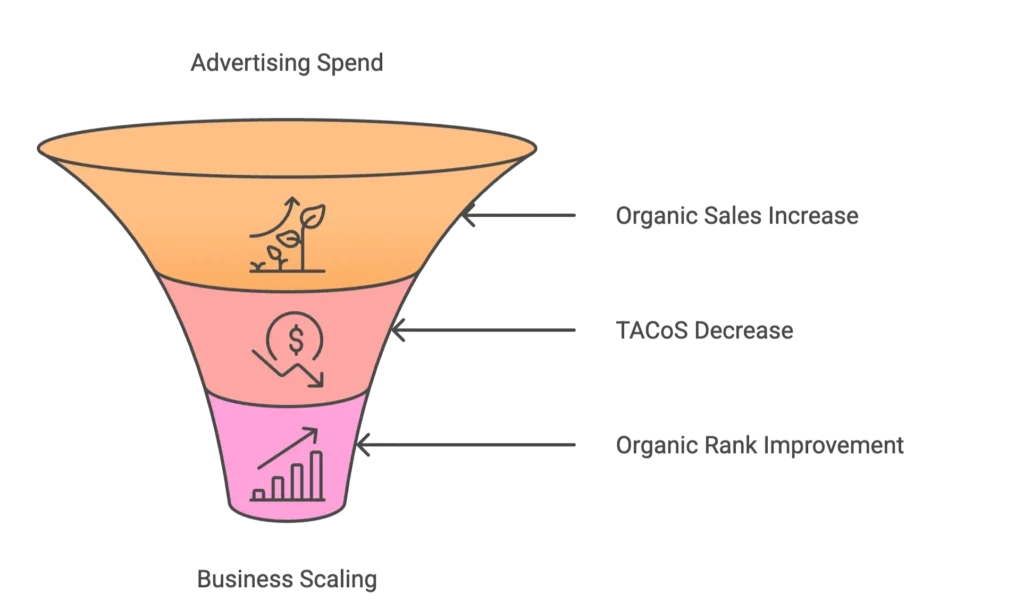
Here’s what changed everything for me: I stopped obsessing over ACoS and started tracking what really matters:
- Are organic sales increasing?
- Is TACoS decreasing?
- Is organic rank improving?
If the answer is no to any of these, you’re just spending—not scaling.
The Real Numbers: What 90 Days Without Ads Actually Looks Like
Let me show you exactly what happened when I turned off all advertising on my personal brand.
Background: This is a non-branded clothing item in a competitive category. Before shutting off ads, we spent heavily during the honeymoon period to build an organic foundation, recognizing that the long-term goal is a favorable ratio of Amazon Organic vs PPC sales.
The Results After 90 Days:
- Ranking Top 5 for competitive keywords with 200,000+ search volume
- Sitting at 4,000 BSR (was 15,000+ when ad-dependent)
- Thousands of organic sales—zero reliance on ads
- Profit margins nearly doubled with zero ad costs
But here’s the part that shocked everyone: my organic rankings didn’t just hold—they improved.
I was in 59th position for my main keyword when stock got low. As soon as inventory restocked and Amazon could show faster delivery times, conversions went up and I climbed back to top 10. Then I hit #1 for a 21,000 search volume keyword—with zero ad spend.
The “gurus” told me this wouldn’t work. They said shutting off ads would destroy my listing. But the numbers don’t lie.
Why Your Organic Strategy Is Probably Broken
Most sellers focus on the wrong metrics entirely. They chase low ACoS while missing the bigger picture.

Here’s what actually matters:
TACoS Should Be Decreasing Week After Week
Your Total Advertising Cost of Sales (TACoS) tells the real story. It doesn’t mean your ad spend needs to go down, but the percentage should be dropping as organic sales increase; tracking this metric is the only way to accurately measure your progress in the Amazon Organic vs PPC war, as it reveals whether your advertising is building a permanent asset or just a temporary spike.
I track this religiously. If TACoS isn’t decreasing over time, there’s a major issue with your listing or strategy.
Organic Sales Must Be Increasing Consistently
This is non-negotiable. If your organic isn’t growing week after week, you don’t have a business—you have an expensive hobby.
When I review accounts, the first thing I check is the Amazon Organic vs PPC sales ratio. If sellers can’t tell me where their sales are actually coming from, they’re flying blind.
Inventory Distribution Matters More Than You Think
Here’s something most sellers never realize: Just because you have inventory in FBA doesn’t mean Amazon is showing your product with two-day shipping.
If your stock isn’t properly distributed across fulfillment centers, customers in certain states see 4-5 day delivery times. That kills conversions and hurts your organic rank—even if you think you have “enough inventory.” This logistics failure forces you into a heavy reliance on Amazon Organic vs PPC spending just to maintain visibility, as the algorithm will stop awarding you “free” organic traffic in regions where you can’t fulfill the Prime promise.
I learned this the hard way. Some of my sizes weren’t completely out of stock, but Amazon didn’t have enough units to place them in every warehouse. Sales slowed until distribution improved, then rankings shot back up—this period of sluggishness is a prime example of how logistics directly affects the balance of Amazon Organic vs PPC, as poor distribution forces you to spend more on ads just to maintain the visibility that fast shipping usually provides for free.
The Strategic Framework: How to Use PPC to Build Organic Dominance
Let me break down exactly how I approach Amazon advertising—not as a revenue generator, but as a ranking tool.

Phase 1: Honeymoon Period Aggression (Days 1-90)
During launch, I spend aggressively—often 40-50% of projected revenue on PPC. Most sellers think this is crazy, but this is when Amazon is most willing to test your listing across hundreds of keyword variations.
The key metrics during this phase:
- Conversion rate improvement (target: 2-3% increase from baseline)
- Organic impression growth for target keywords
- Keyword ranking improvements (tracked daily with Helium 10)
Phase 2: Strategic Pullback (Months 4-6)
As organic rankings solidify, I gradually reduce PPC spend on keywords where we’ve achieved top 10 organic positions. This isn’t sudden—it’s a systematic 25% weekly reduction while monitoring performance to find the perfect equilibrium of Amazon Organic vs PPC sales.
If organic rankings drop more than 5 positions after reducing spend, I immediately restore previous budget levels.
Phase 3: Maintenance and Expansion
Once we’ve achieved organic dominance on primary keywords, PPC shifts to expansion—testing new keyword clusters, seasonal terms, and competitive positioning.
At this stage, we’re typically spending <15% of revenue on ads (vs industry average of 35-45%).
Case Study: How We Scaled a Client From $3M to $24M
Let me share a behind-the-scenes look at one of our most dramatic transformations.
The Problem: A clothing manufacturer stuck at $3M annually. They were burning through ad budget with zero organic growth, treating each size and color variation as separate when Amazon ranks them individually.
The Solution:
- Catalog Restructuring: Fixed parent/child relationships for algorithmic clarity
- Inventory Strategy: Implemented 60-90 day stock minimums across all variations
- Honeymoon Exploitation: Launched new variations with aggressive pricing + heavy PPC
- Systematic Transition: Gradually reduced ad dependency as rankings solidified
The Results:
- Year 1: $3M → $12M (300% growth)
- Year 2: $12M → $24M (100% growth)
- Current ad dependency: <15% of total sales
- Organic rankings: Top 10 for 200+ relevant terms
But here’s what really matters: this isn’t just about scale. It’s about building a sustainable business model that gets stronger every month instead of more expensive.
The Hidden Factors Most Sellers Miss
Stock Levels Impact Rankings More Than You Think

Amazon has specific stock thresholds that affect your visibility:
- Under 30 days: Amazon deprioritizes your listing in search results
- 30-60 days: Minimal fulfillment center distribution
- 60-90 days: Optimal distribution and ranking stability
- 90+ days: Storage fees increase but rankings remain strong
I like to maintain 90 days of inventory. If you have 90 days, you’re not overstocked, and you’re planning for growth. Worst case, sales stay the same and you have good coverage. Best case, you’re pushing sales and your 90 days becomes 45 days of actual inventory.
The 30-Day Stock Rule for Ad Management
Here’s a crucial insight from my personal brand experience: Whenever we’re down to 30 days or less on any ranked child ASIN, ads must be paused immediately.
Why? Because low stock impacts geo-ranking. Customers in different regions start seeing longer delivery times, conversion rates drop, and organic rankings suffer. It’s better to pause ads and preserve organic strength than to burn budget on poor-converting traffic; failing to make this distinction is a major factor in the shift of Amazon Organic vs PPC efficiency, as you’ll end up paying for clicks that never convert due to delivery friction.
Backend Keywords Are Still Underutilized
Amazon recently expanded character limits for backend search terms, yet most sellers haven’t touched theirs in months. These updates boost PPC performance, improve conversion rates, and strengthen organic rank.
It’s an easy win that most people ignore.
When the Strategy Breaks Down: Real Talk
Not every listing can achieve organic dominance. Here’s how to know if you’re fighting an uphill battle:
Product-Market Fit Red Flags
- Conversion rates consistently below category averages despite optimization
- Review acquisition slower than 1 review per 100 units sold
- High return rates or negative review themes around core functionality
- Inability to differentiate meaningfully from top 10 competitors
Category Saturation Warning Signs
- Top 10 competitors all have 1000+ reviews
- Average daily ad spend for top positions exceeds your monthly budget
- Price compression happening across the category
- Patent or trademark barriers preventing effective differentiation
Execution Failures
- Insufficient ad spend during honeymoon period (being “conservative” is expensive long-term)
- Premature optimization based on small data samples
- Inventory management creating ranking volatility
- Pricing strategies prioritizing short-term profit over long-term positioning
The Choice That Defines Your Amazon Future
Every day you stay trapped in the ad-dependency cycle, competitors are building organic moats that become exponentially harder to breach.
You have two choices:
Choice 1: Keep paying Amazon rent for shelf space. Watch margins compress as competition increases. Stay trapped where turning off ads means sales disappear.
Choice 2: Invest strategically in building organic dominance. Use PPC as a ranking development tool. Build a business that gets stronger and more profitable over time.
I just showed you 90 days of real proof that Choice 2 works. Zero ads, growing sales, improving rankings. My clothing brand is generating $400K monthly with zero ad spend while competitors burn budget just to maintain their positions.
The framework exists. The proof is in the screenshots I could share (if my team can get them from me). This isn’t theory—it’s real strategy that works when you stop playing Amazon like Google Ads and start treating it like the ranking ecosystem it actually is. Success depends on understanding the fundamental tension between Amazon Organic vs PPC and using one to fuel the other.
The Reality Check Most Sellers Need
If your sales collapse the second you turn off ads, you’re not building a business—you’re stuck in a pay-to-play cycle that only gets more expensive. This is the ultimate red flag in the struggle of Amazon Organic vs PPC, signaling that you haven’t converted your initial launch momentum into a self-sustaining organic engine.
Amazon rewards sustained performance, not just budget size. The brands dominating in 2024 aren’t the ones with the biggest ad budgets—they’re the ones who understood early that PPC is a tool for ranking, not a permanent crutch for sales.
Stop obsessing over ACoS. Start tracking TACoS, organic growth, and ranking improvements.
Stop treating Amazon like traditional retail. Start understanding it’s an algorithmic ecosystem that rewards strategic thinking over budget throwing.
Stop paying rent for shelf space. Start building organic dominance that compounds month after month.
The choice is yours. But remember—while you’re debating strategy, your competitors are implementing it.
And in Amazon’s ranking game, momentum is everything.
Ready to stop playing the wrong game? If you’re a manufacturer, wholesaler, or established Amazon seller tired of the ad-dependency hamster wheel, let’s talk about building real organic strength. I work with select brands who want to dominate their categories, not just survive in them.

How PPC Velocity Builds Organic Rank — and When It Stops Working
Most sellers treat PPC and organic as separate levers. They’re not. Amazon’s algorithm uses sales velocity as a primary ranking signal, and it doesn’t care much whether those sales came from a Sponsored Product ad or a search result. A conversion is a conversion.
Here’s the mechanic: when you win a keyword through a Sponsored Products campaign and drive consistent daily sales on that keyword, Amazon’s algorithm logs that keyword-to-purchase relationship. Do it long enough — typically 14 to 21 days of steady velocity — and your organic rank for that term starts to climb. This is why new launches front-load ad spend. The ads aren’t just buying immediate revenue; they’re buying rank data.
But the strategy breaks down in two specific situations sellers consistently miss.
Problem 1: Keyword Misalignment Between PPC and Organic
If your Sponsored Products campaigns run on broad or auto match, Amazon is capturing sales across dozens of search terms. Velocity gets diluted across all of them. No single keyword accumulates enough signal to move your organic rank meaningfully. The fix is tight exact-match campaigns on your 3 to 5 highest-intent keywords, with enough daily budget to generate 2 to 5 sales per keyword per day. That concentration is what triggers ranking movement.
Problem 2: The TACoS Trap
When you cut ad spend to improve TACoS, organic rank often follows it down — sometimes with a 2 to 4 week delay. Sellers see lower TACoS in week one, declare victory, then watch revenue drop in week three. The reason: the organic rank you built was being supported by the velocity PPC was generating. Remove the velocity, lose the rank. This is why TACoS optimization requires tracking organic position changes alongside ad spend changes, not just cost ratios.
How to Know If Your PPC Is Actually Building Rank
Pull your Search Query Performance report from Brand Analytics weekly. Filter to your top 5 exact-match PPC keywords. Track your organic rank position for each one separately from your sponsored rank. If organic rank is flat or declining while you’re spending heavily on PPC, one of three things is happening: your conversion rate is below category average, your sessions are diluted across too many match types, or your listing has a quality issue (images, bullets, price) suppressing CVR even when traffic lands.
Fix the CVR problem first. Ad spend on a listing converting at 8% when category average is 15% is money that builds rank slowly and loses money fast.
If you want a second set of eyes on where your PPC-to-organic flywheel is leaking, the free audit starts with exactly that analysis — TACoS trend, organic rank movement by keyword, and CVR against category benchmarks.
How PPC Spend Actually Moves Organic Position (The Mechanism Most Sellers Miss)
Here’s what the organic-vs-PPC debate usually skips: paid and organic don’t run on separate tracks. They share one input—keyword-level sales velocity—and Amazon’s ranking algorithm doesn’t much care whether a sale came from a Sponsored Products click or from an organic placement. A sale is a sale. The ranking signal is the same.
That means your PPC campaigns are either feeding your organic rank or they’re not. The difference comes down to which keywords you’re converting on and at what rate.
The Keyword-Level Velocity Rule
Amazon ranks ASINs for a keyword partly based on recent conversion velocity on that specific keyword. If your Sponsored Products campaigns are driving traffic to a listing that converts at 8% on the keyword ‘insulated water bottle 40oz’, that conversion history accumulates in the same pool that organic ranking draws from. Run the same spend on a broad match that scatters across 200 tangentially related terms, and each keyword gets a thin slice of velocity that moves nothing.
This is why sellers with $30k/month ad budgets sometimes rank worse than a competitor spending $8k: the $8k is concentrated on 12 exact-match terms the listing already converts well on. The $30k is spread thin across auto campaigns that haven’t been pruned in six months.
When PPC Stops Helping Organic (and Starts Masking the Problem)
There’s a threshold where PPC spend stops building organic rank and starts substituting for it. You can tell you’ve crossed it when your TACoS stays flat or rises even as ad spend increases. That pattern means paid is holding revenue steady while organic rank erodes—usually because conversion rate has dropped (listing quality issue) or because the velocity is going to keywords where you can’t sustain a top-3 organic position anyway.
The number to watch is TACoS trend over 90 days, not TACoS at a point in time. A TACoS declining from 18% to 12% over a quarter while revenue holds or grows means organic is genuinely improving. A TACoS stuck at 18% for three months means you’re running to stand still.
The Practical Split: How to Allocate Between Organic Work and Paid
The sellers who get this right typically run a two-bucket system:
- Rank-building bucket (60-70% of budget): Exact-match campaigns on 8-15 high-converting keywords. The goal is velocity accumulation, not immediate ROAS. Accept a higher ACoS here because the organic lift pays back over 60-90 days.
- Harvest bucket (30-40% of budget): Auto and broad campaigns with aggressive negative keyword hygiene. This is where you find new terms, but you harvest and promote winning keywords to the rank-building bucket within two weeks—or pause them.
Most sellers run only the harvest bucket, wonder why organic rank doesn’t move, and assume PPC and organic are separate. They’re not. The mechanism is just slower and less visible than a weekly ACOS report makes it look.
If you want a structured view of how this plays out across a full catalog, the PPC-for-organic-growth breakdown covers the campaign architecture in more detail. And if you’re unsure whether your current ad structure is building rank or just sustaining it, a free audit will show you which keywords are actually moving position and which ones are just keeping the lights on.

