 Skip to content
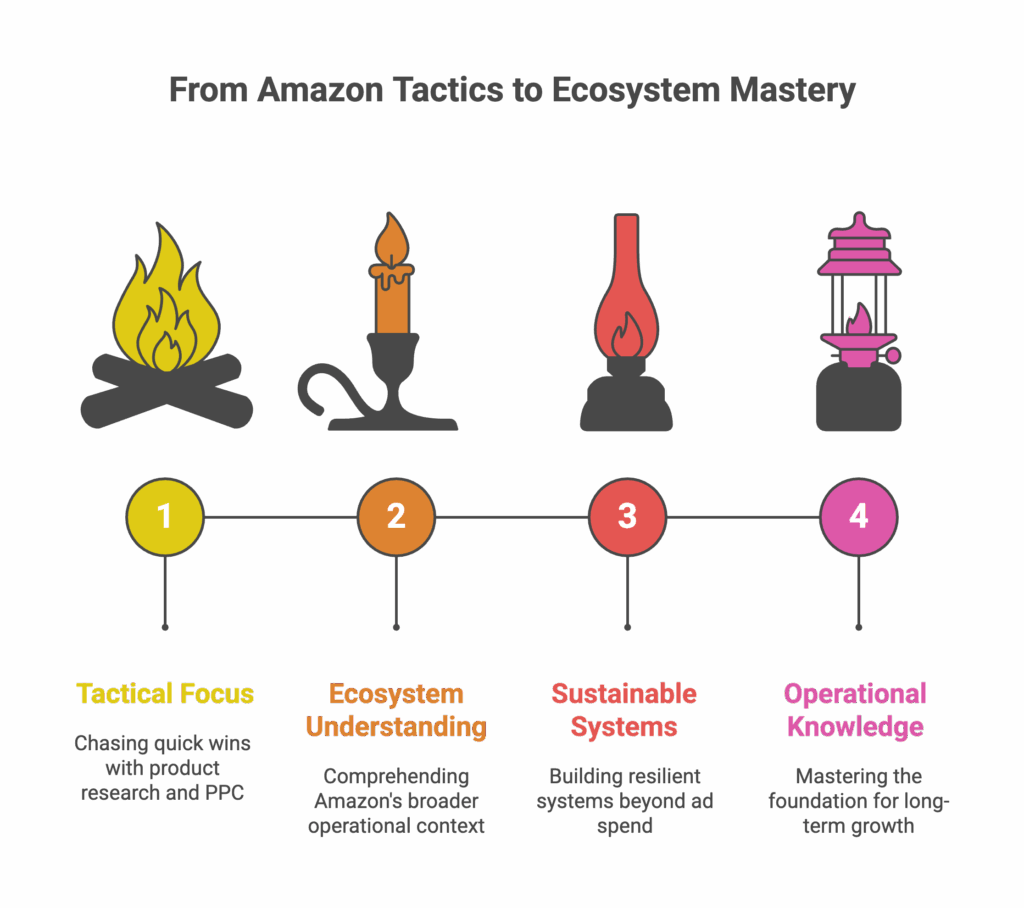
Most Amazon courses promise quick wins with product research and PPC tactics. But after managing accounts for over 12 years and building multiple brands, I’ve learned what separates sellers who plateau at $500K from those who scale past $5M: they understand Amazon’s ecosystem, not just its tactics.
The real Amazon seller education gap isn’t about finding hot products or optimizing ad spend. It’s about building sustainable systems—the core of effective Amazon seller education—that work when your ad budget runs out, when algorithm changes hit, or when you face an Amazon seller graveyard scenario due to flooding competitors.
This isn’t another “Amazon FBA guide” rehashing the same launch strategies. This is the foundation curriculum that traditional courses skip—the operational knowledge that determines whether you’re building a business or just renting sales from Amazon’s advertising platform.
The Hidden Curriculum: What Amazon Courses Actually Skip
Account Health Comes Before Everything Else
Here’s what no course tells you upfront: your Order Defect Rate (ODR) doesn’t just determine whether Amazon suspends your account. It directly impacts your Buy Box eligibility, which affects your organic visibility and sales potential.
Most sellers think account health is just about avoiding the dreaded suspension email. However, your Account Health Rating acts as a silent signal for Amazon seller education, dictating how much traffic the algorithm sends your way. A clean record isn’t just risk management—it’s a competitive advantage that directly affects your organic ranking potential. Investing in ongoing Amazon seller education regarding policy compliance ensures you aren’t throttled by hidden performance metrics that competitors ignore.
Policy compliance works the same way. While other sellers scramble to fix violations after they happen, understanding restricted product categories and compliance requirements upfront positions you to capitalize when competitors get flagged or suspended.
The Real Amazon Fee Structure Reality
Amazon courses love to show simple profit calculators: selling price minus product cost minus referral fee equals profit. But that’s not how real Amazon businesses work.
Beyond the basic referral fees, you’re dealing with FBA long-term storage fees that can eat into margins if you overstock. Return processing fees that vary by category. Removal fees if you need to pull inventory. These “small” costs compound quickly and destroy the cash flow projections that standard Amazon seller education often simplifies. Comprehensive Amazon seller education requires mastering these hidden operational costs to maintain a profitable business model rather than just chasing top-line revenue.
More importantly, most educational content completely ignores working capital requirements. They’ll teach you to order 1,000 units but won’t explain that Amazon’s payment cycles and inventory demands mean you need enough cash to survive 60-90 days between major restocks.
Brand Registry Prerequisites Most Ignore
Everyone talks about Brand Registry as “brand protection,” but they miss the bigger picture. Brand Registry affects your organic ranking potential through enhanced content capabilities, A+ pages, and algorithm preference signals that Amazon doesn’t openly discuss.
The trademark versus IP Accelerator pathway decision matters more than most realize. IP Accelerator gets you faster Brand Registry access, but traditional trademark applications give you broader protection. Investing in Amazon seller education early on helps you navigate these legal hurdles without stalling your launch. Understanding this choice upfront saves months of delays, and continuous Amazon seller education ensures you remain compliant as brand protection policies evolve.
Most courses also skip the restricted product category implications entirely. Certain categories require Brand Registry just to list products, while others have compliance requirements that can shut down unregistered sellers overnight.
The Organic Ranking Foundation (What Actually Drives Sales)
Why Amazon Isn’t Google Ads in Disguise
Amazon isn’t a pay-to-play advertising platform—it’s a ranking game. Most sellers treat PPC as the primary growth lever when it should be building organic strength that sustains long-term success.
I recently completed a 90-day experiment with one of my own listings: zero ad spend while maintaining Top 5 rankings for competitive keywords and sitting at a 4,000 BSR. This only worked because the organic foundation was already built correctly.
The difference? Understanding that Amazon rewards listings that maintain strong conversion rates and fast shipping promises. Ads are just one piece of the puzzle, not the entire solution.
The Conversion Rate Ecosystem
Amazon operates as a chain reaction engine. Ads affect rank. Rank affects reviews. Reviews affect conversion. Conversion affects ad efficiency. If one part breaks, everything suffers.
Most educational content treats listing optimization as a one-time task. But mobile-first optimization matters more than ever since most Amazon traffic happens on mobile devices. If your listing doesn’t convert on mobile, your organic ranking potential gets capped regardless of your ad spend.
Here’s what courses miss: inventory distribution affects your conversion rates in ways most sellers never realize. If Amazon doesn’t have enough of your inventory in the right warehouses, customers in certain regions see longer delivery times. That extra wait time kills conversions, and Amazon notices.
One of my brands experienced exactly this. Some sizes weren’t completely out of stock, but Amazon didn’t have enough inventory to place them in every warehouse. Customers in some regions saw four to five-day delivery times instead of next-day delivery. Conversions dropped, organic rank suffered, and sales slowed down—all because of inventory distribution, not anything wrong with the ads or listing.
Honeymoon Period Strategy
Amazon gives new listings a “honeymoon period” where they test your conversion potential across various keywords and placements. How you perform during this window affects your long-term organic ranking potential.
Catalog structure decisions during this period matter more than your launch budget. Split parent ASINs, wrong variation setups, or duplicate child ASINs create problems that compound over time and limit your scalability.
Strategic pricing during launch windows isn’t about being the cheapest—it’s about maintaining competitive positioning while Amazon tests your conversion rates. Price too high and you fail the test. Price too low and you signal low quality. The sweet spot requires understanding your competitive landscape and Amazon’s testing patterns.
Metrics That Actually Matter (ACoS vs TACoS Explained)
Amazon’s Official Metrics vs Industry Jargon
ACoS (Advertising Cost of Sales) is Amazon’s official metric showing your ad spend as a percentage of ad-attributed sales. If you spend $100 on ads and generate $500 in ad-attributed sales, your ACoS is 20%.
TACoS (Total Advertising Cost of Sales) is an industry metric showing your ad spend as a percentage of total sales, including organic. Same $100 ad spend, but if your total sales (ads plus organic) equal $1,000, your TACoS is 10%.
Here’s why this distinction matters: you can have a “terrible” ACoS of 50% but an excellent TACoS of 15% if your ads are driving strong organic growth. Most sellers optimize for low ACoS and accidentally kill their organic ranking development.
The Organic vs Paid Sales Relationship
The healthiest Amazon businesses show growing organic sales alongside strategic ad investment. When organic sales grow but ad sales plateau, you’ve built real ranking strength. When ad sales grow but organic stays flat, you’re just renting traffic.
Understanding this relationship changes how you approach advertising strategy. Instead of chasing the lowest possible ACoS, you focus on using ads to build organic strength that eventually reduces your advertising dependency.
Featured Offer (Buy Box) Eligibility Factors
Featured Offer eligibility goes beyond having the lowest price. Account performance, fulfillment method, inventory levels, and seller history all factor into Amazon’s rotation algorithm.
Recent changes to Seller Fulfilled Prime demonstrate this perfectly. One of my clients moved heavier items from merchant fulfillment to Seller Fulfilled Prime and saw sales lift before even receiving the Prime badge. Just offering premium shipping options improved their Featured Offer eligibility and organic visibility.
Platform Changes and Adaptation Strategies
Catalog Hygiene and Variation Theme Changes
Amazon constantly updates its catalog requirements, and most sellers don’t adapt until they’re forced to. Recent variation theme changes removed thousands of listings that weren’t compliant with new standards.
Backend keyword character limit expansions represent easy wins that most sellers miss entirely. Amazon increased the available space for search terms, but many sellers haven’t updated their listings to take advantage. These updates boost PPC performance, improve conversion rates, and strengthen organic rank.
The Policy Adaptation Framework
Amazon’s fee structure, restock limits, and fulfillment requirements change regularly. Sellers who build adaptation systems stay ahead of changes instead of reacting after the fact.
For example, Amazon’s inventory restock limits now consider your sales velocity and account health when determining how much inventory you can send. Understanding these limits helps you plan purchases and avoid stockouts that kill organic momentum.
The Sustainable Growth Methodology
Beyond the Launch Phase Mindset
Most Amazon education focuses on launching products successfully. But launching is just the beginning. The real business-building happens in the months after launch when you’re developing organic ranking strength and reducing advertising dependency.
This requires a different mindset: focusing on a few dominant listings doing significant volume rather than spreading resources across dozens of mediocre products. You don’t need hundreds of listings generating $1,000 each. You need a few listings generating $100,000+ each.
Working Capital and Inventory Strategy
Maintaining inventory levels above 30 days is crucial for rank stability. Amazon’s algorithm considers your ability to fulfill orders consistently when determining organic placement. Drop below this threshold and you risk losing hard-earned ranking positions.
Stock distribution across Amazon’s warehouse network affects more than just shipping costs. If your inventory isn’t properly distributed, customers in certain regions see longer delivery promises, which hurts conversion rates and signals Amazon to reduce your organic visibility.
Building Anti-Fragile Amazon Businesses
The strongest Amazon businesses work through algorithm changes, platform updates, and increased competition. This requires building organic ranking strength that doesn’t depend entirely on advertising spend.
As I demonstrated with my own brand, going 90 days with zero ad spend while maintaining top rankings is possible—but only when the foundation is built correctly. This includes strong conversion rates, proper inventory management, competitive pricing, and organic ranking momentum built through strategic early-stage advertising.
FAQ: Amazon Seller Education Fundamentals
How long does it take to build organic ranking on Amazon?
Organic ranking development typically takes 90-180 days with proper foundation work. The key is maintaining inventory levels above 30 days, optimizing for mobile conversion, and using strategic PPC to build initial momentum rather than just chase low ACoS.
What’s the difference between ACoS and TACoS in Amazon advertising?
ACoS shows ad spend as a percentage of ad-attributed sales only. TACoS shows ad spend as a percentage of total sales including organic. TACoS reveals your true advertising dependency and organic strength development.
Can you really run an Amazon business without constant advertising?
Yes, but only with proper foundation building. Strong conversion rates, proper inventory distribution, and organic ranking momentum allow you to reduce advertising dependency over time. However, this requires strategic early-stage investment in ads to build that organic foundation.
What Amazon seller education actually matters for long-term success?
Focus on account health management, fee structure understanding, catalog architecture, and organic ranking development over product research tactics. Most courses teach how to launch products but not how to build sustainable businesses that work through platform changes.
Building Your Amazon Education Foundation
The gap between typical Amazon courses and sustainable business building is wider than most sellers realize. Understanding account health, fee structures, organic ranking development, and platform adaptation strategies matters more than finding the next hot product or optimizing your ACoS by a few percentage points.
Amazon success isn’t about mastering one tactic—it’s about understanding the ecosystem and building systems that work when individual tactics stop performing. The sellers who scale past $5M revenue understand this fundamental difference.
If you’re serious about building a sustainable Amazon business rather than just launching products, start with the foundation work that courses skip. Focus on organic ranking development, understand the true cost structure, and build systems that adapt to platform changes.
The difference between renting sales from Amazon’s advertising platform and building a real business comes down to this foundational knowledge. Master the ecosystem, not just the tactics.

