 Skip to content
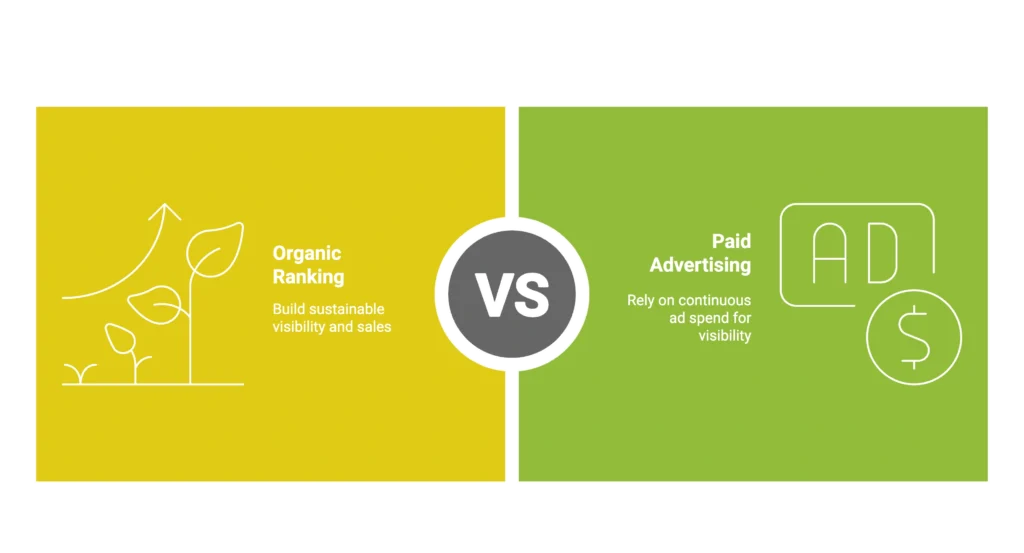
Most Amazon sellers are stuck in an expensive hamster wheel—spending more on ads each month while their organic rankings go nowhere. They think Amazon is just a pay-to-play advertising platform, but without a specific focus on Amazon PPC for organic growth, they’re playing the wrong game entirely. Real success comes from using your ad budget to build an asset, not just buy a click.
Here’s the reality: Amazon isn’t an ad game—it’s a ranking game. The sellers who understand this fundamental difference build listings that eventually sell without ads, while others stay trapped paying rent for visibility they’ll never own.
After 12+ years of building, selling, and launching Amazon brands, I’ve learned that successful PPC isn’t about keeping ACOS low or burning through bigger budgets. It’s about using ads strategically to build the organic foundation that makes future advertising optional, not mandatory. This shift in mindset is the key to building Amazon brands without ads, allowing you to move from a “pay-to-play” model to a sustainable, asset-driven business.
What you’re about to learn goes against everything most agencies teach. This guide reveals the exact methodology behind ads that build lasting organic rank—including the conversion-first approach that lets you scale back (or eliminate) ad spend while sales continue growing, how to leverage the honeymoon period for maximum ranking impact, and why TACoS matters more than ACOS when you’re playing the long game.
The Amazon Ranking Reality Most Sellers Miss
Why “Ads = Sales” is the Wrong Equation
Let me share something that might shock you. For the past 90 days, one of my brands has generated zero dollars in ad spend. Not a single penny. Yet sales keep rolling in, organic rankings stay strong, and profit margins nearly doubled.
This wasn’t planned—stock issues forced me to pause all advertising completely. I expected a slowdown, maybe even a ranking drop. Instead, I discovered the difference between ads that build foundations and ads that just buy temporary placement.
See, most sellers think the equation is simple: ads equal sales. That’s wrong. The real equation is: ads should equal ranking.
If you’re constantly spending just to maintain sales, your ads aren’t working—they’re just buying you shelf space. You’re paying Amazon rent instead of building equity in your listing’s organic position.
Here’s the test: if you turn off ads today, what happens? Does your listing keep moving, or does it flatline? If it collapses, you’re stuck in a pay-to-play cycle that only gets more expensive over time.
The Chain Reaction Most Agencies Ignore
Amazon isn’t a collection of separate tactics. It’s a chain reaction engine where every element affects every other element:
- Ads affect rank
- Rank affects reviews
- Reviews affect conversion
- Conversion affects ad efficiency
When agencies treat these as isolated tasks—running ads without optimizing listings, or fixing copy without considering inventory positioning—the entire system suffers. That’s why most sellers plateau. They’re optimizing individual pieces instead of building a cohesive ecosystem.
I’ve seen it repeatedly: sellers hire one person for ads, another for listings, maybe a third for inventory management. Nobody’s looking at the full picture. Nobody’s connecting the dots between why their TACoS keeps climbing or why their organic rank stays flat despite months of ad spend.
The Rank-First PPC Framework

Phase 1: Foundation Building (Before You Spend a Dollar)
Most sellers rush into advertising without building the foundation that makes ads effective. This is backwards. You need conversion optimization before you need ad optimization.
Start with Auto Campaigns for Discovery
I always begin new listings with auto campaigns because they reveal converting keywords you’d never think to target manually. When optimizing a listing, I include long-tail terms, short-tail terms, Spanish keywords, misspellings—everything the auto campaigns can feed off of. This generates discovery data about terms your listing actually converts for.
The key insight: Amazon’s algorithm tests your listing against keywords based on your backend optimization and listing content. Auto campaigns let Amazon show you which tests are working. Once you identify high-conversion terms with decent search volume, that’s where you build your exact-match “rank push” campaigns.
Mobile-First Conversion Optimization
Most people never scroll past the title on mobile, yet most sellers optimize for desktop. Your main image needs to work in that tiny mobile thumbnail. Your title needs to convert in the first few words. Everything else is secondary.
I spend significant time A/B testing main images for click-through rates. Sometimes competitor images might be technically larger dimensions, but through strategic cropping and positioning, I can make my product look bigger in the search results. These micro-optimizations compound into major conversion rate improvements.
Backend Architecture That Scales
Your backend keywords aren’t just for discovery—they’re the foundation for everything Amazon tests your listing against. Include variations, misspellings, and related terms. Structure them with search intent in mind, not just keyword stuffing.
Most importantly, fill out every backend field yourself. If you skip optional attributes, Amazon’s bots will fill them in automatically—and they usually get it wrong. A simple change from “Pajama Sets” to “Pajamas Sets” can derail your rank, PPC performance, and visibility overnight.
Phase 2: Honeymoon Period Strategy (First 90 Days)
The honeymoon period is real—I’ve observed it consistently across dozens of launches over 12 years. While some claim it’s 30 days, others say 60, I believe it’s strongest for the first 90 days. But here’s what most people miss: it doesn’t end abruptly. It gradually weakens, which means the longer you wait to build momentum, the more expensive it becomes.
Speed to Market is Everything
Time works against you on Amazon. Every day you spend “testing” pricing or “optimizing” copy after launch makes it harder to gain traction. Amazon wants to see quick conversion signals. The algorithm interprets fast, consistent conversions as product-market fit.
This means you need to launch with competitive pricing, optimized images, and conversion-ready copy from day one. The “launch first, optimize later” approach kills momentum before it starts.
Strategic Pricing for Conversion Velocity
During the honeymoon period, I start with aggressively competitive pricing to ensure high conversion rates on every keyword Amazon tests. This isn’t about being the cheapest—it’s about showing Amazon that your listing converts consistently across multiple terms.
Once organic ranking momentum builds, you can gradually increase prices. But if you start too high and Amazon sees poor conversion rates, you’ll spend months trying to overcome that initial negative signal.
Phase 3: Scaling and Data Collection
This is where the rank-first methodology separates from traditional PPC management. Instead of optimizing for ACOS, you’re optimizing for organic rank improvement while maintaining profitability.
The Conversion Rate Decision Matrix
For every keyword your auto campaigns discover, ask these questions:
- Is my conversion rate high on this term? If yes, scale spend aggressively—high conversion rates signal Amazon that your listing belongs at the top for this keyword.
- Am I making money on this term? If yes, increase spend until profitability drops.
- If I’m losing money but conversion rates are strong, is my organic rank improving? If yes, treat it as an investment in future organic sales.
- If I’m losing money and organic rank isn’t improving, pause and fix the underlying conversion issues.
TACoS: The Real Success Metric
Stop obsessing over ACOS. TACoS (Total Advertising Cost of Sales) tells the real story because it includes both your ad spend AND your organic sales in the calculation.
When TACoS trends downward while total sales increase, you know your ads are successfully building organic rank. When TACoS stays flat or increases, you’re just maintaining current position—not building future independence from ad spend.
Here’s the goal: use initial ad investment to build organic rank, then watch TACoS decrease as organic sales replace paid traffic. This is how you transition from renting visibility to owning it.
Advanced Tactics Most Sellers Overlook
Inventory as a Hidden Ranking Factor
Most sellers think inventory management is just about not running out of stock. But inventory levels directly affect your ranking algorithm signals in ways most people never consider.
The 30-Day Death Spiral
When any child ASIN drops to 30 days of inventory or less, Amazon’s algorithm starts deprioritizing your entire parent listing. This happens because Amazon treats each size or color like its own separate listing for ranking purposes.
If your best-selling child ASIN ranks #3 for a major keyword and you sell out, Amazon doesn’t promote another child ASIN to take its place. You lose that #3 position entirely, and your whole listing suffers from the momentum loss.
Geographic Fulfillment Impact
Here’s something most sellers never connect: when you’re low on stock, Amazon can’t distribute inventory evenly across fulfillment centers. The result? A customer in New York sees “2-day shipping” while someone in California sees “5-day shipping” for the same product.
That extended delivery time kills conversions in slower regions. Amazon notices the geographic conversion rate differences and adjusts your ranking accordingly. What looks like a PPC problem is actually an inventory distribution problem.
I aim for 60-90 days of inventory specifically to avoid these algorithmic penalties and ensure consistent conversion rates nationwide.
Catalog Structure for Scale
Parent-Child Architecture Precision
Many brands operate with messy catalog structures—split parents, wrong variation setups, duplicate child ASINs. These structural issues limit your ability to scale because Amazon ranks individual child ASINs, not parent listings.
When your catalog architecture is clean, Amazon can effectively test your variations across keywords and promote your strongest performers. When it’s messy, you’re fighting the algorithm instead of working with it.
Backend Field Management
Amazon’s bots love to make changes without notification. One day your product is properly categorized; the next day, an algorithm decides it belongs somewhere else entirely. These silent changes destroy months of ranking progress.
The solution: monthly audits using the Category Listing Report from Seller Central. Verify your item type keywords and browse nodes match your intended category using Amazon’s Browse Tree Guide. Never accept Seller Central suggestions blindly—Amazon bots don’t understand your business strategy.
The TACoS Governance Model
Reading the Real Signals
While most sellers fixate on ACOS, TACoS reveals whether your advertising strategy is actually working long-term. Here’s how to interpret the trends:
Flat or Decreasing TACoS + Growing Sales = Success This means organic sales are replacing paid traffic. Your ads are building the foundation for future ad independence.
Increasing TACoS + Growing Sales = Warning You’re scaling spend faster than you’re building organic rank. Either optimize conversion rates or reassess keyword targeting.
Stable TACoS + Flat Sales = Maintenance Mode You’re neither building nor declining. This might be acceptable for mature products, but it’s not growth.
When High ACOS is Your Friend
Here’s a contrarian truth: high ACOS isn’t always the enemy. If an ad campaign is driving sales and improving your organic rank for important keywords, temporary profitability loss can be a strategic investment.
The key is monitoring both metrics simultaneously. If you’re losing money on ads but climbing from position 30 to position 10 for a high-volume keyword, that movement has long-term value that justifies short-term ACOS pain.
But if you’re losing money and your organic rank stays flat, you’re just burning budget without building anything sustainable.
Common Pitfalls That Kill Ranking Momentum
The Stock-Out Spiral
Running out of inventory doesn’t just cost you today’s sales—it destroys the ranking momentum you’ve built over months. Amazon’s algorithm interprets stockouts as unreliability signals, and recovery takes significantly longer than the original ranking build.
When stock levels drop below 30 days, I immediately pause ads. Why? Because driving traffic to a listing that can’t fulfill orders consistently trains Amazon’s algorithm that your product isn’t a reliable match for those keywords. The conversion rate data gets polluted, making future ranking efforts more expensive.
Backend Sabotage You Never See Coming
Amazon’s automated systems constantly scan and “improve” your listings. Sometimes this help isn’t helpful. A small change in item type keywords or category classification can tank your rankings overnight without any notification.
I’ve seen Amazon bots change product classifications that destroyed months of ranking progress. The fix requires Category Listing Report audits and manual corrections, but most sellers never think to check these backend elements when performance drops.
Measuring What Matters: KPIs for Rank-Building
The Three-Metric System
Track these three metrics to know whether your PPC strategy is building long-term value:
1. Organic Sales Percentage What percentage of your total sales come from organic traffic versus ads? This should increase over time as your ranking improves.
2. TACoS Trend Direction Is your total advertising cost (as a percentage of total sales) decreasing? Downward TACoS trends indicate successful organic rank building.
3. Keyword-Level Rank Movement Are your priority keywords climbing in organic position? Track this weekly—if ranks aren’t improving despite ad spend, your conversion rates need work before scaling spend.
When to Scale, When to Pause
Use this decision framework for every keyword:
- Making money + improving rank = scale spend aggressively
- Losing money + improving rank = continue strategically as investment
- Making money + no rank improvement = optimize listing conversion first
- Losing money + no rank improvement = pause and fix foundation
The Exit Strategy: Building Ad Independence
Identifying Organic Strength Signals
You’re ready to reduce ad dependency when your listing demonstrates:
- Conversion rates equal to or better than competitors
- Sustained organic rank positions across multiple keywords
- Geographic performance consistency (no regional conversion rate gaps)
My own brand met these criteria, which is why cutting ads during stock shortages didn’t hurt sales. The organic foundation was strong enough to sustain momentum.
The Phased Reduction Method
Never cut ads cold turkey unless forced by inventory constraints. Instead, gradually reduce spend on keywords where you’ve achieved strong organic positions while maintaining “maintenance campaigns” for minimal velocity on strategic terms.
Monitor your organic rank weekly during reduction phases. If you see position drops, you reduced too aggressively. If ranks hold steady, you successfully transitioned from paid to organic dominance.
Key Takeaways: Stop Paying Rent, Start Building Equity
Amazon rewards listings that convert consistently across keywords. When you optimize for conversion rates first and use PPC to scale those signals, you’re building organic ranking equity that compounds over time.
The boutique approach works because precision matters more than volume. Focus on building a few dominant listings rather than managing dozens of mediocre ones. Amazon’s algorithm responds to concentrated success signals, not scattered mediocrity.
Most importantly, remember that Amazon wants you to succeed—they make money when you make sales. When you show them consistent conversion data across relevant keywords, they’ll reward you with better organic positioning and lower ad costs over time.
The choice is yours: keep paying rent for temporary visibility, or invest in building organic rankings that work even when the ads are off. The methodology exists. The framework is proven. The only question is whether you’re ready to stop playing Amazon’s short-term game and start building long-term dominance.
FAQ: Amazon PPC for Organic Growth
How long should I run ads before seeing organic ranking improvement?
The honeymoon period provides your best opportunity for quick ranking gains—typically strongest in the first 90 days. However, ranking improvement timing depends on conversion rates and competition. Track keyword-level rank movement weekly rather than waiting for dramatic shifts. Small upward movements indicate the strategy is working, even if you don’t see page-one results immediately.
What’s the difference between ACOS and TACoS, and which should I focus on?
ACOS measures profitability of your ad spend in isolation. TACoS (Total Advertising Cost of Sales) includes both ad spend and organic sales, showing the real impact of your advertising strategy. Focus on TACoS trends—when TACoS decreases while total sales increase, your ads are successfully building organic rank that reduces future ad dependency.
Should I pause ads if my organic rank is strong?
Only pause ads when you have both strong organic rankings AND conversion rates equal to or better than competitors. Test phased reductions first—gradually decrease spend on well-ranked keywords while monitoring for rank drops. My 90-day zero-ad case study worked because the conversion foundation was solid before pausing spend.
How much inventory should I maintain for optimal ranking?
Target 60-90 days of inventory minimum. When stock drops to 30 days or less, Amazon’s algorithm begins deprioritizing your listing because they can’t distribute inventory effectively across fulfillment centers. This creates geographic conversion rate inconsistencies that hurt rankings more than paused ads do.
What if my ads aren’t improving my organic rank?
Check your conversion foundation first. If ads drive traffic but don’t improve rank, your listing isn’t converting well enough to send positive signals to Amazon’s algorithm. Focus on image optimization, competitive pricing, and mobile-first listing structure before scaling ad spend. High spend on a poor-converting listing just teaches Amazon your product doesn’t belong in top positions.
Related reading: tracking competitive organic rank week over week

