 Skip to content
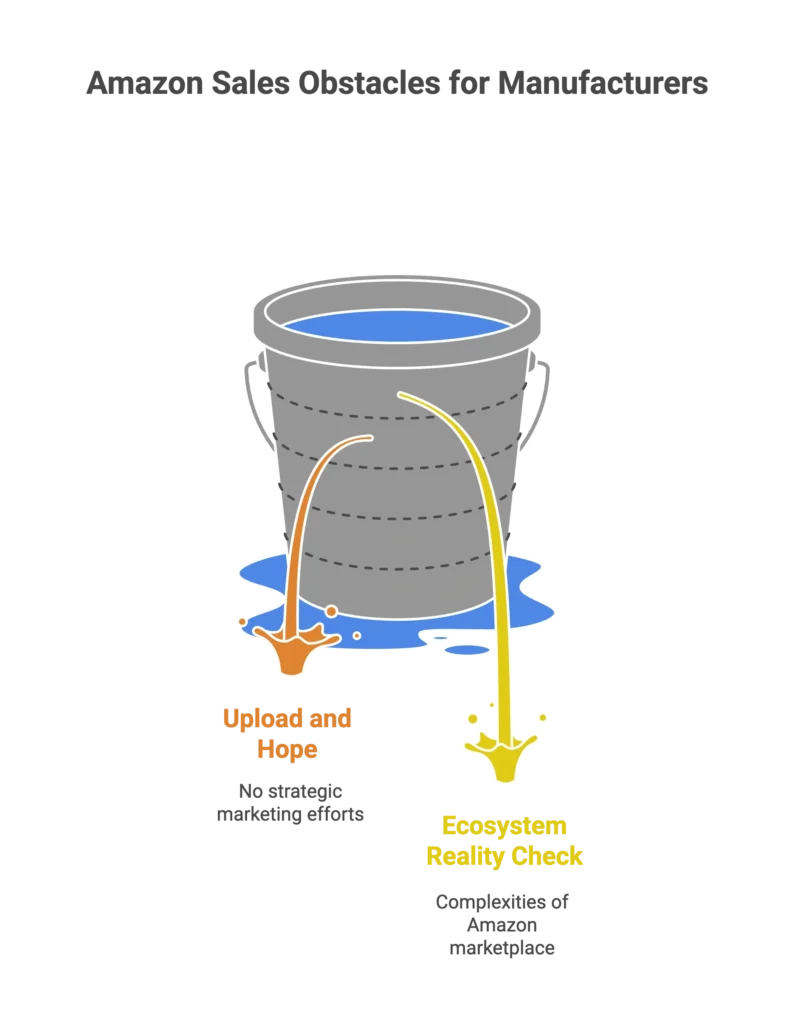
Most manufacturers treat the marketplace like another retail buyer—upload products, set competitive prices, and wait for orders. However, building a successful Amazon strategy for manufacturers requires moving beyond the traditional wholesale mindset. After 12+ years building and selling brands, I’ve watched countless established businesses crash and burn because they treated a ranking ecosystem like a static warehouse.
That’s exactly why they fail.
After 12+ years building and selling brands on Amazon, I’ve watched countless established manufacturers with million-dollar retail distribution crash and burn on the marketplace. Not because their products weren’t good enough, but because they fundamentally misunderstood what Amazon actually is. They focus on traditional retail margins while ignoring the TACoS vs ACoS for Amazon growth metrics that actually dictate whether a brand is scaling its organic reach or simply subsidizing Amazon’s ad platform.
Amazon isn’t traditional retail. It’s a ranking game disguised as a marketplace.
The manufacturers who crack the code don’t just add another sales channel—they often discover their most profitable one. But here’s what separates the winners from the 90% who give up after six months: they understand Amazon operates as an interconnected ecosystem where every decision triggers a chain reaction.
Your inventory levels affect your organic rankings. Your organic rankings determine your ad efficiency. Your ad strategy builds (or destroys) your long-term momentum. Miss one link in this chain, and the entire system collapses.
This guide reveals the exact framework I use to transition traditional wholesale businesses into Amazon powerhouses. You’ll discover why the “honeymoon period” makes or breaks manufacturers, how inventory positioning in Amazon warehouses directly impacts your conversion rates, and why treating Amazon like your existing retail relationships guarantees failure.
Why Traditional Manufacturers Fail on Amazon
The “Upload and Hope” Trap
Most manufacturers approach Amazon with their existing wholesale playbook. They send their product catalog to Amazon like they would to any retailer, set competitive pricing based on retail markup formulas, and expect Amazon to “sell” their products like a traditional buyer would.
This mindset kills Amazon success before you start.
I’ve seen this pattern dozens of times working with NY and NJ-based manufacturers. They have established retail distribution, quality products, and proven market demand. But they treat individual variations casually—thinking in case pack terms instead of understanding that on Amazon, each size and color variation can make or break your entire listing’s performance.
The Ecosystem Reality Check
Amazon’s algorithm evaluates every aspect of your presence simultaneously. Your listing quality affects conversion rates. Conversion rates determine your organic ranking potential. Organic rankings influence your ad efficiency and costs. Ad performance builds momentum during the critical honeymoon window. Inventory levels impact fulfillment speed and ranking stability.
When one element underperforms, it creates a downward spiral affecting everything else.
Here’s what this looks like in practice: Poor listing copy leads to low conversion rates. Amazon’s algorithm notices fewer people are buying after viewing your product, so it shows your listing to fewer customers. Lower visibility means you need to spend more on ads to maintain the same sales volume. Higher advertising costs reduce profitability, leaving less budget for inventory investment. When you run low on stock, Amazon can’t promise fast delivery nationwide, further hurting conversion rates. Eventually, your organic rankings collapse entirely.
Most manufacturers never connect these dots because they’re thinking in traditional retail terms where product placement is negotiated, not algorithmically determined.
The Three Critical Differences: Traditional Retail vs Amazon
Understanding these fundamental differences is crucial for any manufacturer considering Amazon:
Control Over Placement: In traditional retail, you negotiate shelf space, end caps, and promotional placement. On Amazon, algorithmic placement is based on performance metrics and customer behavior that changes in real-time.
Inventory Management Impact: In traditional retail, stockouts mean lost immediate sales. On Amazon, stockouts destroy organic rankings and momentum that take months to rebuild. I’ve seen this personally with my own clothing brand—when certain variations sold out, delivery times extended from two days to a week, causing organic rankings to drop even though I had inventory available.
Customer Relationship: Traditional retail means the retailer owns the customer relationship and data. On Amazon, you compete for customer attention in real-time against every competitor, and Amazon controls the customer relationship.
The Manufacturer’s Amazon Success Framework

Phase 1: Foundation Assessment & Catalog Architecture
Before launching anything, audit your product line through Amazon’s lens. This means validating search volume for your main keywords, assessing competition density, and ensuring your price points can sustain Amazon fees and advertising costs while maintaining profitability.
The biggest mistake I see is manufacturers mirroring their existing wholesale catalog structure on Amazon. Amazon requires strategic grouping based on customer search behavior, not your internal SKU organization. I work with clients to optimize parent-child relationships and variation management strategies that support organic ranking goals.
Phase 2: The Honeymoon Window Strategy
The first 90 days determine your long-term success potential. This isn’t theory—it’s documented algorithmic behavior that I’ve leveraged across client launches for over a decade.
During my recent brand launch, I focused heavily on ads leading into Black Friday to secure top 10 positions for main keywords. When the holiday rush hit, the combination of strong organic rankings and high conversion rates drove significant sales. Eventually, I paused ads entirely and maintained strong performance purely through organic rankings.
But this only worked because the foundation was properly built during the honeymoon period.
Pre-launch preparation requires:
- 90+ days of inventory positioned across Amazon’s fulfillment network
- Pricing strategy that starts low and increases systematically
- Image testing to optimize click-through rates before launch
- Amazon Vine enrollment for initial review velocity
Launch execution focuses on:
- Strategic pricing during weeks 1-4 to maximize sales velocity
- Coordinated advertising that targets exact match keywords first
- Daily ranking monitoring for primary keywords
- Stock level management to avoid any variation sellouts
Phase 3: Organic Ranking Development
Unlike traditional retail where placement is fixed, Amazon rankings fluctuate based on performance. The goal is building sustainable organic visibility that reduces long-term advertising dependency.
I’ve proven this works with my own listings. One of my products maintained top rankings for competitive keywords while spending zero on ads for 90+ days, generating hundreds of thousands in organic sales. This happened because we built genuine organic strength during the initial launch phase.
The ranking formula considers sales velocity for target keywords, conversion rate optimization, customer satisfaction metrics, and inventory consistency to maintain fulfillment speed.
Advanced inventory management is critical here. Amazon’s algorithm considers where your inventory sits within their fulfillment network. Insufficient stock distributed across regions creates delivery delays that kill conversion rates, even if you technically have inventory. Customers in certain states might see four to five-day delivery times, which lowers conversions and hurts organic rank.
Phase 4: Strategic Advertising Integration
Most manufacturers view Amazon ads like Google Ads—pay for clicks and hope for sales. That’s wrong. Amazon advertising should build organic ranking, not replace it.
The ecosystem approach means using ads to boost sales velocity for target keywords during launches, focusing on exact match campaigns for primary search terms, and monitoring organic ranking improvement as your advertising success metric. As organic rankings strengthen, you can scale back advertising spend.
This is exactly how I achieved $400K monthly sales with one listing while turning off all ads. The foundation was built through strategic advertising that prioritized ranking development over short-term ACOS targets.
Phase 5: Sustainable Growth & Scaling
Once organic rankings are established, you can scale without proportional advertising increases. Strong organic rankings improve ad efficiency when you do advertise. Better ad performance generates more data for optimization. Higher conversion rates strengthen organic ranking stability. Reduced advertising dependency improves overall profitability.
Common Manufacturer Mistakes That Kill Amazon Success

Mistake #1: Treating Variations Casually
Traditional wholesale thinking applies case pack mentalities where all sizes and colors are equally important. On Amazon, each child ASIN has individual ranking power. If you’re selling clothing and have multiple colors and sizes, selling out of your best-performing variation crashes rankings for the entire parent listing. Understanding this is a critical component of a strong Amazon strategy for manufacturers.
Amazon’s algorithm ranks based on individual child ASINs. Your main size might rank very high for a keyword, but if that sells out, the next variation might only show on page two for the same keyword. You’ve just killed your momentum and the entire snowball effect—something a professional Amazon strategy for manufacturers prevents.
Mistake #2: Underestimating Inventory Distribution
Here’s what most manufacturers miss: Amazon’s fulfillment network requires strategic stock positioning. Insufficient inventory in specific warehouses creates delivery delays that customers notice and avoid. Effective inventory planning is an essential part of any Amazon strategy for manufacturers.
A customer in California might see 2-day delivery while a customer in New York sees 5-day delivery for the identical product. The New York customer buys from a competitor with faster shipping, reducing your conversion rate and organic ranking. Amazon wants you to make sales—but they need consistent performance across all regions, which is accounted for in a smart Amazon strategy for manufacturers.
Mistake #3: Pricing Strategy Misalignment
Traditional manufacturers set competitive prices and maintain them. Amazon requires strategic pricing during the launch phase, then systematic optimization toward target margins. Pricing decisions are a core part of a holistic Amazon strategy for manufacturers.
The science is simple: Amazon’s algorithm rewards consistent sales velocity during critical windows. Show Amazon it’s a good product from the start with an introductory price that generates sales. Plan your monthly price increases until you hit target margins—a tactic embedded in every Amazon strategy for manufacturers.
The Ecosystem Audit: What Most Agencies Miss
Based on managing accounts generating millions in annual revenue, here are the interconnected issues that destroy Amazon performance:
Backend Keyword Degradation: Amazon’s bots regularly change listing classifications without notification. Your “Pajama Sets” might become “Pajama Set,” altering ranking potential. Monitoring these changes is part of a comprehensive Amazon strategy for manufacturers.
Inventory Positioning Analysis: Your stock might show available in Seller Central, but if concentrated in limited fulfillment centers, delivery promises vary, affecting conversion—a critical focus of Amazon strategy for manufacturers.
Listing Architecture Problems: Split parent listings, wrong variation setups, duplicate child ASINs, or missing backend search terms. Optimizing this is essential for any successful Amazon strategy for manufacturers.
Ad-to-Organic Disconnect: Many manufacturers run ads without tracking organic ranking improvements, missing the primary purpose of advertising during growth phases—a gap a strong Amazon strategy for manufacturers fills.
Why This Framework Works
I’m not a marketing guy who decided to sell on Amazon. I’m a seller who built brands, sold them, launched others, and now manages accounts from the inside out. Everything I recommend comes from real experience, which is why a proper Amazon strategy for manufacturers works.
When I launched my recent clothing brand, I invested $400,000 into inventory and followed the same blueprint I use with clients. The results speak for themselves—one listing doing $400K monthly with ads off, proving the power of a systematic Amazon strategy for manufacturers.
Most agencies look at Amazon as a collection of tasks: listing optimization, ads, account monitoring—but no one connects the threads. A holistic Amazon strategy for manufacturers ties all elements together.
Amazon is a chain reaction engine: ads affect rank, rank affects reviews, reviews affect conversion, conversion affects ad efficiency. One part off, everything suffers—a dynamic addressed by every professional Amazon strategy for manufacturers.
Your Amazon Transformation Starts With Mindset
Manufacturers who build sustainable Amazon success make a fundamental shift: they stop thinking like wholesalers and start thinking like marketplace competitors.
This means understanding that Amazon success isn’t about having the best product or the lowest price. It’s about systematically optimizing every element the algorithm uses to determine visibility—a core principle of Amazon strategy for manufacturers.
The three non-negotiables for manufacturer success:
- Treat the honeymoon period as make-or-break. Initial momentum is critical—a step fully integrated into Amazon strategy for manufacturers.
- Think ecosystem, not tactics. Inventory impacts rankings, rankings affect ad efficiency—central to Amazon strategy for manufacturers execution.
- Measure what Amazon measures. Conversion rates, organic rankings, and customer satisfaction matter more than traditional wholesale metrics—a philosophy embedded in Amazon strategy for manufacturers.
The opportunity is massive. Manufacturers with established distribution relationships, product-market fit, and supply chain expertise just need Amazon-specific execution. Following a tested Amazon strategy for manufacturers converts these advantages into ranking dominance.
Ready to Stop Playing Amazon Like Traditional Retail?
The difference between manufacturers who succeed and those who give up isn’t product quality or pricing—it’s understanding that Amazon requires a different playbook, built on algorithmic optimization, not business relationships. Implementing a proper Amazon strategy for manufacturers ensures consistent, long-term success.
If you’re tired of watching inferior products outrank yours or seeing ad spend rise while organic growth stays flat, it’s time for a systematic Amazon strategy for manufacturers.
I’ve been selling on Amazon for over 12 years, and everything I teach comes from real-world execution, not theory. This is why adopting a full Amazon strategy for manufacturers is the fastest way to transform your brand.
Amazon is still the best place on Earth to build a brand. But most manufacturers approach it the wrong way. A tested Amazon strategy for manufacturers aligns your wholesale advantages with the ranking game for sustainable growth.
The ecosystem framework works because it’s grounded in practical experience building brands generating millions in Amazon revenue. The question isn’t whether this approach works—it’s whether you’re ready to stop treating Amazon like traditional retail and implement a winning Amazon strategy for manufacturers.

