 Skip to content
After 12 years of selling on Amazon and building brands that do $400K+ per month with zero ad spend, I’ve learned one truth about US Amazon FBA: most sellers are paying rent on Amazon instead of building equity.
While everyone else treats US Amazon FBA like Google Ads—throwing money at campaigns and hoping for the best—the real winners understand that Amazon is a ranking ecosystem. It’s not about who spends the most on PPC; it’s about who builds the strongest organic foundation. To truly scale, you must realize that US Amazon FBA success depends on an ecosystem that can sustain growth long after the ads are turned off.
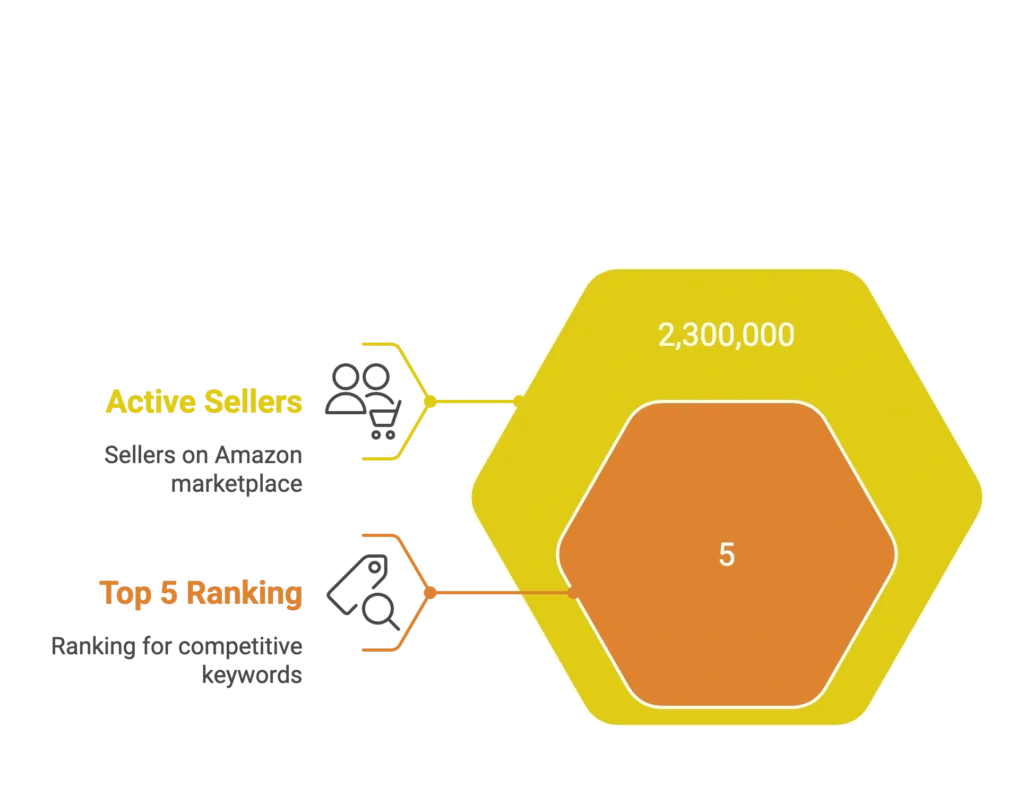
I recently proved this with my own clothing brand. After 90 days of zero ad spend, we’re still ranking in the top 5 for competitive keywords, sitting at a 4,000 BSR, and generating thousands of organic sales monthly. This didn’t happen by accident—it happened because we built the right foundation from day one.
The US marketplace is the most competitive on Earth, with over 2.3 million active sellers fighting for customer attention. But that competition also creates the biggest opportunity for those who understand the game. You don’t need hundreds of mediocre listings. You need a few dominant ones doing serious revenue—$1M+ annually per SKU is absolutely achievable when you approach Amazon correctly.
The US FBA Reality Check
Why the US Market Demands Different Strategies
The US Amazon marketplace isn’t just bigger—it’s fundamentally different. Customer expectations are higher, with two-day delivery considered the minimum standard rather than a competitive advantage. Policy requirements are stricter, from Prop 65 warnings in California to category-specific regulations for supplements and electronics.
Most importantly, the inventory economics of US Amazon FBA have changed dramatically. Amazon’s new low-inventory-level fees can eat into your margins if you’re not managing stock properly. But here’s what most sellers miss: it’s not just about having inventory—it’s about having it distributed correctly across the US Amazon FBA fulfillment network.
When you have only 30 days of stock, US Amazon FBA keeps it concentrated in one fulfillment center. A customer in New York might see two-day shipping, but someone in California gets five-day delivery. That customer in California needs their product for the weekend, sees the longer delivery time, and buys from your competitor instead. Your conversion rate drops, Amazon’s algorithm notices, and your organic rank suffers—even though you technically had inventory available.
The Real Cost of Getting It Wrong
I’ve seen too many brands get trapped in what I call the “expensive hamster wheel.” They’re spending 70-80% of their revenue on ads because they never built organic ranking strength. When they turn off the ads, sales collapse. They’re essentially paying rent to Amazon instead of building equity in their listings.
The solution isn’t more ad spend—it’s building the right foundation through what I call the US FBA Operating System.
The 4-Part US FBA Operating System
Part 1: Compliance-First Foundation
2025 Title and Image Requirements
Amazon’s listing requirements have tightened significantly, and staying compliant isn’t just about avoiding suspensions—it’s about ranking better. The algorithm favors listings that follow current guidelines precisely.
For titles, we’re now dealing with stricter character limits and mobile-first optimization within the US Amazon FBA marketplace. Most customers browse on mobile, where your title gets truncated after about 80 characters. Your most important keywords need to be front-loaded, but they also need to read naturally for actual humans to ensure your US Amazon FBA listings maintain a high click-through rate in 2026.
Images must meet the 85% product fill requirement and maintain 1,000+ pixel dimensions for the zoom feature. But here’s what most sellers miss: Amazon’s AI is getting better at reading text in images. If your product has clear, readable text showing key features or benefits, that information becomes searchable even if it’s not in your backend keywords.
US-Specific Compliance
Prop 65 warnings aren’t optional if you’re selling products that contain certain chemicals to California customers. But rather than seeing this as a burden, smart sellers use compliance as a competitive advantage. Many competitors avoid California altogether rather than deal with the requirements, leaving market share on the table.
The key is building compliance into your operation from the start, not retrofitting it later. Use Amazon’s Category Listing Report monthly to catch any backend classification changes that could affect your listing performance.
Part 2: Brand Control and Intelligence
Strategic Brand Registry Enrollment
Brand Registry isn’t just about protection—it’s your data goldmine and the gateway to Amazon’s most powerful tools. But timing matters enormously.
Enroll before you launch, not after. Once you’re in Brand Registry, you get access to Amazon Vine, which is a critical tool for any US Amazon FBA business to generate 15-30 reviews in the first few weeks. Those early reviews are crucial for conversion rate optimization during your honeymoon period, ensuring your US Amazon FBA listing has the social proof needed when Amazon begins testing your initial performance.
You also gain access to Search Query Performance data in Brand Analytics. This shows you exactly what customers type into the search bar before they buy products in your category. Most sellers are guessing at keywords—you’ll have actual search data.
Mining Brand Analytics for Organic Opportunities
Search Query Performance reveals gaps your competitors haven’t filled. When you see high-volume search terms that aren’t being targeted effectively by top-ranking products, that’s your opportunity to optimize and capture that traffic organically.
I regularly find keywords doing 10,000+ monthly searches where the top-ranking products aren’t even optimizing for those terms in their titles or bullets. That’s free organic traffic waiting to be captured through proper optimization.
Part 3: Always-On Optimization Engine
Manage Your Experiments (MYE) Mastery
Most sellers treat listing optimization like a one-time event. They set up their listing and hope for the best. Winners treat it like an always-on testing engine.
Manage Your Experiments lets you A/B test different versions of your listing elements with statistical significance. But here’s what the tutorials don’t tell you: test hierarchy matters enormously.
Start with hero images—they have the highest impact on click-through rates. A 10% improvement in click-through rate can boost your organic ranking significantly because Amazon sees more people choosing your product over competitors in search results.
Next, test title variations focusing on keyword positioning and mobile truncation. Remember, mobile users see different character limits, so your primary keyword placement needs to account for smaller screens.
The Strategic Testing Approach
Run tests for minimum 30-day cycles to account for weekly business fluctuations. Don’t end tests early just because you see initial results—statistical significance requires adequate sample sizes.
When you find a winning variation, implement it and immediately set up your next test. This continuous optimization approach compounds over time, creating listings that significantly outperform competitors who set and forget their optimization.
Part 4: Inventory Intelligence
IPI Score Architecture
Your Inventory Performance Index isn’t just a metric—it’s Amazon’s way of determining how much FBA capacity you deserve. The four components are sell-through rate, stranded inventory percentage, excess inventory percentage, and in-stock rate for your top ASINs.
But here’s the insight most sellers miss: maintaining 90 days of inventory isn’t just about avoiding stockouts—it’s about ranking performance. When you have deeper inventory, Amazon distributes it across more fulfillment centers, improving delivery times nationwide and boosting conversion rates.
Advanced Stock Distribution Strategy
Amazon’s algorithm considers delivery speed when ranking products. If your competitor can promise two-day delivery nationwide while you’re showing five days in certain regions, they’ll rank higher for those geographic searches.
Monitor your inventory distribution using the inventory ledger reports. When you see stock concentrated in only one or two fulfillment centers, it’s time to send in more inventory for better distribution, even if your total units seem adequate.
I target 90 days of inventory specifically because it gives Amazon confidence to spread your stock properly while providing buffer for sales acceleration during promotional periods or seasonal spikes.
Cross-Border Expansion Through Remote Fulfillment
Canada and Mexico Opportunities
Once you’ve built a strong US foundation, Remote Fulfillment with FBA lets you expand into Canada and Mexico using your existing US inventory. This isn’t about duplicating stock—it’s about leveraging inventory you already have for additional market reach.
The decision framework is simple: if you’re consistently ranking in the top 10 for your main keywords in the US and maintaining healthy conversion rates, test Remote Fulfillment for your bestselling ASINs.
Start with categories where cross-border shipping costs won’t destroy your margins. Electronics and apparel typically work well, while heavy or low-margin products often don’t make economic sense.
Advanced Organic Ranking Strategies
The Honeymoon Period Reality
Amazon gives new products a ranking boost for the first 30-60 days to test market response. Most sellers waste this opportunity by launching with unoptimized listings or insufficient inventory.
Use this period strategically. Launch with Brand Registry already approved, Vine enrollment ready, and 90+ days of inventory. Run targeted PPC campaigns not just for sales, but to gather data on which keywords convert best for organic optimization.
Beyond PPC Dependency
The goal isn’t to eliminate advertising—it’s to build organic strength that reduces your dependence on ads over time. My clothing brand achieved 90 days of zero ad spend because we spent the first year building conversion rate optimization, consistent inventory levels, and strategic keyword targeting.
When organic rankings are strong enough, you can scale back ads without losing sales. But this only works if you’ve built the foundation correctly from the beginning.
Frequently Asked Questions
How do I maintain organic rankings when scaling down ad spend?
You need strong organic rankings (top 10 for main keywords) and conversion rates that match or exceed competitors before reducing ad spend. Scale down gradually—cut spending by 25% increments while monitoring rank stability.
What’s the minimum IPI score needed for consistent FBA capacity?
Maintain above 450 to avoid capacity restrictions. Focus on the four core components: sell-through rate above 90 days, stranded inventory below 1%, excess inventory below 10%, and 90%+ in-stock rate for top ASINs.
When should I enroll in Brand Registry for maximum impact?
Before launching new products, not after. Brand Registry approval takes 2-4 weeks, and you want Vine access from day one for early review generation during the honeymoon period.
How do I handle Prop 65 compliance for FBA products?
Research your product ingredients against California’s Prop 65 list before sourcing. If warnings are required, build them into your packaging and listing images from the start rather than retrofitting later.
What’s the ROI threshold for Remote Fulfillment expansion?
Target 20%+ profit margins after cross-border shipping costs. Test with your best-performing US ASINs first, and monitor conversion rates in new markets—they’re often lower initially due to unfamiliar brands.
Building Amazon Equity vs. Paying Rent
The difference between successful Amazon brands and those stuck in the expensive hamster wheel comes down to foundation building. Winners focus on organic ranking strength, inventory intelligence, compliance-first operations, and data-driven optimization.
Most sellers approach Amazon backwards—they launch first and optimize later. They run ads without building organic strength. They ignore inventory distribution and compliance requirements until problems force their attention.
The US marketplace rewards strategic thinking and systematic execution. Build the US Amazon FBA foundation correctly, and you can achieve sustainable growth that doesn’t require constant ad spend increases. If you skip the foundation work required for US Amazon FBA, you’ll be paying rent to Amazon forever.
Amazon is still the best place on Earth to build a brand, but only if you treat it like the ranking ecosystem it actually is rather than the advertising platform everyone thinks it is. Master the fundamentals, and you’ll dominate your category while competitors burn cash chasing yesterday’s tactics.

