 Skip to content
If you think Amazon is just an “ad game,” you’re playing the wrong game entirely.
Real Amazon marketplace domination remains out of reach for most sellers because they are trapped in what I call the “Amazon hamster wheel”—constantly feeding ads just to maintain sales and watching their TACoS creep up month after month. Instead of building real organic strength, they treat Amazon like Google Ads, failing to understand it’s a ranking ecosystem where organic visibility is everything.
After 12+ years of selling on Amazon—building brands, selling them, and launching new ones—I’ve learned that Amazon marketplace domination isn’t about having hundreds of mediocre listings or the biggest ad budget. It’s about understanding that Amazon is a chain reaction engine built on a solid catalog architecture where every element connects: ads affect rank, rank affects reviews, reviews affect conversion, and conversion affects ad efficiency.
The truth? You don’t need thousands of listings. You need a few dominant ones doing serious revenue each. My own brand just hit $400K in monthly sales from a single listing—no ads running, prices actually raised—because we built the foundation right.
This isn’t theory from someone who’s never had skin in the game. To achieve true Amazon marketplace domination, you need precision work from someone who treats every client account like his own business. I’m still building my own brands in real time, so I know exactly what it takes to maintain Amazon marketplace domination in an ever-shifting landscape.
Here’s the 12-month roadmap to category domination that most agencies will never teach you—because they’re too busy managing hundreds of accounts instead of going deep with the right ones.
Why Most Amazon Strategies Fail (The Ecosystem Blindness)
Most agencies look at Amazon as a collection of tasks. They offer listing optimization, or they run ads, or maybe they monitor your account—but no one is pulling all the threads together.
I’m not a marketing guy who decided to sell on Amazon. I’m a seller who built brands, sold them, launched others, and now manages accounts from the inside out to achieve true Amazon marketplace domination. I know what it’s like to be stuck, to lose rank, to fight for reviews, to get bad ad data, and to watch competitors pass you.
The biggest mistake I see? Sellers treating Amazon like traditional retail. They think it’s just another sales channel, like selling to retail stores. But Amazon is its own business model with its own rules.
Here are the pain points I hear again and again:
For Manufacturers and Wholesalers:
- They were misled by agencies who overpromised and underdelivered
- They treated Amazon like a place to “upload listings and hope for sales,” not realizing the algorithm needs strategic, coordinated effort across every touchpoint
- Their listings are weak—bad titles, bad bullets, no SEO, no story—then they wonder why ads don’t convert or organic rank never moves
- They run ads without understanding the relationship between ads and organic, so they either overspend or get discouraged and stop
For Established Amazon Sellers:
- They’ve hit a plateau, spending heavily on ads but not building organic rank
- They’ve tried “tactics” but not strategy—their foundation is weak, copy isn’t converting, images don’t tell the story
- They’re managing 10 different agencies or tools, but no one is looking at the account holistically
- Their TACoS is creeping up, and they feel like they’re treading water instead of scaling
At the core, all of these problems come down to the same issue: they don’t realize that Amazon is an ecosystem. It’s not about doing one thing right. It’s about doing everything right—with precision.
Amazon is a chain reaction engine. Ads affect rank. Rank affects reviews. Reviews affect conversion. Conversion affects ad efficiency. If one part is off, it all suffers.
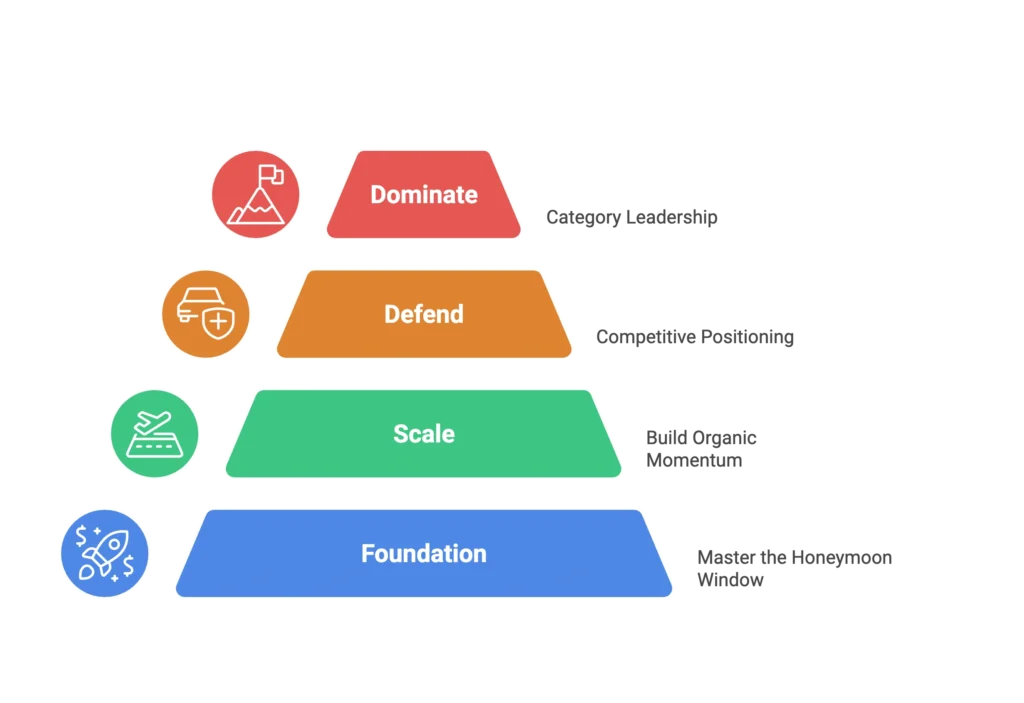
The 12-Month Category Domination Framework
Q1 – Foundation Phase: Master the Honeymoon Window
The honeymoon period is your secret weapon—but most sellers completely waste it.
Everyone has different opinions on how long it lasts. Some say 30 days, some say 60, some say 90. I believe it’s 90 days when it’s strongest, but it doesn’t end there. The longer you wait to push for Amazon Marketplace Domination, the harder it gets. It just becomes more and more aged, making it much tougher to regain that early momentum.
But here’s what most people don’t know: you can refresh the honeymoon period. I recently relaunched a year-old listing and successfully ranked it into top positions for main keywords. It’s not over just because you missed the initial window.
Pre-Launch Setup (Weeks 1-2):
Catalog Architecture Audit: Many brands have messy listings—split parents, wrong variation setups, or duplicate child ASINs. We fix the catalog architecture so you can rank and scale the right way.
Mobile-First Listing Optimization: Most people never even scroll past the title on mobile. We write copy that converts and structure the backend with search intent in mind. We don’t just add keywords; we build a story that makes someone want to buy.
Inventory Positioning: When you’re down to 30 days of stock, Amazon can’t distribute your inventory properly across fulfillment centers. Some customers see 4-5 day delivery times, which kills conversions and hurts organic rank—even if you’re not technically out of stock.
Launch Execution (Weeks 3-12):
Start with Auto Campaigns: When I’m building a listing, I make sure to put in longtail keywords, short tail, even Spanish terms and misspellings. Auto campaigns feed off all of this and show me so many different terms I might not have thought of.
A/B Test Everything: I do a lot of A/B testing on click-through rates for images to make sure when people search, they’ll really click into our listing. I’ve even made my images appear bigger than competitors’ by adjusting the square shape—small details that make huge differences in ad performance.
Focus on Conversion, Not Just Clicks: Your listing has to convert. Amazon tests you by sending traffic—if you’re getting traffic but not converting, they won’t want to show you for those words again.
Q2 – Scale Phase: Build Organic Momentum
This is where the magic happens—when ads start building your organic foundation instead of just buying temporary visibility.
The TACoS Trajectory Management:
Weekly Metrics That Matter: Your organic sales must be increasing week after week. Your TACoS should be going down week after week. It doesn’t mean your ad spend needs to decrease, but your TACoS needs to decrease and your organic sales need to go up. That’s how you know if you’re doing something right.
The PPC-to-Organic Handoff: I use tools like Scale Insights that connect with organic rank tracking. You can set up rules where anytime you’re in the top five spots organically for more than a certain number of days, you lower the CPC on that keyword. If organic drops, you increase CPC to rebuild the conversions and organic ranking.
Strategic Campaign Structure:
Split Keyword Campaigns: I prefer ranking campaigns with under 10 keywords each. When you have a campaign with 30-40 keywords, it’s very annoying to optimize each one. But with focused campaigns, you can easily spot-check weekly and make precise adjustments.
Conversion Rate Focus: If I see a keyword converting well and there’s decent search volume, I should be spending a lot on it because it’ll bring up my organic rank. The goal isn’t low ACoS—it’s building rank through high-converting traffic.
Q3 – Defend Phase: Competitive Positioning
This phase is about protecting and expanding the organic strength you’ve built.
Inventory-Rank Protection:
The 30-Day Rule: Amazon’s algorithm hates when you’re low on stock. Think of it like a regular retail store—if something is running low, they’re not going to put it on the front shelf. When you have low inventory, Amazon keeps it in one fulfillment center instead of spreading it out, causing delivery time variations that hurt conversions.
Child ASIN Management: If you’re selling clothing with multiple colors and sizes, and you sell out of your MVP (best-selling variation), the whole listing can crash. Amazon ranks you on child ASINs, so if your main child ASIN that was ranked highly sells out, the next variation might only show on page two for the same keyword. You’re killing the whole momentum—the whole snowball effect.
Review and Conversion Maintenance:
Quality Over Quantity: You don’t need thousands of reviews. More important to have a good review average. Amazon looks at review percentages and where reviews are coming from—never risk your business for fake reviews.
Price Positioning: Your price has to be competitive. Doesn’t have to be cheapest—you don’t want to be cheapest—but you also don’t want to be most expensive. When people see your listing, the image should make them want to click, and the price should make them want to buy.
Q4 – Dominate Phase: Category Leadership
This is where you transition from growth mode to dominance mode.
Beyond Ad Dependency:
My personal brand faced major stock issues recently, forcing me to cut off ads completely. I expected a slowdown, maybe a drop in sales or organic rank. But sales kept rolling in. Organic rank held strong. Why? Because I wasn’t just “renting” space—I had achieved true Amazon Marketplace Domination. The ads weren’t there to prop up the listing; they were there to build its foundation.
The Real Test: If you turn off ads today, what happens? Does your listing keep moving, or does it flatline? Are you building a business or just renting visibility?
Sustainable Growth Indicators:
- Organic units still growing with ads paused
- PPC costs can be cut without sales collapse
- Rankings hold strong without constant ad support
Focus Over Proliferation:
I don’t believe in having thousands of low-selling or mediocre listings. I believe you can achieve Amazon Marketplace Domination with just a few very good listings doing serious money. I personally have single-SKU listings that generate over a million dollars a year.
Whatever your biggest competitor is doing on Amazon, they don’t know any secrets we don’t know. It’s really about looking at the data, doing the right work, and having the right strategy.
The Hidden Levers Most Agencies Miss
Inventory Location Strategy
Here’s something most sellers never think about: where your inventory is sitting affects your conversion and organic rank.
When you have sufficient inventory, Amazon spreads it throughout different fulfillment centers to facilitate Amazon marketplace domination. But when you’re running low—even if you’re not completely out of stock—Amazon keeps everything in one location, which can quickly stall your Amazon marketplace domination by increasing shipping times and hurting your conversion rates.
The Delivery Time Trap: One customer might see two-day shipping while another in a different state sees five or six days. The customer who needs it for the weekend won’t buy it. Conversion rate drops. Amazon notices. Your rank suffers.
The Geographic Ranking Problem: This is especially critical because when stock is low, you lose what I call “geo-ranking”—your ability to show up consistently across all regions.
Catalog Architecture That Actually Scales
Most sellers have no idea their catalog structure is sabotaging their growth.
The Split Parent Problem: Wrong variation setups or duplicate child ASINs prevent you from concentrating review velocity and ranking power. You want all your reviews and sales momentum focused on the right parent listing.
Backend Organization: When I’m optimizing listings, I structure the backend with search intent in mind, using longtail, short tail, even Spanish terms and misspellings. This feeds into auto campaigns and helps Amazon understand exactly what your product is relevant for.
Mobile-First Design: Since most people never scroll past the title on mobile, every element of your listing must work for the mobile experience first.
The PPC-to-Organic Pipeline (Most Sellers Get This Wrong)
Strategic Ad Spending vs. Budget Burning
I’m not here to help you spend more. I’m here to help you spend intentionally. That means using ads to climb rank, get data, and build momentum—not just generate clicks. Every dollar spent has a reason behind it.
The Ranking Campaign Strategy: I always start listings with auto campaigns because Amazon looks at your backend keywords and lets their algorithm decide which terms to test. Auto campaigns run forever, continuously generating more terms based on what Amazon thinks your listing would be a good fit for.
Conversion-Focused Bidding: High ACoS isn’t the enemy if your ads are driving sales and helping your rank. The question is: are your organic sales increasing? Is your TACoS decreasing? Is organic rank improving? If not, you’re just spending—not scaling.
When to Scale Back Ad Spend
Here’s the key insight most sellers miss: if you shut off ads for a keyword you’re not ranking high enough for organically, expect a drop. Lowering spend or pausing ads is fine—as long as you’re ranked well enough to hold that traffic organically.
I recently went 90 days with zero ad spend on my main listing. Day 90, still ranking in top 5 for competitive keywords, sitting at 4,000 BSR, thousands of organic sales with zero reliance on ads. But this only worked because I built the organic foundation correctly first.
The Decision Framework:
- Are organic sales increasing week after week?
- Is TACoS decreasing over time?
- Can you hold your current rank without ad support?
If the answer to any of these is no, pulling back too soon can tank your growth.
Mobile-First Domination (The 5-Second Rule)
Mobile optimization isn’t just about responsive design—it’s about understanding mobile user psychology.
Why Desktop Optimization Kills Mobile Sales
Most people never scroll past the title on mobile. Your listing must convert in 5 seconds or you’ve lost the sale.
Image Strategy: I A/B test main images constantly to ensure maximum click-through rates. The main image needs to be so vivid that when people see your ad, they want to click into it. Remember, they can’t touch the product—it has to be compelling enough to overcome that limitation.
Title Psychology: When someone is scrolling on mobile, your title is make-or-break. It needs to communicate value, differentiation, and relevance instantly.
Price Positioning: If you’re showing multiple variations and one is cheaper, you usually want to display the cheaper item first unless you’re confident the higher-priced variation will still convert well.
Building Stories That Sell Mobile-First
We don’t just add keywords to listings—we build stories that make someone want to buy. To achieve true Amazon Marketplace Domination, the backend needs to be structured with search intent in mind, and every element must be optimized for the mobile-first experience.
This means thinking about how information displays on a small screen, how quickly users make decisions, and what drives them to take action within seconds of landing on your listing.
Advanced Inventory Management for Rank Protection
The 30-Day Stock Rule
This is critical and most sellers have no idea: when you drop to 30 days of stock or less, your path to Amazon marketplace domination hit a massive roadblock. Ads must be paused because organic rank suffers—especially geo-ranking—and protecting your status in Amazon marketplace domination requires strategic pauses rather than burning through remaining inventory with poor visibility.
The Fulfillment Center Science: When you have sufficient inventory, it gets spread out better throughout different fulfillment centers. Amazon does more FC transfers, which means consistent delivery times across regions. But when stock is low, everything stays in one location.
The Algorithm Response: Amazon’s algorithm works like a regular retail store—if something is running low on stock, they’re not going to put it on the front shelf. They see how much value you have in their ecosystem.
Strategic Inventory Planning
Safety Stock Strategy: You can’t be sending in just 30 days worth of stock at a time. You need enough inventory depth to maintain proper distribution and avoid the delivery time penalties that kill conversions.
Seasonal Considerations: Q4 planning requires different inventory strategies to capture holiday momentum without running into stock issues during peak selling periods.
Multi-Source Approach: Having backup inventory sources and proper lead time management prevents the rank-killing stockouts that destroy months of organic building work.
The Real Amazon Success Formula
Here’s what I’ve learned after 12+ years: Amazon wants you to make sales. That’s how they get paid. The more they see you doing, the more they’re going to keep pushing it. It’s a real snowball effect.
Focus on Dominant Listings, Not Product Proliferation
I don’t believe in having thousands of low-selling or mediocre listings. I believe you could have a few very good listings doing a lot of money. I have listings that do over a million dollars a year on single SKUs.
Whatever your biggest competitor is doing, they don’t have a secret formula for Amazon marketplace domination that we don’t already know. It’s just really about looking at the data, doing the right work, and having the right strategy to secure your own Amazon marketplace domination over the long term.
The Ecosystem Approach in Action
When I work with clients, I treat their accounts like my own business. We audit everything—listings, ads, backend, images, keywords, pricing, ranking—and we connect the dots.
We rebuild listings from the ground up: Copy that converts, backend structure with search intent in mind, mobile-first optimization.
We restructure catalogs for scale: Fix messy variation setups, eliminate duplicate child ASINs, optimize parent-child relationships.
We run advertising that fuels organic growth: Every dollar spent has a purpose—building rank, gathering data, creating momentum.
We handle the chain reaction: Monitor and manage the entire ecosystem so nothing slips through the cracks.
Beyond the Ad-Spend Hamster Wheel
Most sellers are paying rent for visibility instead of building equity in their listings. If your sales collapse the second ads stop, you’re stuck in a pay-to-play cycle.
During my recent stock challenges, I had to pause ads completely for 90 days. Sales continued growing. Organic rank held strong. That’s what a properly built foundation does—it survives without constant ad support.
The Reality Check Questions:
- If you turn off ads today, what happens to your sales?
- Are you building a business or just renting shelf space?
- Is your TACoS decreasing as organic strength builds?
The Mobile-First Conversion Engine
Since most Amazon traffic is mobile, your entire strategy needs to be mobile-first.
The 5-Second Decision Framework
Mobile users make buying decisions faster than desktop users. Your listing must communicate value, build trust, and drive action within seconds.
Main Image Optimization: I A/B test click-through rates constantly. The image needs to be so compelling that users can’t scroll past it. Small adjustments—like making your product appear larger through smart cropping—can dramatically impact performance.
Title Strategy: Most people never scroll past the title on mobile. Every word counts. It needs to include your main keyword, communicate the primary benefit, and differentiate from competitors.
Price Psychology: Competitive pricing doesn’t mean being the cheapest. You don’t want to be the cheapest, but you also can’t be the most expensive. The price needs to feel right when combined with your image and title.
Conversion Rate Protection
Your listing has to convert consistently. When Amazon tests you by sending traffic, you need to prove you deserve that traffic through conversions.
Review Strategy: Quality matters more than quantity. A good review average is more important than thousands of reviews. Amazon monitors review percentages and sources—never risk your business for fake reviews.
Backend Optimization: Structure your keywords with search intent mapping, not just keyword stuffing. Include longtail terms, short tail, even misspellings that auto campaigns can leverage.
Breaking Free from Agency Limitations
Most agencies manage hundreds of accounts. They can’t go deep. They can’t treat your business like their own. They’re built to check boxes, not build dominant brands.
The Boutique Advantage
My company is small by design. We don’t take on every client, but for the ones we do, our focus is entirely on Amazon marketplace domination. I act like a partner, not a vendor—if something’s wrong with your listing, ads, stock, pricing, or backend, I’ll identify it before you do to ensure nothing compromises your Amazon marketplace domination.
Full Ecosystem Management: We don’t just manage one piece. We handle listings, ads, inventory planning, catalog structure, review strategy—everything working together.
Education-Focused Approach: I teach the “why” behind every strategy. When I work with teams, I train them on the ecosystem thinking so they understand how all the pieces connect.
Real-Time Experience: I’m not just consulting—I’m actively building my own brands using the same strategies I recommend. When I give advice, it’s from the field, not from a whiteboard.
The Results Speak for Themselves
My personal brand recently achieved Amazon marketplace domination with $230K in sales in one month and a $56K profit—a healthy 25% margin. Organic units and overall performance surged even with minimal ad spend, proving that a true strategy for Amazon marketplace domination relies on more than just high advertising costs.
The main listing is now doing $400K monthly with no ads running and prices actually raised. This only happens when you build the foundation right—when organic strength can carry the business without constant ad support.
Your Path to Category Domination
Amazon is still the best place on Earth to build a brand. There is no faster way to get your product seen, tested, and loved by customers around the world. But most people approach it the wrong way.
The Ecosystem Reality: You don’t need 10 agencies doing different things. You need one partner who sees the full picture and can help you dominate.
The Focus Principle: You don’t need hundreds of listings. You need a few dominant ones that own their categories.
The Long-Term Vision: Build organic strength that survives ad shutoffs, price increases, and competitive pressure.
If you’re ready to stop paying rent for visibility and start building sustainable Amazon dominance, the framework is here. The question is: are you ready to treat Amazon like the ranking ecosystem it actually is?
Ready to break free from ad dependency and build sustainable Amazon growth? The manufacturers, wholesalers, and established sellers I work with don’t want to just survive on Amazon—they want to own their categories. If that’s you, let’s talk about what’s really possible for your brand.

