 Skip to content
How to Build Amazon Rankings? Most Amazon sellers are trapped in an expensive hamster wheel. They spend thousands on PPC, watch their sales numbers climb, then panic when they need to pause ads for even a week. Sales collapse. Rankings disappear. Twelve months of “progress” evaporates overnight.
Sound familiar? You’re not alone. After 12 years of selling on Amazon—and currently building a brand doing $400K monthly with zero ad spend—I’ve watched countless sellers make the same critical mistake: they treat Amazon like Google Ads instead of understanding it’s a ranking game.
Here’s the uncomfortable truth: if your sales depend entirely on ad spend, you don’t have a business. You have an expensive rental agreement with Amazon’s traffic.
But there’s a better way. My own clothing brand just hit $400,000 in monthly sales with ads completely turned off for 90+ days. This isn’t luck—it’s the result of building what I call “owned rankings” during the critical honeymoon period and maintaining them through strategic organic growth. Learning How to Build Amazon Rankings that don’t vanish the moment you stop paying for clicks is the difference between an expensive hobby and a scalable asset. If you master How to Build Amazon Rankings based on “owned” data, you effectively decouple your profitability from rising CPC costs.
In this guide, I’ll show you the exact framework that transforms ad-dependent listings into ranking powerhouses. You’ll learn why most sellers fail at organic growth, the three-phase system for How to Build Amazon Rankings, and how Amazon’s new AI features are changing the game forever. Mastering How to Build Amazon Rankings is no longer about “hacking” the system; it is about engineering a listing that is mathematically the most profitable choice for Amazon to display.
The New Reality: Amazon’s AI Revolution Changes Everything
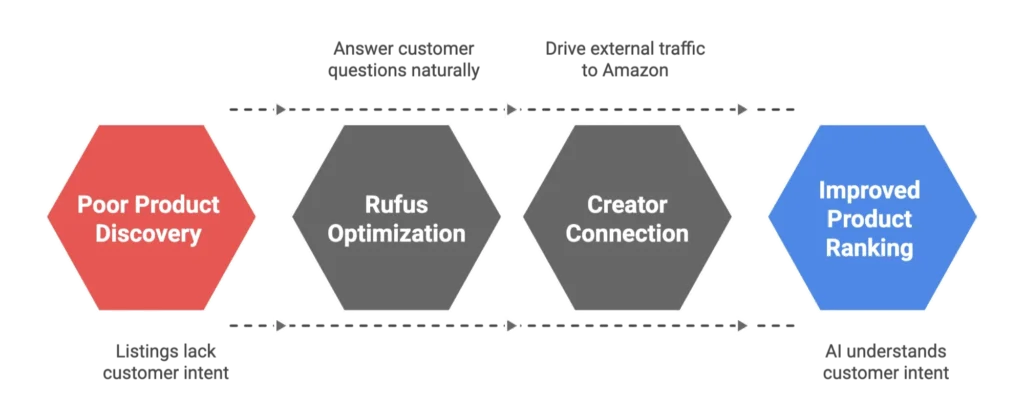
Before we dive into organic ranking strategies, you need to understand that Amazon’s algorithm is undergoing its biggest transformation since its inception. Amazon’s Rufus AI isn’t just a customer service bot—it’s fundamentally changing how products get discovered and ranked. Learning How to Build Amazon Rankings in 2026 requires a total shift from “keyword stuffing” to “semantic clarity” so that AI agents can confidently recommend your ASIN. If you ignore this shift, you’ll find that traditional methods of How to Build Amazon Rankings simply won’t yield the same results they did a year ago.
I’ve been testing this extensively with my own brand and client accounts. Rufus reads your images, reviews, listing content, and even the text in your infographics. When customers ask questions like “What’s the inseam length?” or “Is this tag-free?”, Rufus pulls answers directly from your listing optimization.
Here’s what this means for sellers: traditional keyword stuffing is dead. Amazon’s AI now understands customer intent, not just keyword matching. If your listing can’t answer real customer questions naturally, you’ll lose rankings to competitors who optimize for AI discovery.
The Creator Connection Opportunity
Amazon’s Creator Connection program is another game-changer most sellers are ignoring. I’ve been working with clients to build influencer campaigns that drive external traffic to Amazon—and Amazon loves external traffic.
The key insight: you don’t need massive influencer budgets. I’m seeing success with micro-influencers who create authentic content around product use cases. When these creators drive traffic to Amazon, it signals to the algorithm that your product has organic demand beyond paid ads. This external validation is the ultimate catalyst for How to Build Amazon Rankings, as it proves to the A10 algorithm that your brand is a market leader even off-platform. Mastering this traffic flow is exactly How to Build Amazon Rankings in a saturated 2026 market.
Why Most Amazon Sellers Never Escape Ad Dependency

The Amazon advertising industrial complex wants you to believe success means optimizing ACOS and scaling ad spend. But here’s what they don’t tell you: Amazon’s algorithm rewards listings that can convert traffic organically, not listings that need artificial life support.
Think about it from Amazon’s perspective. They make money two ways: advertising fees and fulfillment fees. While they profit from your ad spend, they make significantly more when you sell units organically. A $20 product generates maybe $2 in ad revenue but $3-4 in fulfillment fees. Amazon’s algorithm naturally favors listings that can drive sales without constant advertising intervention. This logic is the cornerstone of How to Build Amazon Rankings, as it proves that being a “low-maintenance” revenue generator is the best way to maintain high How to Build Amazon Rankings over time.
The Ad Dependency Trap Explained
Most sellers follow this broken playbook:
- Launch with generic listing optimization
- Start PPC campaigns focused solely on ACOS
- Scale ad spend when ACOS looks good
- Never track organic ranking improvements
- Panic when forced to reduce ad spend
This creates what I call “rented traffic”—you’re paying Amazon for temporary shelf space without building any lasting competitive advantage.
I’ve audited hundreds of accounts, and the pattern is always the same. Sellers optimize for vanity metrics like ACOS instead of the metrics that actually matter: organic rank improvement and conversion rate optimization. They’ll celebrate a 15% ACOS while completely ignoring that their organic rankings haven’t budged in six months. Learning How to Build Amazon Rankings requires a mindset shift from short-term ad profitability to long-term market dominance, as the real wealth is found when you master How to Build Amazon Rankings through organic visibility.
The Hidden Costs of Rented Traffic
Beyond the obvious advertising costs, ad dependency creates several hidden expenses:
Competitive Vulnerability: When your ranking depends on outbidding competitors, you’re always one budget increase away from losing visibility. I’ve seen sellers lose 60% of their sales overnight when a competitor decided to get aggressive with PPC.
Seasonal Fluctuations: Q4 advertising costs can triple, making previously profitable campaigns unsustainable. What happens to your business when your cost per click jumps from $2 to $6?
Platform Risk: Algorithm changes or account issues can instantly eliminate your traffic source. Amazon doesn’t send warning letters before changing the rules.
AI-Resistance: As Rufus AI becomes more prominent, listings optimized purely for PPC performance often fail to answer customer questions naturally, losing long-term visibility.
The Organic Ranking Foundation: Understanding Amazon’s True Algorithm
Amazon’s search algorithm prioritizes one thing above all else: relevance + conversion probability + AI compatibility. While most sellers focus on relevance (keywords, categories, attributes), they completely ignore conversion probability and the new AI factors—and that’s where organic rankings are won or lost.
The Four Pillars of Modern Amazon Success

Pillar 1: AI-Optimized Content Strategy
Amazon’s Rufus AI reads everything—your images, bullet points, A+ content, and even customer reviews. When customers ask questions, Rufus pulls answers from your optimized content.
During a recent client call, I discovered their activewear listing was losing sales because Rufus couldn’t answer “What’s the inseam length?” The information wasn’t clearly stated in their content. We added it to their images and A+ content, and within two weeks, organic conversion rates improved by 18%. This simple fix is a masterclass in How to Build Amazon Rankings, as it removes the “information gap” that prevents the AI from closing the sale. By addressing these specific data points, you provide the foundation for How to Build Amazon Rankings that actually last.
AI-Optimization Checklist:
- Include customer question answers directly in your images
- Use clear, readable fonts in infographics (Rufus struggles with poor quality text)
- Add misspellings and alternative terms in backend keywords
- Structure bullet points to answer common customer questions
- Include Spanish and other language variations for broader reach
Pillar 2: Mobile-First Conversion Optimization
Over 70% of Amazon searches happen on mobile, yet most sellers optimize for desktop. On mobile, customers make buying decisions in seconds, often without scrolling past the title and main image.
When I relaunched my own brand, I spent weeks A/B testing main images specifically for mobile visibility. The winning image improved click-through rates by 34% and directly contributed to our organic ranking improvements. Most sellers never test their listings on mobile—they just assume they look good because they formatted them on a laptop. If you want to master How to Build Amazon Rankings, you have to stop designing for your 15-inch MacBook and start designing for a 6-inch iPhone screen, as mobile-first optimization is the primary driver of modern How to Build Amazon Rankings.
Mobile Optimization Essentials:
- Main image tells complete story without text dependency
- Title front-loads primary keyword and core benefit
- Price point positioned competitively within top 3 search results
- Bullet points that work in Amazon’s mobile app layout
Pillar 3: Review Velocity and Quality Management
Amazon’s algorithm tracks review velocity (reviews per unit sold) and average rating trends. A listing getting 1 review per 50 sales will always outrank a listing getting 1 review per 200 sales, even with more total reviews.
The key is understanding that Amazon Vine reviews during launch aren’t just about getting initial social proof—they’re about establishing review velocity patterns that the algorithm interprets as customer satisfaction signals. When you master this, you unlock the most efficient path for How to Build Amazon Rankings because you are feeding the A10 algorithm exactly what it needs: social proof coupled with early-stage trust. Learning How to Build Amazon Rankings effectively requires a shift from “getting reviews” to “managing velocity.”
I always enroll products at 30–50% below target pricing, even though Vine reviewers get the product free. Why? Because Vine reviewers still evaluate value, and they’ll leave better reviews if they perceive a good deal. A 4-star Vine review can kill momentum during the crucial honeymoon period. This specific approach to How to Build Amazon Rankings ensures that your initial social proof is bulletproof, as high-quality reviews are the primary fuel for How to Build Amazon Rankings in a competitive category.
Pillar 4: External Traffic and Creator Partnerships
Amazon’s Creator Connection program is transforming how smart sellers build organic rankings. When influencers drive external traffic to your listings, Amazon interprets this as organic demand validation.
I’ve been working with clients to identify micro-influencers in their categories. Instead of massive campaigns, we focus on authentic product integrations where creators naturally mention the product’s benefits. These partnerships often cost less than daily PPC spend but create lasting ranking improvements. This strategy is essential for How to Build Amazon Rankings because it generates high-quality external traffic, which is a major signal for How to Build Amazon Rankings in the 2026 algorithm.
The 90-Day Organic Dominance Blueprint
The honeymoon period—roughly the first 90 days after launch—is your single biggest opportunity to establish organic rankings. Miss this window, and you’ll spend 10x more on ads trying to recover the same positions later.

Phase 1 (Days 1-30): Foundation Building
Week 1-2: Pre-Launch Optimization
Before you send your first unit to Amazon, everything must be perfect. I’ve seen sellers rush launches only to realize their main image doesn’t work on mobile or their backend keywords are incomplete. You can’t fix these issues mid-launch without losing momentum.
Complete your backend optimization using Amazon’s expanded character limits—most sellers haven’t updated their backend keywords since the character limits increased. Include misspellings, Spanish translations, and alternative product terms that Rufus AI might recognize.
Your category and browse node selection needs verification using Amazon’s Browse Tree Guide. Get this wrong, and your PPC performance suffers immediately.
Vine enrollment should happen at aggressive pricing. I typically price 40-50% below target during Vine to ensure positive reviews. Remember, you’re not making money during launch anyway—you’re investing in algorithmic trust.
Week 3-4: Controlled Launch
Start with limited PPC spend on exact match, high-converting keywords only. Don’t spray and pray with broad campaigns during the honeymoon period. Amazon is evaluating your listing’s conversion potential—show them focused, high-conversion traffic.
Price your product 20-30% below target to maximize conversion rate. This feels uncomfortable, but it’s an investment in organic rankings that will pay dividends for years. Track daily ranking improvements for your top 10 target keywords using Helium 10 or similar tools.
Ensure your inventory is positioned across multiple fulfillment centers. Use Amazon’s inventory placement service if necessary—broad distribution is worth the extra cost during launch.
Phase 2 (Days 31-60): Momentum Acceleration
Strategic Price Increases
Every 2-3 weeks, increase your price by 5-10% while monitoring conversion rates. The goal is finding the optimal price point where you maintain high conversion while maximizing profit. I use a simple rule: if conversion rate drops more than 15% after a price increase, I roll back and wait another week.
Creator Partnership Development
This is the perfect time to launch Creator Connection campaigns. Reach out to influencers who’ve worked with competitors—they’re already familiar with your category and likely have engaged audiences.
I’ve discovered a strategy that’s working incredibly well: find creators who’ve posted about competitor products, then invite them to your Creator program. The success rate is nearly 100% because they’re already creating content in your category.
PPC Strategy Evolution
Shift from exact match to phrase and broad match campaigns, but only for keywords showing organic ranking improvement. Add auto campaigns to discover new keyword opportunities—Amazon’s algorithm often finds relevant terms you missed during research.
Here’s the crucial part: focus ad spend on keywords ranking positions 11-20 organically. These are keywords where you’re “almost there” and additional traffic can push you into the top 10. Conversely, pause ads on keywords where you’ve achieved top 10 organic rankings—let organic traffic carry those terms.
Phase 3 (Days 61-90): Ranking Consolidation
Advanced AI Optimization
Update your EBC alt-text with expanded keyword targeting and customer question answers. Most sellers leave these fields blank, missing a significant optimization opportunity where Rufus AI can find relevant information.
Test your main image for click-through rate improvement. Even small improvements during the honeymoon period create compounding effects on organic rankings.
Organic Transition Strategy
Begin reducing PPC spend on keywords where you’ve achieved top 10 organic rankings. This is where most sellers panic—they’re afraid to reduce ads. But if you’ve built true organic strength, these keywords will maintain or improve rankings without advertising support.
Reinvest PPC savings into building rankings for secondary keywords and expanding your Creator Connection partnerships.
Case Study: $0 to $400K Monthly Revenue with Zero Ad Spend
Let me walk you through the exact strategy I used to build my current clothing brand—complete transparency on what worked, what didn’t, and the specific tactics that drove results.
The Foundation (Months 1-3)
Initial Investment: $400,000 in inventory across two parent listings Launch Strategy: Aggressive pricing with focus on conversion rate optimization
Month 1: $66,000 in sales (launch month, partial) Month 2: $22,000 in sales (learning phase, pricing adjustments) Month 3: $69,000 in sales (momentum building)
The key insight from this phase: clothing requires obsessive stock management. Each size and color combination ranks independently. When our medium black t-shirt (our best seller) went out of stock, our entire listing lost rankings for primary keywords, even though we had other sizes available.
The Crisis and Recovery (Months 4-8)
The Problem: Supply chain delays forced stockouts on key variations Revenue Impact: Sales dropped from $69K to $20K monthly
This was painful but educational. I learned that Amazon treats each child ASIN separately for ranking purposes. Losing stock on your top-performing variation can crash your entire listing’s visibility.
Recovery Strategy:
- Air-freighted inventory at 3x normal cost to restore stock levels
- Restarted PPC campaigns focused on previously ranking keywords
- Implemented aggressive pricing to rebuild conversion rates
- Used Lightning Deals strategically to boost organic ranking recovery
But here’s the interesting part: the recovery happened faster than expected because our original honeymoon period optimization had created enough algorithmic trust. Customers in certain states saw 4-5 day delivery times due to low inventory distribution, which initially hurt conversions. But the moment stock levels improved and inventory spread across fulfillment centers, organic ranks bounced back without extensive advertising.
Current Performance (Months 9-12)
Monthly Revenue: $400,000+ with zero ad spend for 90+ days Key Metrics:
- Ranking top 5 for primary keywords with 200K+ search volume
- 4.7-star average rating with consistent review velocity
- 60+ days inventory across all variations maintained
- Profit margin improved from 8% to 25%+
Why This Works:
The foundation built during the honeymoon period created enough algorithmic trust and organic momentum to sustain growth without ongoing ad investment. When I tell other sellers I’ve had zero ad spend for three months, they don’t believe it. But the rankings speak for themselves.
The secret isn’t magic—it’s understanding that Amazon rewards listings that prove they can convert traffic organically. Once you establish that trust during the honeymoon period, the algorithm works in your favor instead of against you.
Advanced Strategies: The AI-First Ecosystem Approach
Building sustainable organic rankings requires understanding how every element of your Amazon presence works together in the new AI-driven marketplace. Most sellers optimize in silos—tweaking PPC here, updating copy there—without understanding the chain reaction effects.

Rufus AI Optimization Strategy
Amazon’s Rufus AI is reading more of your listing than you realize. In my recent client calls, I’ve been showing sellers how Rufus extracts information from images, even when the text is small or poorly formatted.
Image Text Optimization: Your infographics need clear, readable text that answers customer questions. I’ve seen listings lose sales because Rufus couldn’t read important product details from poorly designed images. Use high contrast, large fonts, and test your images by uploading them to ChatGPT to see if AI can read the text clearly.
Backend Keyword Evolution: With AI reading capabilities, your backend keywords should include customer intent phrases, not just product terms. Include phrases like “helps prevent chafing” or “moisture-wicking material” alongside traditional keywords.
Creator Connection Integration
The Creator Connection program isn’t just about getting reviews—it’s about building external traffic signals that Amazon’s algorithm loves.
Micro-Influencer Strategy: Instead of targeting influencers with millions of followers, focus on creators with 10K-100K highly engaged audiences in your niche. These partnerships are more affordable and often drive higher conversion rates because the audience trusts the creator’s recommendations.
Cross-Competitor Outreach: Here’s a strategy that’s working incredibly well: identify creators who’ve posted about competitor products, then invite them to your Creator program. They’re already creating content in your category, understand your target audience, and typically accept invitations because they’re familiar with the product type.
Catalog Architecture for Scale
Parent-Child Relationship Optimization: Each variation (color, size, etc.) is ranked independently by Amazon’s algorithm. If your top-performing variation goes out of stock, your entire listing can lose rank for primary keywords.
Strategic Variation Management:
- Identify which variations rank for primary keywords
- Maintain higher stock levels on ranking variations
- Use PPC to build rankings across multiple variations
- Monitor keyword rankings at the child ASIN level
When my clothing brand’s black medium t-shirt went out of stock, our rankings for “men’s graphic tee” dropped from position 3 to position 18, even though we had the same design in other colors and sizes. Amazon’s algorithm had learned that the black medium specifically converted well for that keyword.
Implementation Framework: Your 90-Day Action Plan
Week 1-2: Audit and Foundation
Complete Account Audit: Download your Category Listing Report from Seller Central to identify backend errors Amazon may have introduced. I’ve found instances where Amazon’s bots changed item type keywords without notification, killing organic rankings overnight.
Audit all variations for keyword ranking at the child ASIN level using Helium 10’s keyword tracking. Most sellers only track parent ASIN rankings, missing critical variation-level insights.
AI-Ready Listing Optimization: Rewrite your copy with both mobile-first approach and AI discoverability in mind. Every bullet point should answer a potential customer question that Rufus might be asked.
Test all your images by uploading them to ChatGPT and asking if it can read the text clearly. If AI struggles to read your product information, so will Rufus.
Week 3-6: Launch Execution
PPC Strategy: Start with exact match campaigns on your top 10 keywords only. Bid aggressively during the honeymoon period—this is not the time to optimize for ACOS. You’re investing in future organic rankings.
Track organic rank daily using keyword tracking tools. Create alerts for significant ranking changes so you can adjust strategy quickly.
Creator Partnership Launch: Set up your Creator Connection campaigns and start outreach to micro-influencers. Focus on creators who’ve already posted about products in your category—they understand your audience and are more likely to create authentic content.
Week 7-12: Optimization and Scale
Performance Analysis: Identify which keywords are improving organically week over week. These are your candidates for PPC reduction.
Reduce PPC spend gradually on top-ranking keywords while monitoring for ranking drops. If organic rankings hold steady for 2 weeks after PPC reduction, the keyword has achieved organic sustainability.
Advanced AI Tactics: Monitor what questions customers are asking about your products and ensure your listing content answers them clearly. Use Amazon’s customer questions section and review analysis to identify content gaps.
Optimize your images based on AI readability—clear, high-contrast text that answers customer questions directly.
Measuring Success: KPIs That Actually Matter in the AI Era
Forget vanity metrics. These are the only numbers that matter for building sustainable organic growth:
Primary KPIs
Organic Rank Improvement: Track your position for top 10 keywords weekly. Consistent improvement indicates your organic strategy is working. I use a simple traffic light system—green for improving rankings, yellow for stable, red for declining.
Organic Sales Percentage: Calculate what percentage of total sales come from organic traffic vs. PPC. Aim for 70%+ organic within 6 months. My current brand is at 95%+ organic.
AI Question Coverage: Monitor whether Rufus can answer common customer questions about your product. Test this regularly by asking Rufus questions about your listing.
Creator-Driven Traffic: Track external traffic from Creator Connection campaigns. This metric is becoming increasingly important as Amazon favors listings with diverse traffic sources.
Secondary KPIs
Review Velocity: Reviews per 100 units sold. Industry benchmark is 1-3 reviews per 100 units, but top-performing listings often achieve 4-5 reviews per 100 units through superior customer experience.
Mobile Conversion Rate: Track this separately from desktop. With 70%+ of traffic on mobile, your mobile conversion rate is often more important than overall conversion rate.
Inventory Distribution Score: Monitor how your inventory is distributed across fulfillment centers. Poor distribution leads to longer delivery promises and lower conversion rates.
Common Mistakes That Kill Organic Rankings

Mistake 1: Ignoring AI Optimization
Most sellers are still optimizing for 2019 Amazon, not 2025 Amazon. They stuff keywords in backend fields without considering that Rufus AI needs natural, readable content to answer customer questions.
Solution: Optimize your entire listing for AI discoverability. Include customer question answers in your images, use clear fonts, and structure content so AI can easily extract information.
Mistake 2: Missing the Creator Economy
Sellers are leaving massive opportunity on the table by ignoring Creator Connection. External traffic signals are becoming increasingly important for organic rankings.
Solution: Start small with micro-influencers in your niche. Even one successful creator partnership can drive meaningful ranking improvements.
Mistake 3: Treating Variations Independently
Each color/size variation competes independently for keyword rankings. Sellers often optimize the parent without considering variation-level performance.
Solution: Track keyword rankings and stock levels by individual variation. Prioritize inventory management for your highest-ranking variations.
Mistake 4: Premature PPC Optimization
Reducing ad spend before establishing organic rankings leaves you dependent on increasingly expensive traffic. I see sellers pause profitable campaigns because they think 25% ACOS is “too high,” not realizing those campaigns are building organic rankings worth 10x the ad spend.
Solution: Only reduce PPC spend on keywords where you’ve achieved top 10 organic rankings consistently for 2+ weeks.
Conclusion: Building Amazon Real Estate in the AI Era
The choice is simple: continue renting traffic from Amazon through ever-increasing ad costs, or invest in building organic rankings you actually own in this new AI-driven marketplace.
I’ve shown you the exact framework that built my $400K monthly clothing brand with zero ongoing ad spend, plus the new strategies required for success with Rufus AI and Creator Connections. The strategies aren’t theoretical—they’re battle-tested over 12 years of selling and refined through helping dozens of manufacturers and private label brands break free from ad dependency.
Your next steps:
- Audit your listings for AI compatibility and mobile optimization
- Set up Creator Connection campaigns with micro-influencers
- Implement the 90-day honeymoon period strategy for your next launch
- Track the KPIs that actually matter for organic growth in the AI era
Remember: Amazon is still a ranking game, not an advertising platform. But the rules have evolved. Master the new ranking game with AI optimization and external traffic building, and advertising becomes a tool for acceleration rather than survival.
The sellers who understand this distinction are building sustainable, profitable businesses in the AI era. The ones who don’t are stuck in an expensive hamster wheel, watching their margins shrink as advertising costs increase and their listings become invisible to AI discovery.
Amazon’s Rufus AI isn’t just changing how customers find products—it’s rewriting the entire playbook for organic success. The sellers who adapt first will dominate their categories. The ones who wait will be left behind.
Which seller will you be?
Frequently Asked Questions
Q: How does Rufus AI change traditional Amazon SEO strategies?
Rufus AI reads your images, reviews, and listing content to answer customer questions. Traditional keyword stuffing is less effective than creating content that naturally answers customer questions. Focus on clear, readable information that AI can extract and present to customers.
Q: Can I build organic rankings without spending on ads initially?
While possible, it’s significantly more difficult and time-consuming. Strategic PPC during the honeymoon period accelerates organic ranking development by providing the traffic volume needed for Amazon’s algorithm to evaluate your listing’s conversion potential. Combine this with Creator Connection traffic for best results.
Q: How do I know if my listing is optimized for AI discovery?
Test your images by uploading them to ChatGPT and asking if it can read the text clearly. Monitor customer questions about your product and ensure your content answers them. Use Rufus AI directly on your listing to see what information it can extract.
Q: What’s the minimum budget needed for Creator Connection campaigns?
Start with $500-1000 for micro-influencer partnerships. Focus on creators with 10K-100K followers in your niche. Many creators accept free products plus small payment for authentic reviews and social posts that drive external traffic to Amazon.
Q: How long does it take to see results from organic ranking strategies?
With proper execution during the honeymoon period, you can establish strong organic rankings within 90 days. However, achieving complete ad independence typically takes 6-12 months depending on competition level and execution quality. AI optimization results can be seen within 2-4 weeks.


