 Skip to content
Most private label sellers are trapped in an expensive hamster wheel, spending more on ads each month but never mastering the art of building Amazon brands that achieve true organic ranking dominance. After 12+ years of building, selling, and launching Amazon brands—including a current brand doing $400,000+ monthly with zero ad spend—I’ve learned that Amazon isn’t just a sales channel; it’s a ranking ecosystem.
After 12+ years of building Amazon brands—including a current brand doing $400,000+ monthly with zero ad spend—I’ve learned that Amazon isn’t a pay-to-play advertising platform. It’s a ranking ecosystem where organic visibility determines everything, and success in building Amazon brands hinges on mastering that organic growth.
The uncomfortable truth? Most sellers treat Amazon like Google Ads instead of understanding it’s a complex ecosystem where building Amazon brands requires listing optimization, catalog architecture, inventory positioning, and strategic advertising to work in perfect harmony. You don’t need hundreds of mediocre listings—you need a few dominant ones doing serious revenue. When building Amazon brands, the goal is to shift from a transactional mindset to a long-term strategy that captures market share across the entire platform.
This isn’t another “how to start private label” guide filled with surface-level tactics. This is the complete brand-building system I use with my own brands and high-level clients—the exact framework that helped me take a clothing client from $3 million to $24 million in two years by fixing one critical oversight most sellers never consider.
The Amazon Ecosystem Reality Check: What Most Private Label Sellers Get Wrong
After managing accounts for 12+ years, I see the same pattern everywhere: sellers focus on individual tactics instead of understanding how everything connects. When one piece fails, the entire ecosystem collapses.
Here’s what most private label sellers fundamentally misunderstand about Amazon:
Amazon treats each variation as its own listing with independent ranking power. If you have a clothing item with multiple colors, each color ranks separately for keywords. When your best-performing variation sells out, Amazon doesn’t just swap in another color—you lose that ranking position entirely, and your whole listing suffers.
I learned this lesson with a client building Amazon brands who was doing well but constantly running out of stock on key variations. They’d restock different colors and wonder why their rankings kept crashing; they didn’t realize that building Amazon brands requires treating variations as independent ranking assets rather than interchangeable inventory. The problem wasn’t their product or their ads—it was a fundamental misunderstanding of how the algorithm weights individual parent-child relationships.
Once we fixed their inventory strategy and treated each variation like its own business, their growth exploded from $3 million to $24 million over two years. The lesson? Amazon rewards consistency and reliability across every single ASIN in your catalog.
Backend errors silently destroy rankings without visible symptoms. Amazon’s bots regularly update product classifications, sometimes changing “Pajama Sets” to “Pajamas Sets”—a tiny tweak that can tank your organic rank, PPC performance, and visibility. Most sellers never notice until it’s too late because everything looks normal on the front end.
Inventory distribution affects organic rank more than most sellers realize. Having stock in FBA doesn’t guarantee fast shipping promises. If Amazon can’t distribute your inventory properly across fulfillment centers, customers in certain regions see longer delivery times, which kills conversions and hurts your organic positioning.
“This happened with building Amazon brands of my own recently. Even though I had inventory, some regions saw 4-5 day shipping instead of 2-day delivery, proving that building Amazon brands requires as much focus on logistics as it does on marketing. Sales slowed down until inventory levels improved and Amazon could promise faster shipping again; however, the ranking recovered immediately once distribution normalized.”
The Private Label Brand Architecture Framework: Building Listings That Dominate
Pre-Launch Foundation: The Honeymoon Advantage
Everyone talks about the honeymoon period lasting 30-90 days, but I believe it’s more nuanced. The first week is strongest, but the advantage doesn’t suddenly disappear—it gradually weakens. Even a year-old listing can be “relaunched” with the right strategic refresh.
I proved this with my own brand. After a year of operations, I successfully refreshed the listing and ranked into top positions for high-volume keywords with over 387,000 monthly search volume. The key was treating it like a strategic relaunch, not just turning ads back on.
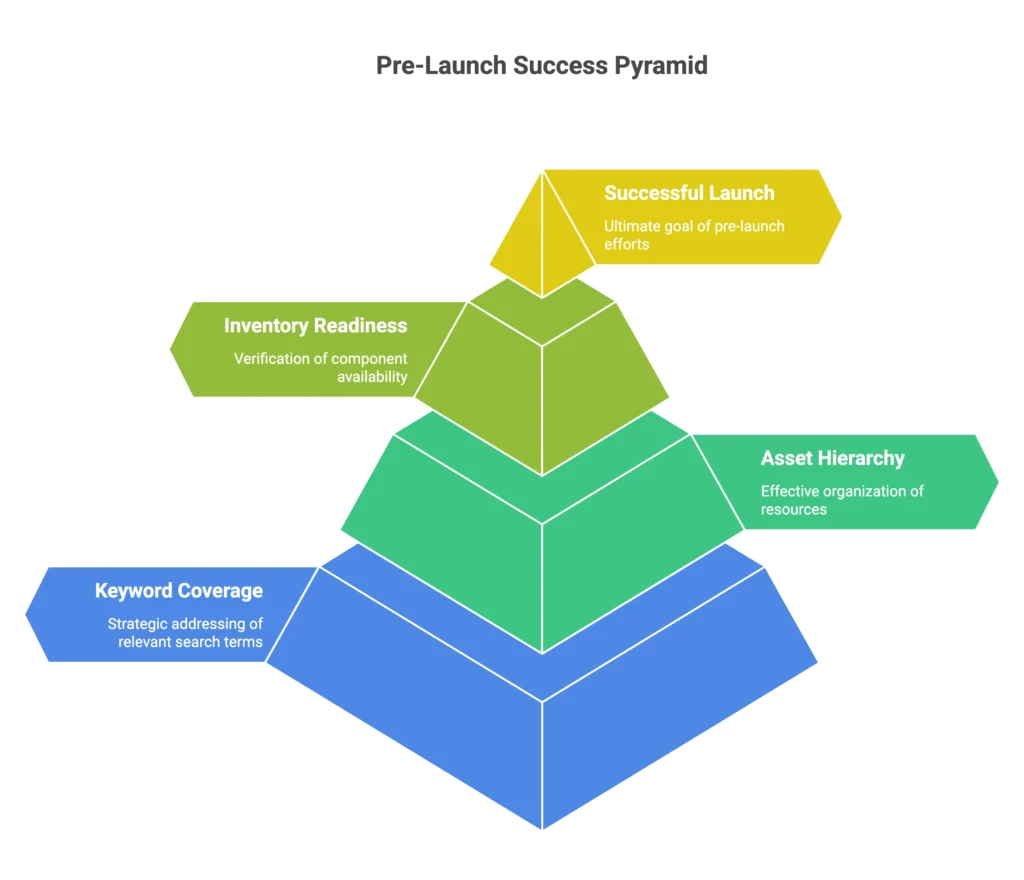
Your pre-launch foundation determines everything:
Keyword coverage mapping means building comprehensive backend optimization that feeds your advertising strategy. When I optimize a listing, I include longtail keywords, short tail, Spanish keywords, even common misspellings. This gives auto campaigns a rich foundation to work from, uncovering opportunities I never would have considered manually.
Asset hierarchy strategy focuses on mobile-first optimization because most people never scroll past the title on mobile. Your image sequence, A+ content placement, and video integration must tell the complete story and drive conversion in seconds, not minutes.
Inventory readiness gates require 60-90 day stock levels minimum. If you only have 30 days of inventory, Amazon deprioritizes your listing because they see low stock as unreliable. Limited stock also creates uneven fulfillment center distribution, causing delivery time variations that kill conversions.
Catalog Architecture as Competitive Moat
Most sellers have messy catalogs with duplicate ASINs, wrong variation setups, or split parents that dilute their ranking power. We audit and rebuild catalog architecture so every listing scales correctly.

Parent-child structure optimization consolidates ranking signals instead of spreading them thin. Many brands unknowingly split variations that should be combined, or combine variations that should be separate. Each decision affects how Amazon interprets your catalog and distributes ranking power.
Bundle and multipack strategies compound your ranking signals when done strategically. Instead of just offering single units, well-designed bundles can capture different search intents while building authority for your core product variations.
ASIN cleanup methodology eliminates ranking dilution from duplicate or conflicting listings. Every duplicate ASIN in your catalog weakens your overall ranking potential by splitting the signals Amazon uses to determine relevance and authority.
The Ads-to-Organic Flywheel System: Strategic PPC That Builds Rank
Beyond ACOS: The Real Amazon Advertising Metrics
Stop obsessing over ACOS—it’s not always the right metric. A low ACOS doesn’t always mean success, and a high ACOS doesn’t always mean failure.
Sometimes higher ACOS is strategically smart if the ad is driving organic rank improvement. If your organic rankings aren’t climbing for target keywords, you’re just fueling Amazon’s pockets, not building your brand’s foundation.
I like to start with auto campaigns because they feed off comprehensive backend optimization, which is the first step in building Amazon brands. Amazon’s algorithm tests your listing against keywords based on your backend content, continuously generating new targeting opportunities. Since these auto campaigns run forever, they help in building Amazon brands by discovering relevant terms I never would have found manually.
The key metric isn’t ACOS—it’s conversion rate on target keywords combined with organic rank movement. High conversion rates signal to Amazon that your listing deserves better organic positioning for those terms.
My current brand proves this system works. After building strong organic rankings through strategic advertising, I was able to turn off ads completely and maintain $400,000+ monthly revenue. This is the ultimate goal of building Amazon brands without ads — creating a listing so healthy that the organic momentum carries the revenue without the need for constant PPC “rent.”
The Inventory-Rank Connection Most Sellers Ignore
Amazon rewards listings that can reliably deliver fast shipping. If your stock isn’t properly distributed across fulfillment centers, Amazon deprioritizes your product even when you have inventory available.
The 60-90 day inventory strategy ensures Amazon can distribute your stock across multiple fulfillment centers, guaranteeing consistent shipping promises. When customers across different regions see the same fast delivery options, your conversion rates stay high and rankings remain stable.
Stock level monitoring prevents the ranking crashes that happen when key variations sell out. Remember: each size and color ranks independently. Losing your top-performing variation doesn’t just mean lost sales—it means lost ranking position that’s difficult to recover.
This inventory-rank connection explains why my brand’s rankings dropped when stock levels got low, even though I wasn’t out of inventory. The moment distribution improved, organic rankings and sales recovered immediately.
Mobile-First Optimization Strategy: Building Listings That Convert in 5 Seconds
Amazon is increasingly mobile-first, but most sellers still optimize for desktop. Your listing must convert mobile browsers who make split-second decisions while scrolling.
Title optimization for mobile means front-loading the most important information. Mobile users see truncated titles, so your core value proposition must be clear in the first few words, not buried at the end.
Image hierarchy focuses on thumb-stopping power. Your main image needs to clearly communicate what the product is and why someone should click. Secondary images must tell the complete story through infographics and lifestyle shots that work on small screens.
Backend optimization for expanded character limits takes advantage of Amazon’s recent increases in backend keyword space. Many sellers haven’t updated their backend fields in years, missing easy opportunities for improved PPC performance and organic discovery.
Advanced Private Label Tactics: What Agencies Don’t Check
Backend Audit Framework
Amazon might secretly change your product classification without notification. One day your item type keyword is “Pajama Sets,” the next day Amazon’s bots change it to “Pajamas Sets.” This tiny change can destroy your organic rank, PPC performance, and visibility.
Monthly backend audits catch these classification changes before they tank your performance. Download the Category Listing Report from Seller Central to uncover hidden issues that don’t show up on the front end.
Browse Tree Guide verification ensures your item type keywords and browse nodes match your category correctly. Misalignment here crushes your performance because Amazon can’t properly categorize and rank your product.
Field completion strategies prevent Amazon’s bots from auto-filling missing attributes incorrectly. Skipping optional backend fields gives Amazon permission to guess—and they usually get it wrong, hurting your ranking potential.
Pricing Psychology and Competitive Positioning
Strategic pricing during honeymoon periods maximizes your initial momentum without training customers to wait for discounts. The goal is building sustainable price perception, not just generating early sales through deep discounts.
Competitive positioning without racing to the bottom means understanding that you don’t need to be the cheapest—you need to be the obvious choice. Price competitively within your category while building superior value perception through listing optimization and customer experience.
My current brand actually raised prices while maintaining growth because the organic ranking strength and listing optimization made it the clear category leader. Customers chose us despite higher prices because the value proposition was superior.
Frequently Asked Questions
How long does the Amazon honeymoon period actually last for private label products?
The honeymoon period is strongest in the first 90 days, with the first week being most powerful. However, it doesn’t end abruptly—the advantage gradually weakens over time. Even established listings can be strategically relaunched to capture renewed momentum.
Can you build organic ranking without spending thousands on Amazon PPC?
Yes, but PPC accelerates the process when used strategically. Focus on conversion rates and organic rank improvement rather than just ACOS. My current brand maintains $400K+ monthly revenue with zero ad spend after building proper organic foundation through strategic advertising.
What’s the minimum inventory level needed to maintain Amazon ranking?
Aim for 60-90 days of inventory to ensure proper fulfillment center distribution. Lower stock levels cause Amazon to deprioritize your listing and create shipping time variations that hurt conversions and rankings.
How do you fix a private label listing that’s stuck at low rankings?
Audit your entire ecosystem: backend optimization, catalog structure, inventory positioning, and mobile conversion experience. Most ranking problems stem from foundational issues, not just advertising tactics.
What backend errors tank Amazon rankings without sellers knowing?
Classification changes (item type keywords, browse nodes), missing field auto-fills by Amazon’s bots, and variation structure problems. These happen silently and require regular audits to catch early.
Building Brands That Sell Themselves
Building a sustainable private label brand on Amazon isn’t about tactics—it’s about understanding the ecosystem. Every element from catalog architecture to inventory positioning to mobile optimization must work together strategically.
After 12+ years of building brands on Amazon—including my current $400K/month brand running profitably with zero ad spend—I know what separates winners from the endless middle. It’s not about spending more. It’s about building smarter.
The brands that truly sell themselves have mastered the fundamentals: rock-solid catalog architecture, strategic inventory management, mobile-first optimization, and advertising that builds organic ranking rather than just generating clicks.
Most sellers are stuck in the ad-spend hamster wheel because they never built these fundamentals. They’re renting traffic instead of building assets. They’re managing symptoms instead of addressing root causes.
Ready to stop renting traffic and start building organic dominance? The difference between a listing that survives and one that dominates lies in treating Amazon like the complex ecosystem it is—not just another place to run ads.

