 Skip to content
Amazon isn’t a pay-to-play advertising platform—it’s a ranking game. Most sellers are stuck in an expensive hamster wheel because they treat Amazon like Google Ads instead of understanding it’s an ecosystem where organic ranking is everything.
After 12 years of selling on Amazon and building multiple brands from scratch, I’ve learned that you don’t need hundreds of mediocre listings churning through ad spend. You need a few dominant ones doing millions each year, powered by Amazon organic rankings that work whether your ads are on or off. Developing a system for sustainable Amazon organic rankings is the only way to move from simply paying for traffic to owning your market share.
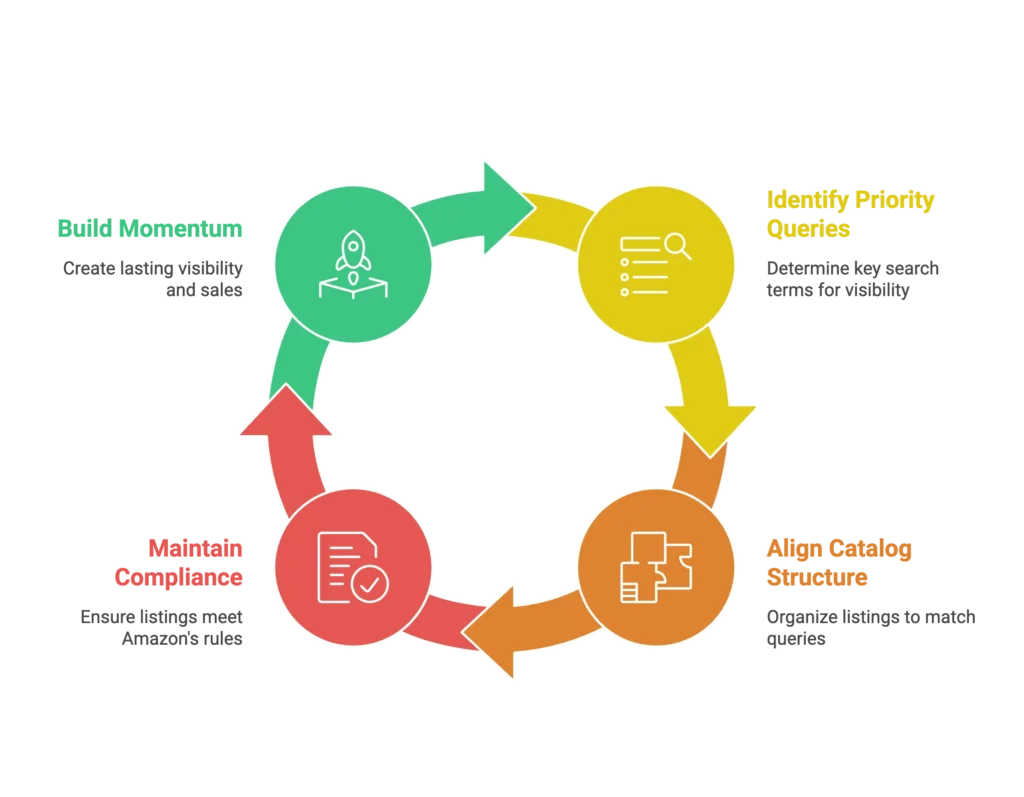
Most ‘Amazon SEO‘ advice focuses on surface-level tactics while missing the systematic approach that actually moves the needle. The real game is building what I call an ‘Organic Ranking Operating System’—a data-driven framework that identifies priority queries, aligns your catalog architecture to those queries, maintains compliance with Amazon’s evolving rules, and creates momentum that compounds over time.
Whether you’re a manufacturer looking to break into Amazon or an established seller tired of feeding the ad machine, this framework will show you how to build rankings that last.
Understanding Amazon’s Ranking Ecosystem
Amazon’s algorithm doesn’t just reward the highest bidder—it rewards listings that convert consistently across multiple touchpoints. When you understand this, everything changes.
Here’s what most sellers miss: Amazon treats each size, color, or variation of your product as an individual listing. If one variation ranks organically for a high-value keyword and you run out of stock, Amazon doesn’t simply substitute another variation. You lose that ranking position entirely, and your entire parent listing suffers.
This is why I focus on inventory management as a ranking factor, not just a logistics concern. When customers in New York see 2-day delivery but customers in California see 5-day delivery for the same product, conversion rates drop. Amazon notices this performance difference and adjusts your Amazon organic rankings accordingly to favor sellers with better regional coverage. Protecting your Amazon organic rankings requires a 90-day inventory buffer to ensure consistent delivery promises across all zones.
The Data Sources That Actually Matter
Most sellers rely on guesswork when they should be using Amazon’s native tools:
Search Query Performance (SQP) shows exactly which search terms are driving traffic to your listings. This data tells you where to focus your optimization efforts based on real customer behavior, not keyword tool speculation.
Search Catalog Performance (SCP) reveals where your funnel is breaking down. You can see the exact drop-off points from impressions to clicks to cart adds to purchases, identifying specific optimization opportunities.
Product Opportunity Explorer (POE) sizes market demand for specific niches and keywords, helping you prioritize which products and terms deserve your attention and budget.
The key insight: Amazon gives you the data you need to win. Most sellers just don’t know how to use it systematically.
The Organic Ranking Operating System Framework
Phase 1: Demand Discovery and Target Identification
Start with Product Opportunity Explorer to size your market. Navigate to Brand Analytics and filter by your relevant categories. Look for high search volume keywords with manageable competition levels.
Next, leverage Search Query Performance for query prioritization to boost your Amazon organic rankings. Access your current traffic data and identify which queries already drive traffic to your listings. Calculate conversion rates for each query type and prioritize based on both search volume and conversion potential, as securing top Amazon organic rankings requires a data-driven approach to keyword relevance.
For competitive analysis, identify your top competitors and analyze their keyword footprint. Map their ranking positions for priority keywords and calculate the estimated sales velocity needed to compete effectively.
Phase 2: Backend Optimization That Actually Impacts Rankings
Amazon has expanded character limits for backend search terms, yet most sellers haven’t updated theirs in years. This represents a massive opportunity.
Backend Search Terms Best Practices:
- Use all available character space (limits vary by category)
- Include misspellings, synonyms, and related terms customers actually use
- Avoid repetition from title and bullets—this is wasted space
- Include Spanish terms if relevant to your customer base
- Test long-tail variations that auto campaigns discover
Critical Backend Fields Most Sellers Miss: Your Item Type Keyword must match the Browse Tree Guide exactly. A mismatch here can silently tank your rankings without any notification. Fill out Target Audience fields, material composition, size and color attributes, and subject matter tags. If you leave these blank, Amazon’s bots will fill them in—and they usually get it wrong.
Phase 3: 2025 Compliance Framework
Amazon updated title requirements in January 2025, and many sellers still haven’t adapted. Here’s what you need to know:
Title Optimization Rules:
- No promotional phrases like “Best,” “Top Rated,” or “#1”
- Include your primary keyword in the first 60 characters
- Use proper capitalization (no ALL CAPS except brand names)
- Include key specifications that customers search for
Image Requirements: Your main image needs minimum 1000px on the longest side for zoom functionality. Use a pure white background and ensure your product fills 85% of the frame. Lifestyle and infographic images must provide clear value, not just look pretty.
Compliance isn’t just about avoiding violations—it’s about maximizing your listing’s performance within Amazon’s current algorithm preferences.
Strategic PPC That Builds Organic Rank
Most sellers obsess over keeping ACOS low. This is backwards thinking that keeps you small.
The Real Framework: High conversion rate keywords deserve higher spend, not lower. If a keyword converts well for your listing, that signals to Amazon that your product is relevant for that search term. Increased spend on high-converting keywords builds organic momentum.
Campaign Structure for Organic Growth
Auto Campaigns as Research Tools: Launch auto campaigns for every new listing and let Amazon’s algorithm test keyword relevance. Monitor search term reports weekly to identify high-converting, high-volume opportunities that you might have missed in manual research.
Exact Match Scaling: Move proven keywords to exact match campaigns and bid aggressively during the honeymoon period (first 30-60 days). Monitor organic rank improvement week over week, then gradually reduce bids as organic strength builds.
I currently manage accounts where clients maintain 7% TACOS while building consistent organic growth. The key is treating PPC as an investment in organic rank, not just a direct sales driver.
Inventory Management as a Ranking Factor
Maintaining 60-90 days of inventory isn’t just good business—it’s a ranking requirement that most sellers don’t understand.
Why Inventory Levels Impact Rankings: Amazon distributes products across fulfillment centers based on current stock levels. Low inventory means inconsistent delivery promises across regions. When customers see longer delivery times, conversion rates drop. Poor conversion rates signal Amazon to reduce organic visibility.
The 90-Day Rule in Practice
I learned this lesson with my own brand. Even when I had inventory, running low on certain variations meant Amazon couldn’t promise fast delivery in all regions. Some customers saw 2-day shipping while others saw 5-day shipping for the same product. The conversion rate difference was dramatic, and my Amazon organic rankings reflected it immediately. Maintaining regional stock balance is essential because the algorithm prioritizes local availability to ensure fast delivery. Ultimately, if your logistics falter, your Amazon organic rankings will drop regardless of how well your listing is optimized.
Per-Variation Management: Treat each size and color as an independent business unit. Calculate 90-day velocity for each child ASIN and send inventory based on individual variation performance. Never launch with less than 60 days supply, and plan for 3x normal velocity during promotional periods.
Advanced Optimization Tactics
Monthly Backend Audits
Amazon’s bots constantly scan your listings and sometimes make “improvements” without notification. Download your Category Listing Report monthly and compare item type keywords to the Browse Tree Guide. Verify all required attributes are populated and correct any discrepancies immediately.
I’ve seen listings lose 50% of their organic traffic because Amazon changed their item type keyword from “Pajama Sets” to “Pajamas Sets”—a small change that completely altered their categorization and visibility.
Testing Framework That Works
Use Manage Your Experiments to test one element at a time. Run tests for minimum 4-6 weeks to get statistically significant results. Track both conversion rate changes and organic rank movement, not just immediate sales impact.
Measuring and Maintaining Momentum
Track these metrics weekly: organic units sold versus total units, keyword ranking positions for your top 10 targets, conversion rate by traffic source, and days of supply remaining per variation.
Monthly analysis should include Search Query Performance trends, Search Catalog Performance funnel analysis, competitive ranking position changes, and backend field compliance audits.
The Million-Dollar Listing Formula: Focus on products with $1M+ annual potential. Perfect one listing before launching variations. Build organic strength before expanding your catalog. Reinvest profits into inventory and optimization rather than launching more mediocre products.
When Rankings Drop: Diagnostic and Recovery
When rankings drop unexpectedly, check inventory levels and distribution first. Audit backend fields for unauthorized changes and review recent policy updates. Analyze competitor activity and verify your fulfillment performance metrics.
Stock-Out Recovery: Prioritize fastest inbound shipping methods and communicate delivery expectations clearly. Monitor rank recovery timeline, which typically takes 2-4 weeks after inventory levels normalize.
Frequently Asked Questions
How long does it take to build organic rankings?
With proper execution, you can see meaningful organic rank improvements within 30-60 days for new listings, and 60-90 days for established listings that need optimization. The key is maintaining consistent sales velocity and conversion rates during this period.
Can I really turn off ads and maintain sales?
Yes, but only after you’ve built strong organic rankings and high conversion rates. My own brand maintained $400K monthly sales with zero ad spend for 90+ days, but this was only possible because we had already secured top 5 organic positions for competitive keywords.
What’s the biggest mistake sellers make with backend keywords?
Most sellers either leave backend fields empty or haven’t updated them in years. Amazon has expanded character limits and field options, but sellers are still using old optimization strategies.
How do I know if my organic strategy is working?
Track your organic units percentage weekly. If 70%+ of your sales require ads, you’re not building true organic strength. Healthy listings eventually achieve 60-80% organic sales.
Should I focus on one listing or multiple products?
Master one listing first. It’s better to have one product doing $1M+ annually than ten products each doing $100K. Once you’ve proven the system works, you can replicate it across your catalog.
From Ad Dependency to Organic Dominance
Building Amazon organic rankings isn’t about gaming the system—it’s about understanding how Amazon’s ecosystem actually works and aligning your strategy accordingly.
The sellers who win long-term are those who treat Amazon as a ranking game, not an advertising platform. They focus on conversion rates and building Amazon organic rankings, not just chasing a low ACOS. They optimize for customer experience, not just keyword stuffing. By managing inventory strategically rather than reactively, they ensure consistent availability, which is the secret engine behind sustainable Amazon organic rankings and long-term market dominance.
This framework has helped my clients build sustainable businesses that don’t collapse when ad costs rise or budgets get cut. But it requires patience, precision, and a willingness to invest in the foundation rather than just chasing quick wins.
The choice is yours: keep feeding the ad machine and hoping for the best, or build the systematic approach that creates lasting competitive advantage.
If you have to keep feeding ads to make sales, you’re not growing—you’re paying rent. Build the organic foundation, and let Amazon’s algorithm work for you instead of against you.

