 Skip to content
Most Amazon sellers crushing it in the US make the same costly mistake when expanding internationally—they copy-paste their Amazon USA Mastery playbook and wonder why it crashes and burns.
I’ve been managing Amazon accounts for 12+ years, building multi-million dollar brands exclusively in the US marketplace. When clients ask me about expanding to Europe or Canada, I’m brutally honest: “That’s not my expertise, and here’s exactly why that matters.”
The Amazon US ecosystem I know inside and out—where Amazon USA Mastery means organic ranking trumps ad spend, where inventory positioning can make or break your Q4, and where the honeymoon period determines your long-term success—operates by completely different rules once you cross borders. Achieving true Amazon USA Mastery requires understanding that this isn’t just a bigger market; it is a ranking ecosystem that rewards those who build brand equity over those who simply “pay rent” to Amazon.
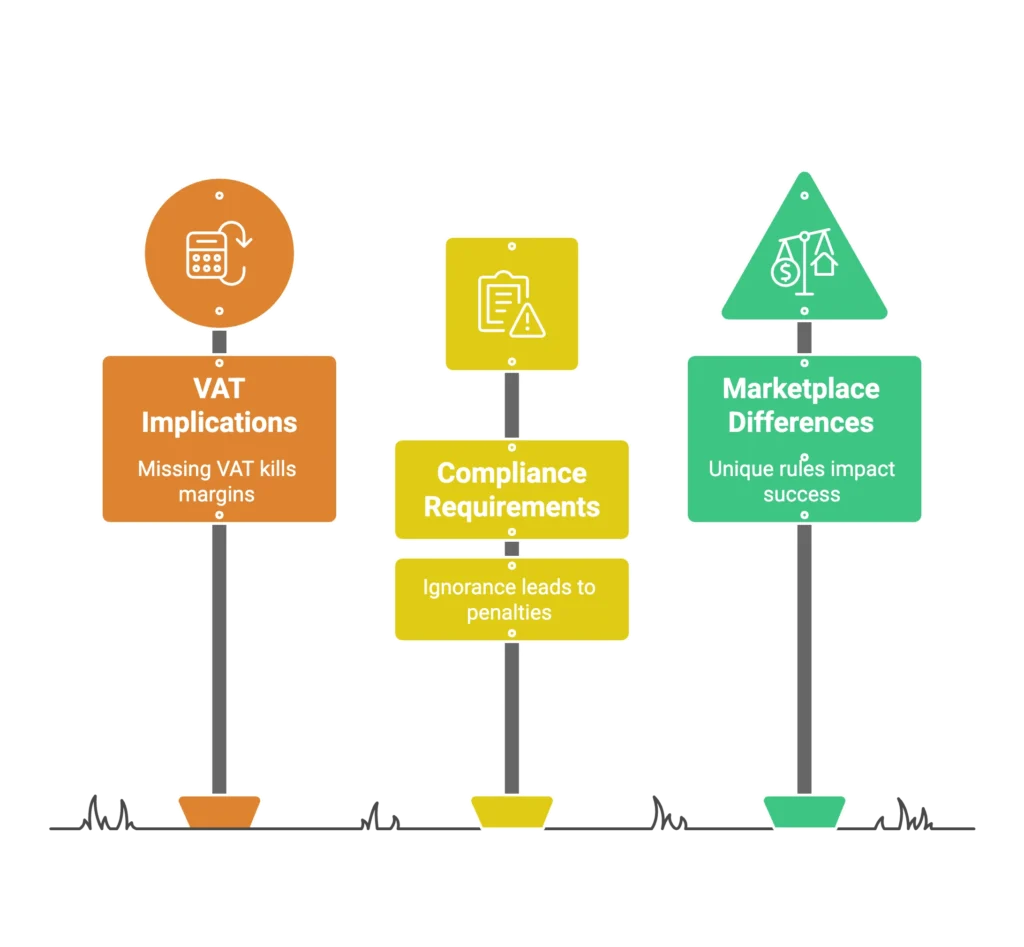
The brutal truth? Your $1M+ US listing strategy that dominates search results and converts at 15%+ will likely fail in the EU because you’re missing VAT implications, compliance requirements, and fundamental marketplace differences that can kill your margins before you even launch.
This isn’t about being negative—it’s about understanding that each Amazon marketplace is its own ecosystem with unique rules, fees, and customer behaviors. What works in New York doesn’t automatically work in Frankfurt or London, which is why breaking the Amazon seller plateau requires a localized strategy rather than a one-size-fits-all approach.
In this guide, I’ll break down exactly why US strategies fail internationally and what you need to know before expanding, even though I’ll be the first to tell you to find an expert who specializes in those markets.
The Amazon US Success Formula (That Doesn’t Travel)
What Makes US Amazon Different
Based on my 12 years of experience building brands exclusively in the US marketplace, here’s what drives success in America:
Organic ranking reigns supreme. The algorithm rewards sustained inventory levels and conversion rates over ad spend. I’ve seen clients go 90+ days with zero ad spend while maintaining top 5 rankings for competitive keywords—but only after building that organic foundation properly.
The honeymoon period is everything. New listings get 2-4 weeks of enhanced visibility if executed correctly. Miss this window, and you’re fighting an uphill battle for months. I’ve watched manufacturers waste this golden opportunity because they didn’t understand inventory positioning during launch.
Sales tax stays simple. Amazon handles state-level sales tax collection in most cases. You price your product, Amazon adds tax at checkout, and your margins remain predictable.
FBA fees follow clear patterns. Fulfillment costs are transparent, placement strategies are established, and tools like AWD provide secondary storage solutions that integrate seamlessly with your inventory management.
Customer behavior is consistent. American buyers make fast purchase decisions, trust Prime delivery promises, and follow predictable search patterns that you can optimize around.
When you master these elements in the US market, you can build listings that generate millions in revenue with sustainable organic growth. The longer you stay in stock, the more keywords you rank for, the stronger your organic position becomes.
The “Copy-Paste” Trap
Here’s where successful US sellers get dangerous. They assume international expansion means:
- Listing optimization techniques translate directly
- Ad strategies and TACoS targets remain relevant
- Inventory management and placement work identically
- Customer acquisition costs and lifetime values match US numbers
- Compliance requirements are similar or easier to navigate
Every single assumption fails internationally. I learned this the hard way when I tried expanding to the UK years ago. The costs doubled, compliance became a nightmare, and I had to open new tax registrations. That experience taught me the value of specialization—and why I refer international projects to experts who live and breathe those markets.
Why EU/UK Markets Break US Playbooks
VAT: The Margin Killer You Didn’t See Coming
In the US, sales tax is straightforward. You set your product price, Amazon adds state tax at checkout, and your contribution margins stay intact.
EU/UK changes everything. VAT must be displayed in your listing price, fundamentally altering your entire pricing strategy. That $29.99 product that converts beautifully in the US becomes €29.99 including VAT—except now your actual revenue is €24.59 (assuming 22% VAT), not the €29.99 customers see.
But it gets worse. Since August 2024, your Amazon USA Mastery playbook hit a major roadblock because Amazon charges VAT on their fees too. Your FBA fulfillment costs, referral fees, and advertising spend all include VAT on top, creating a fee-on-fee effect that destroys margins US sellers never calculated.
Real impact: A product with 40% margins in the US might drop to 25% margins in Germany once you factor in VAT-inclusive pricing and VAT on Amazon’s fees. Many US sellers discover this after launch when it’s too late to adjust.
Compliance Landmines That Stop Launches Cold
US compliance feels simple compared to European requirements. Prop 65 warnings for California products, basic FDA requirements for certain categories, and Amazon handles most sales tax complexity.
EU/UK compliance is a different beast:
CE/UKCA marking requires technical documentation, conformity assessments, and authorized representative appointments. Miss this, and your listings get blocked immediately.
Responsible Person requirements mean appointing an EU-based entity to handle regulatory compliance. This isn’t optional—it’s mandatory for most product categories.
EPR (Extended Producer Responsibility) covers packaging waste, electronics disposal, and now single-use plastics in Germany starting 2025. Each requires separate registrations and ongoing reporting.
Consumer protection laws give EU/UK customers 14-day return rights that impact your pricing strategy, inventory planning, and reverse logistics costs.
I’ve seen US sellers launch in Europe only to have their listings deactivated within weeks because they missed critical compliance steps. The appeal process takes months, killing momentum and burning cash.
Fulfillment Model Confusion
US fulfillment follows predictable patterns. Send inventory to Amazon, they distribute it across fulfillment centers, customers get fast delivery through FBA.
Europe offers multiple options that each come with tradeoffs:
Pan-EU FBA spreads your inventory across multiple European countries from one shipment. Great for coverage, but complex for inventory management and VAT compliance.
EFN (European Fulfillment Network) lets you fulfill orders across Europe from one country’s inventory. Simpler setup, but slower delivery times hurt conversion rates.
Post-Brexit UK fulfillment requires separate inventory pools and compliance frameworks. What worked for EU expansion pre-2021 doesn’t work anymore.
Most US sellers pick the wrong fulfillment model because they don’t understand the tax, compliance, and customer experience implications of each choice.
Canada and Mexico: Closer but Still Different
North America Remote Fulfillment (NARF) Reality
NARF lets your US inventory fulfill Canadian and Mexican orders without establishing separate fulfillment centers. Sounds perfect, right?
The customer experience tells a different story. While US Prime members expect 1-2 day delivery, NARF orders take 5-7 days. Canadian customers paying for Prime often feel disappointed by longer shipping times, hurting conversion rates and reviews.
Currency fluctuations add complexity. Your $30 USD product becomes $40+ CAD, but exchange rates change daily. Sudden currency swings can make you uncompetitive overnight or squeeze margins you thought were safe.
Returns processing crosses borders. That simple return process US customers love becomes international shipping for Canadian returns, adding costs and delays that hurt customer satisfaction.
I’ve watched US sellers test NARF thinking it’s “easy international expansion,” only to discover the operational complexity and customer experience challenges make it better as a demand validation tool than a long-term strategy.
What Actually Transfers from US Success
Some organic ranking principles I’ve perfected over 12 years do translate across borders:
Quality listings still outperform mediocre ones everywhere. Strong product images, compelling copy, and strategic keyword placement matter in any marketplace.
Inventory consistency remains crucial universally. Running out of stock kills organic ranking whether you’re in Ohio or Ontario.
Customer reviews and ratings drive purchase decisions globally. Social proof works the same psychologically across cultures.
But the execution details change completely. What converts American customers might confuse European buyers. Search behaviors vary by culture. Competition levels differ dramatically between markets.
The Region-Proof Expansion Framework
Before expanding internationally, run through these three decision trees to avoid costly mistakes:
Decision Tree 1: Fees & Fulfillment Analysis
Calculate true landed costs including:
- VAT implications on both product pricing and Amazon fees
- Duty and import costs for your product category
- Currency hedging or exposure management
- Returns handling and reverse logistics expenses
Compare fulfillment models realistically:
- NARF shipping times vs. customer expectations
- Pan-EU complexity vs. EFN limitations
- UK-specific requirements post-Brexit
- Secondary storage options and costs
Key question: Does your US margin structure survive international fee reality? If your 40% US margins drop below 20% internationally, expansion might not make financial sense.
Decision Tree 2: Tax & Compliance Readiness
Complete this pre-flight checklist before launching:
- Product certification requirements identified and documented
- Responsible Person appointed for EU/UK markets
- EPR registrations completed for applicable categories
- VAT registration and reporting systems established
- Return policies aligned with local consumer protection laws
Compare compliance complexity honestly:
- Prop 65 warnings (US) vs CE marking documentation (EU) vs UKCA requirements (UK)
- State sales tax automation vs VAT calculation complexity
- FTC advertising guidelines vs EU consumer protection regulations
Reality check: Can you handle ongoing compliance management, or do you need local expertise for Amazon USA Mastery? Choosing the right path is critical because compliance mistakes often cost significantly more than specialist fees; failing to maintain this standard is the fastest way to lose your Amazon USA Mastery and face listing suppression.
Decision Tree 3: Go-to-Market Capability Assessment
Audit feature availability by market:
- Sponsored TV rollout differs by country
- Brand Store tools vary in functionality
- A+ Content localization requirements
- Amazon DSP geographic targeting options
- Vine program rules and availability
Assess localization needs:
- Translation quality beyond basic conversion
- Cultural adaptation for images and messaging
- Local competition analysis and positioning
- Customer service capabilities in local languages
Strategic question: Are you prepared to compete against sellers who specialize in these markets, or are you expecting US tactics to carry you?
When US Expertise Becomes a Liability
The Specialization Advantage
After 12 years focused exclusively on US Amazon, I deliver results because I understand one ecosystem deeply rather than spreading expertise thin across multiple markets.
My US specialization means:
- Deep algorithm knowledge specific to how the US marketplace rewards organic ranking
- Inventory management strategies optimized for US fulfillment center behavior
- PPC approaches built on American customer search patterns and purchase psychology
- Organic ranking tactics proven in the competitive US landscape
When clients come to me with $500K-$5M+ revenue but hit growth plateaus, I can identify exactly where their Amazon USA Mastery breaks down. Usually, it’s because they’re managing too many mediocre listings instead of building a few dominant ones; they are treating the platform like Google Ads instead of achieving true Amazon USA Mastery by understanding it as a ranking ecosystem.
Real example: One client was spending heavily on ads but not building organic rank because their inventory management kept causing stockouts. Once we fixed inventory positioning and focused on fewer, stronger listings, their organic sales grew while ad dependency decreased.
Why I Refer International Projects
When clients want EU or UK expansion, I connect them with specialists because half-knowledge is dangerous in complex regulatory environments.
The honest truth: International expansion requires expertise in:
- Local tax law and ongoing compliance management
- Cultural nuances that affect conversion optimization
- Market-specific competitive landscapes and positioning strategies
- Regulatory frameworks that change frequently
You don’t want someone learning international compliance with your money at risk. The cost of mistakes—blocked listings, compliance penalties, tax issues—far exceeds specialist consulting fees.
My approach: Perfect your US operations first, then partner with international experts who live and breathe those markets. This combination gives you the best chance of successful expansion without sacrificing your US growth.
Master One Before Many
The Amazon US marketplace offers enormous opportunities for sellers who understand its specific ecosystem. This is why achieving Amazon USA Mastery is the most profitable path for any brand in 2026. Before chasing international expansion, ask yourself: are you truly maximizing your US potential? By focusing on Amazon USA Mastery, you ensure that your brand captures the highest-spending customer base in the world with a scalable, organic-first strategy.
Most manufacturers and established sellers I work with discover they’re nowhere near their US ceiling. They’re managing 50+ mediocre listings instead of building 5-10 dominant ones. They’re running ads without building organic rank. They’re treating inventory management casually instead of understanding its impact on algorithm performance.
My recommendation: Perfect your US foundation first. Build that sustainable organic ranking system where each listing generates $1M+ in annual revenue. Master the ecosystem where you have natural advantages—language, cultural understanding, regulatory familiarity, and logistical simplicity.
Then expand strategically. Partner with specialists who know international markets as deeply as I know the US. This approach costs more upfront but delivers better ROI long-term by avoiding expensive mistakes and regulatory issues. Learn more about our approach and expertise here:
Ready to dominate the US market first?
My boutique firm works with select manufacturers and established sellers who want to achieve Amazon USA Mastery for sustainable organic growth. If you’re doing $1M+ in traditional retail sales or stuck at a plateau on Amazon, let’s discuss how Amazon USA Mastery can unlock your true US potential before expanding internationally.
The Amazon US opportunity is massive for sellers who approach it strategically. Master this market first, then conquer the world with specialists who know those territories as well as you’ll know America.

