 Skip to content
Most Amazon sellers think launching a product is about uploading a listing and running ads until they get sales.
That’s exactly why 90% of new products die within 90 days.
I just hit 90 days with my own brand doing $400,000 per month—with zero ad spend. This Amazon Product Launch strategy relied on zero PPC for three months straight. Still ranking top 5 for competitive keywords with 200,000+ monthly searches. Still sitting at a 4,000 BSR.
This isn’t some miracle. This is what happens when you understand that Amazon isn’t a pay-to-play advertising platform—it’s a ranking game. And if you nail the Amazon Product Launch, the momentum carries your listing for years. Successfully executing an Amazon Product Launch is about shifting your focus from “buying clicks” to “buying data” that convinces the algorithm your product is the new market leader.
I’ve spent 12+ years building, scaling, and selling Amazon brands. I’ve helped clients grow from $23 million to $45 million in a single year. I’m currently working with brands targeting $100 million in the next two years. But here’s what most “experts” won’t tell you: every single success story started with a perfect launch strategy.
The brutal truth? Amazon gives you exactly 90 days to prove your product belongs. Mess this up, and you’ll spend 2-3x more money trying to recover—if you can recover at all.
Here’s the exact framework that turns launches into million-dollar listings.
The $400,000 Reality Check: Why Most Launch Strategies Are Dead Wrong
Let me destroy the biggest myths about Amazon launches right now.
Myth #1: “The Honeymoon Period Is 30 Days”
Wrong. It’s 90 days, with the strongest algorithmic boost in the first few weeks.
I just proved this with my clothing brand. During the first 90 days, we went from zero ranking to dominating competitive keywords. But here’s what separates winners from losers: I treated those 90 days like they would make or break the entire business.
Because they do.
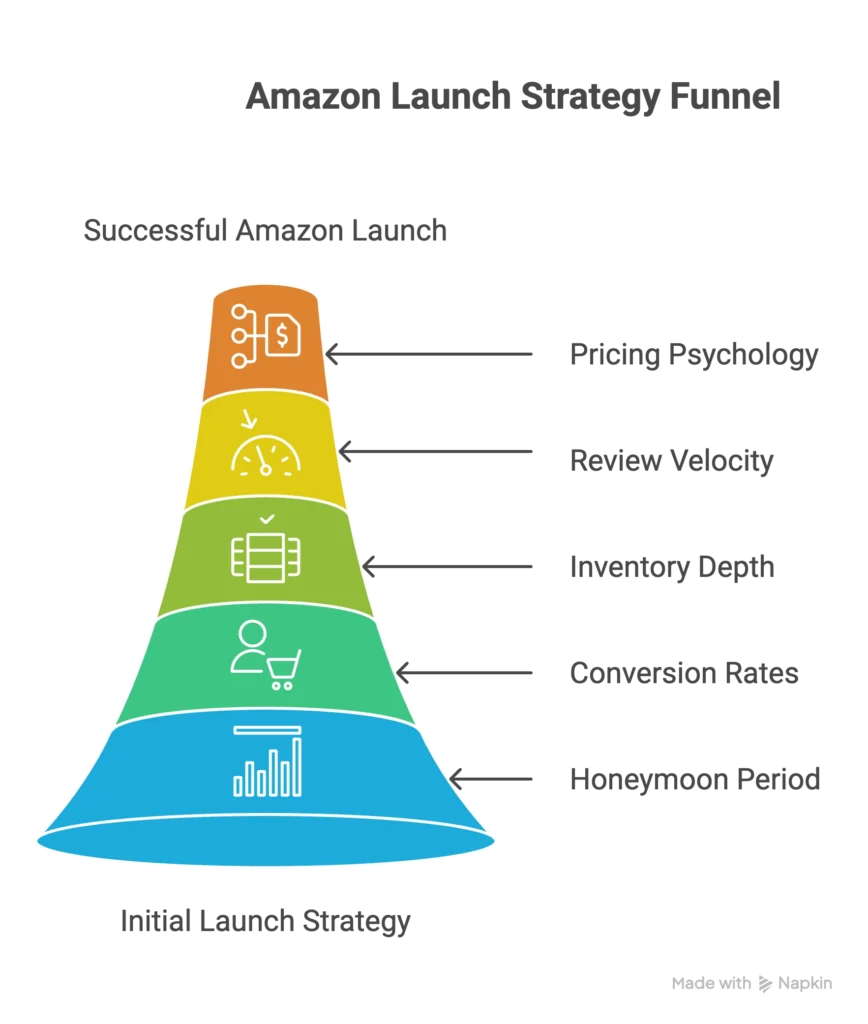
During this Amazon Product Launch phase, the algorithm isn’t just looking at sales. It’s analyzing conversion rates, inventory depth, review velocity, pricing psychology, and dozens of other signals that scream “this product is going to be a long-term winner for our marketplace.”
Most sellers waste this window with generic tactics. They start at full price with minimal inventory, run basic auto campaigns, and wonder why their organic rankings never move. Amazon sees weak conversion rates and inconsistent sales velocity, then flags the product as mediocre. To succeed, you must treat your Amazon Product Launch as a high-stakes data-gathering mission where conversion is the only currency the algorithm accepts. A failed Amazon Product Launch is almost impossible to recover from, as the algorithm’s memory of those early “mediocre” signals is long.
Game over.
Myth #2: “Amazon Is Just Another Sales Channel”
This is where manufacturers and wholesalers get destroyed.
You think because you sell to Walmart and Target, Amazon Product Launch should be easy. But Amazon isn’t a buyer making shelf space decisions. It’s an algorithm making split-second relevancy decisions based on customer behavior data. If you treat your Amazon Product Launch like a traditional retail rollout, you’ll find yourself buried on Page 10 before the first week is over.
Traditional retail rewards relationships and volume discounts. Amazon rewards conversion rates and customer satisfaction metrics. The playbook that made you successful in wholesale will actually hurt you on Amazon.
I work primarily with NY/NJ manufacturers who tried Amazon once, failed, and assumed it “doesn’t work” for their products. Their products are usually perfect for Amazon—they just applied the wrong strategy. A successful Amazon Product Launch isn’t about hope; it’s about a calculated engineering of the algorithm to favor your brand from day one. Without a structured Amazon Product Launch, even the best products remain invisible in a sea of competitors.
The Hidden Truth About My $400K/Month Success
Want to know why I can run zero ads for 90+ days and still dominate?
Because I spent the first 90 days building an ecosystem where every element amplifies the others:
- Listing copy that converts mobile traffic (70%+ of Amazon is mobile)
- Strategic pricing that builds momentum without killing margins
- Inventory positioned for maximum algorithmic favor (60-90 days minimum)
- Backend optimization that most sellers ignore
- PPC campaigns focused on organic rank building, not just sales
When everything works together, you create exponential growth instead of linear progress. Each element makes the others stronger.
That’s why I can pause ads and watch sales keep climbing. The foundation is bulletproof.
The Million-Dollar Launch Framework: My Exact 90-Day System
This is the same framework I use with clients targeting 8-figure revenue. No fluff, no theory—just what actually works.

Phase 1 – Foundation (Days 1-30): Building Your Ranking Engine
The first 30 days determine everything that follows. This is when Amazon decides whether your product gets algorithmic support or algorithmic indifference.
Complete Listing Optimization Before Any Traffic
Your listing must convert before you drive a single visitor to it. I see sellers rushing to launch with “good enough” copy and images, planning to optimize later. But Amazon’s algorithm forms opinions about your conversion rate immediately.
Show weak performance early, and you’re tagged as a poor performer. Show strong performance early, and Amazon starts favoring you in search results.
Every element must be mobile-first. Over 70% of Amazon traffic comes from mobile devices, yet most sellers optimize for desktop. Your main image needs to tell the complete story in a 1-inch square thumbnail. Your title must communicate value in the first 80 characters—the only part mobile users see without clicking. This fundamental shift is the core of a successful Amazon Product Launch, as failing to capture the mobile shopper means you are invisible to the majority of your market. To win your Amazon Product Launch, you must design for the thumb, not the mouse.
The Backend Secret Most Sellers Miss
Here’s where the real ranking power lives: backend search terms, item type keywords, and browse node classifications.
Amazon recently expanded character limits for backend fields, yet most sellers haven’t updated theirs in years. This is free ranking improvement sitting on the table.
I use a systematic approach:
- Primary keywords in the title
- Secondary keywords in bullets
- Long-tail and misspellings in backend search terms
- Precise item type keywords that match your category’s browse tree guide
This creates maximum indexation without keyword cannibalization. One client saw a 40% improvement in PPC performance just from updating backend fields properly. This technical cleanup is the bedrock of a successful Amazon Product Launch, as it ensures your ad spend is driving relevancy for the right terms. Without this foundation, an Amazon Product Launch often wastes thousands of dollars on irrelevant traffic that never converts.
Strategic Launch Pricing (This Kills Most Manufacturers)
This is where manufacturers struggle most. They want to launch at full retail price to “protect margins” and “maintain brand value.”
Amazon’s algorithm doesn’t care about your margin concerns. It cares about conversion rates.
I launch every product at an aggressive introductory price—typically 20-30% below target price. This serves three purposes:
- Ensures strong conversion rates during algorithmic testing
- Generates sales velocity that signals market demand
- Creates room for strategic price increases as organic rankings improve
One of my clients was terrified to launch below $50 for a product they wanted to sell at $69. We launched at $39, dominated the category within 60 days, then gradually increased to $75. They now own the top ranking and sell at higher margins than originally planned.
Inventory Positioning for Algorithmic Favor
Amazon’s algorithm heavily weighs inventory depth when making ranking decisions. Products with less than 30 days of inventory get deprioritized because Amazon can’t rely on them for consistent customer fulfillment.
But here’s what most sellers miss: it’s not just about total units. Amazon needs enough inventory to distribute across their fulfillment network.
I had a client with 500 units showing 5-day delivery in certain regions because Amazon didn’t have enough inventory to place in all fulfillment centers. This killed conversion rates in slower regions and tanked overall performance.
The solution? Plan inventory like a supply chain expert. I work with clients to map out 6-month forecasts that account for sales growth, seasonal fluctuations, and lead times.
Phase 2 – Acceleration (Days 31-60): Scaling Organic Momentum
The second month is about converting initial algorithmic interest into sustained organic ranking growth.
PPC Strategy That Builds Rankings, Not Just Sales
Most sellers run PPC to generate immediate sales. I run PPC to build organic rankings that generate long-term sales.
The strategy is simple: identify the 10-15 keywords that drive the majority of category sales, then systematically prove to Amazon that your product converts well for those terms.
I start with auto campaigns to discover which keywords Amazon naturally associates with the product, then graduate top performers to exact match campaigns with aggressive bids. The goal isn’t immediate profitability—it’s ranking improvement that leads to sustainable profitability.
One client was spending $50,000/month on ads with mediocre results. We shifted focus from sales to rankings, temporarily increased spend to $70,000/month, but built organic positions that let us scale back to $20,000/month while maintaining the same sales volume.
Review Generation That Actually Works
Reviews matter, but not how most sellers think. Amazon’s algorithm cares more about review velocity than total review count.
A product with 50 reviews earned over 60 days looks stronger than a product with 100 reviews earned over 6 months.
Amazon Vine is the only safe way to generate initial reviews quickly. I enroll every new product in Vine at the low introductory price, which increases the likelihood of positive reviews since Vine reviewers consider value for money.
One critical insight from my client calls: timing matters. Vine reviews during the honeymoon period carry more algorithmic weight than Vine reviews on established products.
Phase 3 – Domination (Days 61-90): Cementing Market Position
The final month of the honeymoon period is about cementing your position and building sustainable competitive advantages.
The Transition to Organic Dominance
By day 60, if you’ve executed properly, you should see significant organic ranking improvements for your target keywords. This is when I begin scaling back ad spend on keywords where organic rankings are strong enough to maintain traffic.
With my own brand, I was able to pause ads completely by day 90 because organic rankings were carrying the entire sales volume. But this only works if you’ve built the proper foundation.
The goal isn’t to eliminate ads entirely—it’s to reduce ad dependency while maintaining or growing sales. If you can maintain the same sales volume with 50% less ad spend, you’ve essentially doubled your profit margin while proving the strength of your organic foundation.
Building Your Competitive Moat
Amazon is zero-sum. Your success often comes at the expense of existing sellers. By day 90, competitors will notice your growing market share and may respond with aggressive tactics.
This is why building a strong organic foundation matters. Competitors can match your ad spend, but they can’t instantly replicate months of algorithmic trust-building. Your organic rankings become a competitive moat that’s expensive and time-consuming for others to overcome.
I had a client whose main competitor tried to copy their success by launching identical products with massive ad budgets. The competitor spent 3x more on ads but never achieved the same organic rankings because they missed the honeymoon period opportunity.
The Hidden Launch Killers (And How to Avoid Them)

Stock-Out Catastrophe: Why Inventory Is Your Ranking Lifeline
Running out of stock—or even running low—is the fastest way to destroy months of ranking progress.
Let me share a real example from my own brand. Last month, I started running low on certain variations (down to about 30 days of inventory). The moment stock levels dropped, delivery times extended from 2 days to 5-7 days in some regions. This inventory “flicker” is the silent killer of an Amazon Product Launch, as it signals to the algorithm that you can no longer fulfill the demand you’ve worked so hard to build. If you don’t manage your stock depth during an Amazon Product Launch, you risk losing your ranking momentum before you even turn a profit.
Amazon’s algorithm immediately noticed. Conversion rates dropped in regions with slow delivery. Organic rankings started sliding. Sales momentum slowed.
This had nothing to do with pausing ads. The moment my stock levels improved and delivery times normalized, organic rankings and sales picked right back up.
The 30-Day Rule: Amazon’s algorithm treats inventory levels as a signal of business reliability. Drop below 30 days of stock, and you get algorithmically penalized—even if you’re not completely out.
The Distribution Factor: It’s not just about total inventory. Amazon needs enough units to distribute across fulfillment centers. Insufficient stock means some regions get slow delivery while others get fast delivery. This creates inconsistent conversion rates that hurt overall performance.
The Backend Blunder That Kills Rankings Silently
Amazon’s bots love to change your backend settings without notice. One day your product is categorized as “Pajama Sets,” the next it’s “Pajamas Set.” Seems minor, right? For a high-stakes Amazon Product Launch, this tiny shift is the difference between page 1 dominance and total invisibility.
Wrong. This silent killer can tank your organic rank, force you to overspend on ads, and drain sales without you realizing why.
I discovered this with a client whose rankings mysteriously dropped after months of steady growth. When we audited their backend fields, Amazon had changed their item type keyword from the correct classification to something completely irrelevant.
The Monthly Audit: Download your Category Listing Report from Seller Central monthly. Look for any changes Amazon made without your knowledge. Verify everything against the Browse Tree Guide to ensure accuracy.
One character difference in item type keywords can place your product in the wrong classification, limiting visibility and destroying ad performance.
The Mobile Conversion Killer
Over 70% of Amazon traffic comes from mobile devices, yet most listings are optimized for desktop viewing.
On mobile, customers see maybe 80 characters of your title, your main image in a tiny thumbnail, and the first bullet point if they scroll. That’s it. If those elements don’t immediately communicate value and differentiation, the sale is lost.
I recently helped a client increase conversion rates by 30% just by optimizing for mobile. The changes:
- Main image that tells the complete story in thumbnail size
- Title that front-loads benefits in the first 80 characters
- First bullet point that communicates the primary value proposition
Small changes, massive impact.
Advanced Tactics: The $45 Million Scaling Secrets

The Ecosystem Approach That Actually Works
I have a client that did $23 million last year. This year? They’re tracking toward $45 million, with a 2-year goal of hitting $100 million.
Part of this growth came from understanding that Amazon success isn’t about individual tactics—it’s about creating systems where every element amplifies the others.
When they moved some heavy items from merchant fulfillment to Seller Fulfilled Prime, sales got a noticeable lift even before receiving the Prime badge. Why? Because offering premium shipping options improved their competitive positioning.
But the bigger lesson goes beyond shipping. It’s about optimizing every piece:
- Refined listings that convert traffic better
- Backend optimization that improves PPC performance
- Strategic inventory management that maintains algorithmic favor
- Pricing strategies that balance growth and profitability
Each improvement makes every other element more effective.
The Long-Term Domination Strategy
The honeymoon period ends, but optimization never stops. Amazon’s algorithm continuously reevaluates product performance, and competitors are always trying to capture your market share.
My long-term strategy focuses on creating sustainable competitive advantages:
Review Velocity Maintenance: Consistent new reviews signal continued market relevance. I use strategic pricing and exceptional customer service to maintain steady review flow.
Competitive Monitoring: Track competitor changes and respond strategically. When competitors launch aggressive campaigns, I often double down on organic ranking factors they can’t quickly replicate.
Continuous Testing: A/B test images, pricing, and copy to maintain conversion rate leadership. The goal is building listings that get stronger over time, not weaker.
Most sellers peak during launch and slowly decline. I help clients build listings that are more dominant in year two than year one.
My clothing brand is a perfect example. A year after launch, we’re doing $400K/month with zero ad spend. Organic rankings are stronger than ever. Profit margins are higher because we’re not paying for traffic.
That’s what happens when you execute a perfect launch and maintain the momentum.
FAQ: The Questions Every Serious Seller Asks
What’s the most critical mistake sellers make during launches?
Starting at target price instead of strategic introductory pricing. Amazon’s algorithm prioritizes conversion rates during the honeymoon period. Launch at full price with no reviews and no ranking history, and you’ll show poor conversion rates that signal to Amazon your product isn’t market-fit.
How much should I spend on ads during launch?
Focus on percentage of sales (15-25% during honeymoon) rather than absolute dollars. The goal is building organic rankings, not immediate ROI. I often tell clients: “Pay for momentum now, profit from rankings later.”
Can I recover from a failed launch?
Yes, but it requires a complete reset and typically 2-3x the effort. I helped one client “relaunch” a year-old product by treating it like a new launch. We refreshed everything—images, copy, pricing, inventory strategy. It worked, but we could have saved months of effort by getting it right the first time.
How do I know if my launch strategy is working?
Track organic ranking progression for target keywords weekly. If rankings aren’t improving consistently in the first 60 days, something’s wrong. Sales without ranking improvement indicates ad-dependent growth that isn’t sustainable.
What’s the minimum inventory I need for launch?
60-90 days minimum, but make sure Amazon can distribute it properly across fulfillment centers. I’ve seen sellers with 500 units show slow delivery in some regions because inventory wasn’t positioned correctly.
Your Million-Dollar Launch Starts Now
Here’s what most Amazon “experts” won’t tell you: the opportunity is shrinking every day.
Competition is increasing. Amazon’s algorithm is getting more sophisticated. The tactics that worked two years ago barely move the needle today.
But if you understand the game—if you nail the launch strategy and build real organic dominance—you can create a business that generates consistent revenue without constant ad dependency.
I just proved it with my own brand. $400,000 per month, zero ad spend, still growing. This isn’t luck. This is the result of understanding exactly how Amazon’s ecosystem works and executing with precision.
The clients I work with understand this. They’re not looking for quick wins or shortcuts. They want to build real businesses that dominate their categories for years.
That’s why I only work with serious manufacturers, wholesalers, and established brands. People who understand that Amazon success requires the same strategic thinking and execution excellence that built their existing businesses.
If you’re ready to build a real Amazon business—not just test the waters—I’m interested in talking. But understand: this framework requires investment, patience, and precision execution.
The market won’t wait forever. Every day you delay, competitors are capturing market share that becomes exponentially harder to reclaim.
The best time to dominate Amazon was five years ago. The second-best time is now.
Bonus: The 90-Day Launch Playbook (My Exact Framework)
Days 1-30: Foundation Phase
- [ ] Complete mobile-first listing optimization (images, title, bullets)
- [ ] Backend keyword implementation (search terms, item type, browse nodes)
- [ ] Strategic inventory positioning (60-90 days across fulfillment network)
- [ ] Aggressive launch pricing (20-30% below target)
- [ ] Amazon Vine enrollment at introductory price
- [ ] Auto campaign launch with broad targeting
Days 31-60: Acceleration Phase
- [ ] Exact match campaigns for top-performing keywords
- [ ] Price optimization based on conversion data
- [ ] Review velocity monitoring and optimization
- [ ] Competitor analysis and positioning adjustments
- [ ] Inventory reorder planning to avoid stock-outs
- [ ] Backend auditing to catch Amazon bot changes
Days 61-90: Domination Phase
- [ ] Organic ranking assessment for ad reduction opportunities
- [ ] Competitive defense strategy implementation
- [ ] Long-term inventory forecasting (6+ months)
- [ ] Strategic price graduation toward target margins
- [ ] Performance documentation for continuous optimization
Critical Metrics to Track Weekly:
- Organic ranking for top 10 target keywords
- Conversion rate by traffic source and device
- Inventory days remaining by ASIN
- Review velocity and average rating
- Ad spend as percentage of sales
- Total sales velocity and trend analysis
The Reality Check: This isn’t a “set it and forget it” strategy. This is a 90-day sprint that determines the next 2-3 years of your product’s performance. Execute it properly, and you build a million-dollar listing. Execute it poorly, and you join the 90% of launches that fail.
The difference between success and failure during an Amazon Product Launch isn’t just following the steps—it’s understanding why each step matters and how they work together to create sustainable Amazon dominance.
Most sellers never experience this level of success because they treat Amazon like a hobby instead of a business. The ones who win treat every launch like it could make or break their entire company.
Because it can.


