 Skip to content
Most private label sellers hit a wall around the $1-5M mark. They’re burning cash on ads, watching competitors steal market share, and wondering why their “optimized” listings plateau. The harsh truth? They’re treating Amazon like an advertising platform instead of what it really is—a ranking ecosystem. To scale beyond this, you need an Amazon private label strategy that focuses on organic dominance rather than just renting visibility through PPC.
After 12+ years of selling on Amazon and scaling client accounts from $3 million to $24 million in two years, I’ve learned that a successful Amazon private label strategy isn’t about spending more on PPC. It’s about building organic dominance through strategic systems most sellers never implement. By focusing on asset protection and high-intent keyword positioning, your Amazon private label strategy creates a sustainable moat that converts traffic into long-term brand equity.
While your competitors chase low ACoS and run campaigns on autopilot, the brands breaking into 8-figure territory understand Amazon’s core algorithm: conversion rates fuel organic rank, organic rank drives sustainable sales, and sustainable sales create the compound growth that transforms businesses. This is why I advocate for TACoS vs ACoS for Amazon growth as the primary health metric; if you only focus on ACoS, you’re missing the “halo effect” that your advertising spend should be having on your organic visibility.
This isn’t another “optimize your listing” checklist. This is the advanced playbook for private label brands ready to break free from the ad-spend hamster wheel and build listings that generate millions in organic revenue—even with ads turned off.
Bottom Line Up Front: Amazon rewards listings that convert consistently across the entire customer journey. Master the five interconnected systems below, and you’ll build the organic foundation that separates 8-figure brands from everyone else stuck paying rent for visibility.
Why Most Private Label Strategies Fail at Scale
The Fatal Flaw: Treating Symptoms, Not Systems
Most Amazon agencies pitch individual services—listing optimization here, PPC management there, maybe some inventory planning if you’re lucky. But a successful Amazon private label strategy isn’t a collection of isolated tasks. It’s a chain reaction engine where every lever affects every other lever, meaning your Amazon private label strategy must be built on total ecosystem integration rather than piecemeal fixes.
Ads affect rank. Rank affects reviews. Reviews affect conversion. Conversion affects ad efficiency. When one link breaks, the entire chain suffers.
I don’t believe in having thousands of low-selling, mediocre listings. I believe you could have a few very good listings that are doing a lot of money. I have listings that do over a million dollars a year on single SKUs—and there’s no secret knowledge here that you can’t access. It’s about looking at the data, doing the right work, and having the right strategy.
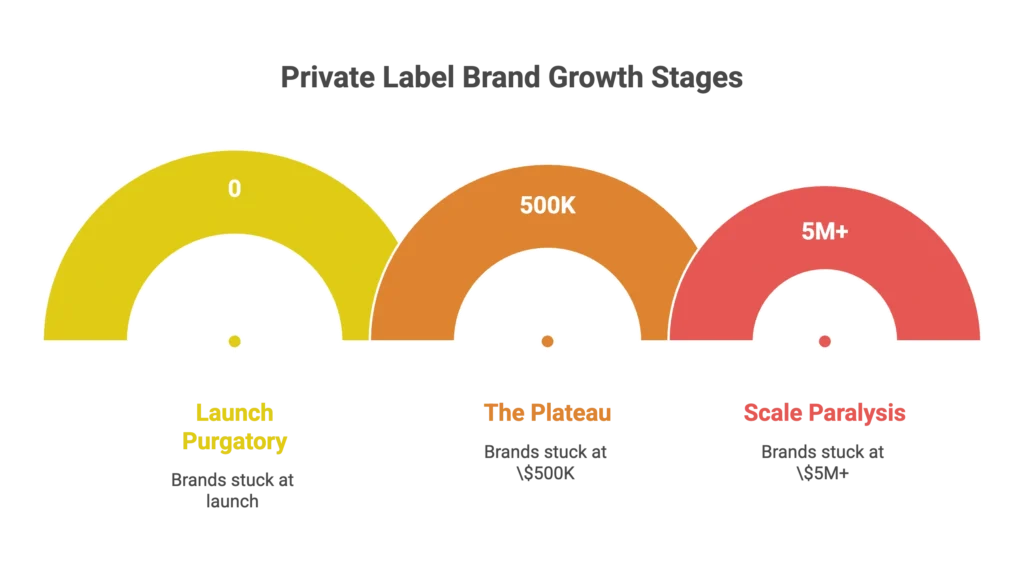
The Three Phases Where Private Label Brands Get Stuck
Phase 1: Launch Purgatory (0-6 months) Most sellers waste their honeymoon period through poor timing and strategy. They upload listings that aren’t mobile-optimized, ignore backend optimization until it’s too late, and wonder why Amazon isn’t showing their products to the right customers.
Phase 2: The Plateau ($500K-$5M annually) This is where most sellers get trapped. They develop ad dependency without building organic rank, mismanage inventory in ways that kill momentum, and create messy catalog architecture that limits expansion. Every month, they’re paying more for the same results.
Phase 3: Scale Paralysis ($5M+) The systems that worked at $1M break at $10M. Variation complexity spirals without strategic structure, and increased competition forces unsustainable ad costs. This is where brands either break through to 8-figures or plateau permanently.
The Organic Ranking Foundation System

Mobile-First Listing Architecture
Here’s the reality: if your Amazon private label strategy doesn’t convert someone scrolling on mobile within 5 seconds, you lose them forever. Most sellers optimize for desktop and wonder why their conversion rates tank, failing to realize that a modern Amazon private label strategy must prioritize the mobile shopper’s immediate intent over everything else.
Most people never even scroll past the title on mobile, which is why we optimize mobile-first—because that’s where the majority of your customers are shopping.
Your Mobile Optimization Framework:
Title Strategy for Truncation: Your first 80 characters must contain your primary keyword plus a compelling hook. The rest might get cut off on mobile, so front-load the essential information. Test title variations using Amazon’s A/B testing tools and track click-through rates, not just impressions.
Image Sequence Psychology: Your main image needs to be clean, professional, and benefit-focused. Your second image is critical—scrollers need immediate relevance and usage context. Images 3-4 should highlight key features with infographic overlays, while images 5-7 cover size, packaging, and warranty information.
Prime Badge Optimization: Here’s what most sellers miss—inventory distribution affects Prime eligibility by region. I’ve worked with brands where moving heavy items from merchant fulfillment to Seller Fulfilled Prime gave sales a noticeable lift even before receiving the Prime badge. Fast delivery times directly impact organic ranking because Amazon wants to show products that keep customers happy.
Backend Keyword Strategy (The Hidden 80%)
Most sellers stuff their backend with random keywords. Advanced sellers use search intent mapping to create semantic keyword clusters that help Amazon understand exactly when to show their listing.
Amazon has expanded character limits for backend keywords, yet many sellers haven’t updated theirs in months. These updates boost PPC performance, improve conversion rates, and ultimately strengthen your organic rank.
“Use your Brand Analytics data to identify high-converting search terms, as this data-driven approach is the backbone of a competitive Amazon private label strategy. Include misspellings and Spanish keywords for broader reach; and here’s something most people miss—download your Category Listing Report monthly to verify your item type keywords match Browse Tree Guide specifications. Because Amazon’s bots often change classifications without notice, failing to maintain this part of your Amazon private label strategy can tank your organic rank and force you to overspend on ads.
Strategic PPC That Builds Rank (Not Just Burns Budget)
The Ad-to-Organic Flywheel
My whole philosophy with PPC is simple: it either has to make you money, or it has to improve your organic rank. If you’re losing money on sales but getting significant sales volume, there might still be value if you’re tracking organic rank improvements for those keywords.
Most sellers think ads equal sales. That’s the wrong equation. Ads should equal ranking. If you’re constantly spending just to maintain sales, your ads aren’t actually working—they’re just buying you temporary placement. You’re paying Amazon rent for shelf space.
I recently turned off ads on my personal brand for 90 days. No ads, but sales kept rolling in. Organic rank held strong. Why? Because the ads weren’t there to prop up the listing—they were there to build its foundation.
TACoS as a Control Metric
TACoS (Total Advertising Cost of Sales) should decrease over time as organic rank improves. If TACoS stays flat or increases, your ads aren’t building organic momentum—they’re just renting visibility.
Your TACoS Optimization Process:
Start by tracking your organic vs. paid sales ratio by keyword. Set TACoS targets by product lifecycle stage and monitor Brand Analytics for search query performance data.
Use your Brand Analytics data to identify high-converting search terms, as this data-driven approach is the backbone of a competitive Amazon private label strategy. Include misspellings and Spanish keywords for broader reach; and here’s something most people miss—download your Category Listing Report monthly to verify your item type keywords match Browse Tree Guide specifications. Because Amazon’s bots often change classifications without notice, failing to maintain this part of your Amazon private label strategy can tank your organic rank and force you to overspend on ads.
The key is knowing when to graduate keywords from paid to organic focus. When you’re ranking organically for a term and converting well, you can reduce ad spend on that keyword and reinvest those savings into new keyword expansion.
Catalog Architecture for Scale
The Parent-Child Strategy That Prevents Implosion
Here’s a critical insight most sellers miss: if you have multiple colors and sizes and you sell out of your MVP (your bestselling product), the whole listing crashes because Amazon ranks each child ASIN separately.
I had a client—a clothing company—who went from $3 million to $24 million in two years, and the breakthrough came when we solved their stockout problem through a refined Amazon private label strategy. They were running out of their best-selling color, bringing in other colors, and running out again, which forced us to rethink their Amazon private label strategy because the platform kills momentum when availability is inconsistent.
Your main child ASIN might rank very high for a keyword, but when that sells out, the next variation might show up on the second page for the same keyword. You’re killing the whole snowball effect.
Inventory Distribution Strategy
Treat each variation like its own business. Maintain 30+ days of inventory on your top-performing child ASINs because whenever you’re down to 30 days or less in stock, it significantly impacts organic rank, especially geo-ranking.
Here’s why: customers in certain regions may see four to five-day delivery times instead of next-day delivery, which lowers conversions and hurts your organic rank. Amazon notices your competitor getting more sales with faster delivery, so they start favoring that listing in search results.
Understocking doesn’t just cost you sales today—it costs you rankings, momentum, and long-term growth.
The Honeymoon Period Mastery System
The 90-Day Window
Everyone has different opinions on the honeymoon period. Some say 30 days, some say 60, some say 90. I believe it’s strongest for 90 days, but it doesn’t end there—it just gets progressively harder. The first few weeks are much stronger than the weeks after, and the first few months are stronger than the months after, but the opportunity doesn’t disappear.
Strategic Launch Orchestration
Time is against you on Amazon. It’s all about speed to market and showing Amazon that conversions are happening quickly. The longer you wait to get things right, the harder it gets and the more money it costs.
If you’re not converting well on certain keywords because your images are poor, your title isn’t compelling, or your price is too high, Amazon thinks your product isn’t a good match for those keywords. You’ll have to keep raising your cost-per-click, and sometimes you won’t even get impressions because Amazon doesn’t think you belong there.
Your Launch Strategy:
Start with competitive pricing during your first two weeks to maximize initial velocity. Use strategic coupon deployment and consider lightning deals during high-traffic periods for visibility boosts. Amazon deals often don’t make money directly, but they’re incredibly useful if you’re showing up on page one for keywords and now have a deal badge when people search those terms.
Gradually optimize pricing during weeks 3-8 while monitoring conversion rates. Use A/B testing for price points and maintain momentum while improving margins. By weeks 9-12, establish your competitive market position and prepare for post-honeymoon organic strength.
Advanced Systems Integration
Tracking What Actually Matters
Recently, I worked with a brand that was all-in on PPC. They were driving solid sales through ads, but they had no idea where those sales were actually coming from. Every time they saw a sales spike, they were left guessing whether it was due to specific ad keywords or if their organic ranking was quietly boosting visibility.
Without tracking your organic ranking alongside PPC, you’re flying blind. If you have a big sales month, you should be able to pinpoint why. Was it all ads? Or did a high-ranking keyword finally start pulling in organic traffic?
The Full-Ecosystem Approach
Amazon success isn’t just one piece of the puzzle—it’s about putting every piece in place. Look at your backend fields and keywords, refine your listings, understand keyword performance, and optimize fulfillment options. A holistic strategy makes all the difference.
I’ve got a client brand that did $23 million in sales last year. This year, they’re tracking toward $45 million, with a two-year goal of hitting $100 million. Part of this growth came from moving heavier items from merchant fulfillment to Seller Fulfilled Prime, which gave sales a lift even before receiving the Prime badge.
But the bigger lesson goes beyond shipping—it ties back to optimizing every part of your listing and understanding how all the pieces work together.
Breaking Free from the Ad-Dependency Trap
If you have to keep feeding ads to make sales, you’re not growing—you’re paying rent. The brands that break through to 8-figures understand that PPC is a tool for building organic dominance, not a permanent crutch.
I paused all ads on one of my listings for 90 days and maintained top 5 rankings for competitive keywords while generating thousands of organic sales with zero ad spend. But this only worked because the foundation was already there: strong organic rankings and high conversion rates that matched or exceeded competitors.
The question every private label seller needs to ask is: if I turn off ads today, what happens? Does my listing keep moving, or does it flatline? If it’s the latter, you’re stuck in a pay-to-play cycle that gets more expensive every quarter.
Your 90-Day Implementation Plan
Weeks 1-2: Foundation Audit Download your Category Listing Report and verify all classifications are correct. Audit your mobile listing experience, checking for title truncation issues, image sequence problems, and Prime eligibility gaps. Review your backend keywords and update them with Amazon’s expanded character limits.
Weeks 3-6: Catalog Optimization Restructure your parent-child relationships to preserve reviews and maintain rank stability. Implement an inventory distribution strategy with 30+ day minimums on your top performers. Set up proper keyword tracking to monitor organic rank changes.
Weeks 7-12: Strategic PPC Transition Launch auto campaigns for keyword discovery and backend validation. Implement exact match campaigns for rank consolidation on converting terms. Test ad pause strategies on organically strong keywords and reinvest savings into new keyword expansion.
The Path Forward
The difference between private label sellers who plateau at $1-5M and those who break into 8-figures isn’t more products or bigger ad budgets—it’s systems thinking.
Every 8-figure Amazon brand I’ve worked with understands that organic ranking is the foundation of sustainable growth. They optimize for conversion rates, structure catalogs for scale, master the honeymoon period, treat inventory as ranking insurance, and use ads strategically to build momentum rather than just generate sales.
Amazon isn’t just an ad game—it’s a ranking game. Get that part right, and sales come to you. The brands that understand this principle are the ones that build sustainable, profitable businesses that don’t collapse when ad costs rise or competition intensifies.
If you’re generating $500K+ annually but feeling stuck in the ad-spend hamster wheel, there might be catalog issues, mobile optimization problems, or inventory strategies you haven’t considered. The brands that break through to 8-figures don’t just work harder—they work on the right systems.
Pick one system from this guide and implement it completely over the next 90 days. Whether it’s rebuilding your mobile-first listing architecture, auditing your catalog structure, or developing your ad-to-organic flywheel, depth beats width every time. That’s how you transform from paying rent for visibility to owning your market position.

