 Skip to content
If you’re tracking Featured Offer % but ignoring organic units, you’re measuring the wrong Amazon performance metrics. Most Amazon sellers drown in dashboards while missing the handful of numbers that actually predict success.
After 12+ years building and managing Amazon brands—including my current brand doing $400K monthly with ads completely turned off—I’ve learned that sustainable growth comes from tracking metrics that directly impact Amazon’s ranking algorithm, not the vanity numbers that make pretty reports.
Recently, I worked with a brand that was all-in on PPC. They were driving solid sales through ads, but here’s the catch—they had no idea where those sales were actually coming from. Every time they saw a sales spike, they were left guessing: was it ads or organic ranking improvements? Their attribution was sitting at 82% of total sales, which is a staggering indicator of weak organic performance.
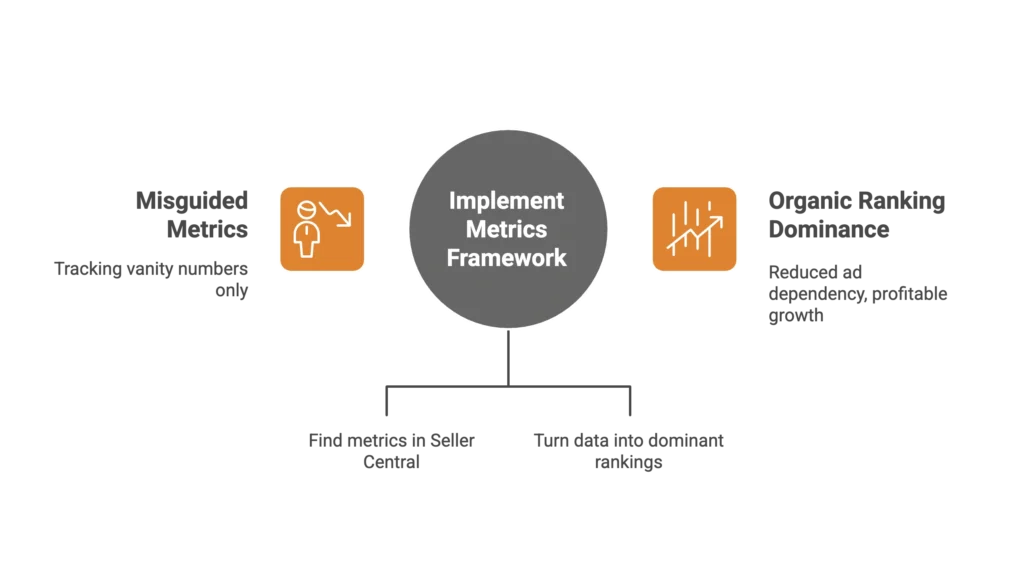
This guide reveals the four-layer metrics framework I use with my own brands and clients to build organic ranking that reduces ad dependency and drives profitable growth. You’ll learn which metrics Amazon actually uses to determine visibility, how to find these numbers in Seller Central, and the weekly review process that turns data into dominant rankings.
Why Most Amazon Metrics Are Misleading Your Growth Strategy
The biggest mistake I see sellers make is treating Amazon like Google Ads instead of understanding it’s a ranking ecosystem. They get obsessed with ACoS while completely missing whether their ads are actually building organic strength.
Here’s the reality: if you have to keep feeding ads to make sales, you’re not growing—you’re paying rent. When I turned off ads on my main listing after reaching strong organic positions, sales kept climbing. But this only worked because my product already had strong organic rankings and conversion rates that matched or beat competitors.
The difference between scaling and just spending more comes down to three critical questions:
- Are organic sales increasing month over month?
- Is your Total ACoS (TACoS) decreasing as organic strength builds?
- Is your organic rank improving for target keywords?
If you can’t answer these confidently, you’re flying blind. Most sellers focus on traffic metrics (sessions) when they should be watching conversion metrics (Unit Session Percentage). Others obsess over Featured Offer % without understanding how it connects to buyability versus actual ranking strength.
Amazon rewards listings that maintain strong conversion rates and fast shipping—ads are just one piece of the puzzle. But without the right metrics framework, you’ll never see the full picture.
The Four-Layer Amazon Metrics Framework
After managing my own brands and working with clients doing millions in revenue, I’ve developed a systematic approach to Amazon performance metrics that actually matter. Think of it as four layers that build on each other, from market intelligence to business efficiency.
Layer 1: Market Demand Intelligence
Search Query Performance (SQP) is your window into what customers actually search for and how they interact with results. Track query share, click-through rate, add-to-cart rate, and purchase rate for your target keywords.
Search Catalog Performance (SCP) shows your ASIN-level funnel from views to orders, revealing where potential customers drop off in their buying journey. These specific Amazon performance metrics allow you to see exactly where your traffic leaks.
Where to Find: Navigate to Brand Analytics > Search Analytics > Search Query Performance or Search Catalog Performance.
Action Triggers: If your CTR drops below 0.3% for important keywords, you’ve got title or main image problems. If your purchase rate sits below 1% consistently, investigate conversion elements immediately.
Layer 2: Conversion & Buyability Metrics
Unit Session Percentage (USP) is the most critical conversion metric Amazon tracks—it measures how many sessions result in purchases, not just how much traffic you’re getting.
Featured Offer Percentage determines your buy box eligibility and visibility. This isn’t just about having the lowest price; it’s about Amazon’s confidence in your ability to fulfill orders reliably. High-level Amazon performance metrics for the Featured Offer are essential for winning the Buy Box consistently.
Understanding the difference between Session Percentage and Unit Session Percentage reveals whether you have a traffic problem or a conversion problem. Session % shows visits, but your Amazon performance metrics for Unit Session Percentage (USP) reveal your true sales efficiency.
Where to Find: Business Reports > Detail Page Sales & Traffic by ASIN.
Action Triggers: If USP is declining while competitors maintain theirs, you need listing optimization. If Featured Offer % drops, investigate pricing and fulfillment issues immediately.
Layer 3: Account Health & Availability
Your Account Health Rating (AHR) directly impacts listing visibility. Amazon doesn’t advertise this connection, but accounts with declining health see reduced organic reach. Monitoring your Amazon performance metrics within the Account Health dashboard is a non-negotiable daily task.
Order Defect Rate (ODR) must stay below 1% to avoid restrictions. Late Shipment Rate (LSR) affects Featured Offer eligibility and organic ranking. These Amazon performance metrics act as the “guardrails” for your account survival.
Inventory Performance Index (IPI) controls your storage limits and fees, but more importantly, low stock levels kill organic rank even when you’re not completely sold out.
Where to Find: Account Health dashboard and Inventory Planning section.
Action Triggers: Any AHR decline requires immediate investigation. If IPI drops below 450, you’re facing storage restrictions that will impact growth.
Layer 4: Paid Efficiency Metrics
ACoS and ROAS measure campaign-level efficiency, but Total ACoS (TACoS) reveals business-level advertising effectiveness. TACoS = Total Ad Spend ÷ Total Revenue (organic + paid). These broader Amazon performance metrics tell you if your brand is actually profitable.
Organic Units Growth is the ultimate measure of whether your ads are actually working. If you’re spending on ads but organic units aren’t increasing, you’re just renting visibility.
Where to Find: Amazon Ads Console combined with Business Reports data.
Action Triggers: If TACoS is increasing while ACoS improves, your ads aren’t building organic growth—they’re just getting more efficient at the same level.
The Weekly Amazon Metrics Review Process
Consistency beats intensity when it comes to tracking your Amazon performance metrics. Here’s the weekly rhythm I use to stay ahead of problems:
- Monday: Market Intelligence Review Check your SQP data for query share changes and identify any new competitor movements. Review SCP funnel performance to spot early conversion issues.
- Wednesday: Conversion Health Check Monitor USP trends across your top ASINs and verify your Featured Offer percentage is holding steady. Check that delivery promise consistency isn’t creating fulfillment issues.
- Friday: Business Performance Analysis Calculate your TACoS vs. ACoS comparison and review organic units growth trends. Assess your inventory runway and how IPI might impact upcoming performance.
I track organic rank hourly during launches because it changes constantly, but these weekly reviews of Amazon performance metrics catch the trends that actually matter for long-term growth.
Advanced Metrics Most Sellers Miss
Beyond the core framework, there are hidden Amazon performance metrics that can make or break your performance.
Backend Field Accuracy matters more than most realize. Amazon’s bots love to change things—one day your product is categorized as “Pajama Sets,” the next it’s “Pajamas Sets.” This small change can derail your rank, PPC performance, and visibility.
Use the Category Listing Report monthly to uncover hidden backend issues. Cross-reference with the Browse Tree Guide to ensure your item type keywords and browse nodes match your category exactly.
Inventory Distribution Tracking reveals why some customers see longer delivery times even when you have stock. If Amazon can’t promise fast delivery across all regions, your organic rank suffers. Each variation needs individual inventory planning—I aim for 60-90 days of stock to maintain ranking stability.
Geographic Fulfillment Performance shows how stock distribution affects conversion rates. Running low on inventory (under 30 days) triggers Amazon to deprioritize your listing, even before you’re actually sold out.
Common Metrics Mistakes That Kill Growth
Mistake #1: Treating ACoS as the Primary Success Metric High ACoS isn’t the enemy if ads are driving sales and improving your organic rank. I’d rather have 30% ACoS that builds long-term organic strength than 15% ACoS that generates clicks without ranking improvement. The key is tracking TACoS alongside other Amazon performance metrics.
Mistake #2: Ignoring Query-Level Performance Most sellers only look at ASIN-level data and miss the demand insights that SQP provides. You might think your listing has conversion problems when really you’re just targeting keywords with low commercial intent.
Mistake #3: Missing the Inventory-Performance Connection Low stock doesn’t just mean potential stockouts—it creates fulfillment inconsistency that kills conversion rates. These logistical Amazon performance metrics directly feed the ranking algorithm.
Building Your Sustainable Metrics System
Start with the four-layer framework, but don’t try to implement everything at once. Focus on Layer 2 (conversion metrics) first—Unit Session Percentage and Featured Offer % will give you the biggest immediate insights into your Amazon performance metrics.
Use Seller Central’s native reporting for accuracy, but invest in rank tracking tools like Helium 10 for consistency. The key is connecting the dots between different data sources rather than getting lost in any single dashboard.
Set up monthly backend audits using the Category Listing Report. Verify your browse nodes match your category, ensure backend fields are complete, and never let Amazon automatically update your listing without review.
Frequently Asked Questions
How often should I check my Amazon performance metrics? Organic ranking needs hourly monitoring during launches and weekly tracking for established products. Account health metrics require daily review, while business performance needs weekly analysis.
What’s a good Unit Session Percentage for Amazon products? USP varies significantly by category and price point. Focus on month-over-month improvement in your Amazon performance metrics rather than absolute benchmarks.
Should I pause ads if my organic rank is strong? Only if you have consistent organic units growth and stable Featured Offer percentage. I recently paused ads on a $400K/month listing because organic strength supported it.
How do I track TACoS vs ACoS effectively? TACoS = Total Ad Spend ÷ Total Revenue (organic + paid). Keep a weekly spreadsheet to visualize these Amazon performance metrics side-by-side.
What Account Health Rating should I maintain? Keep AHR above “Good” rating consistently. Any decline requires immediate investigation as it directly impacts organic visibility.
The Path Forward
The Amazon performance metrics that matter aren’t the ones that look impressive in reports—they’re the numbers that directly influence Amazon’s ranking algorithm. After 12+ years building brands on Amazon, I’ve seen too many sellers get lost in vanity metrics while missing the handful of numbers that actually drive sustainable growth.
The four-layer framework isn’t theory—it’s the exact system I use to manage my own brands and help clients build organic ranking that reduces ad dependency. When you focus on Amazon performance metrics that Amazon actually uses to determine visibility, you stop renting success and start building it.

