 Skip to content
Most sellers approach Amazon Lightning Deals like throwing money at a wall and hoping something sticks. They schedule a deal, crank up ad spend, and watch their margins evaporate while wondering why their organic rankings don’t improve long-term.
Here’s what 12+ years of building and managing Amazon brands has taught me: Amazon Lightning Deals aren’t just about moving inventory—they’re precision tools for organic ranking when used strategically. But most sellers are using them completely wrong.
The real opportunity isn’t in the deal itself—it’s in understanding when Amazon Lightning Deals make sense versus 7-Day Deals or Price Discounts, how to structure them for maximum ranking impact, and most importantly, how to avoid the fee traps that destroy profitability during peak seasons, following best practices in Seasonal Amazon Inventory.
After managing accounts doing $700K+ in monthly sales and building my own brands from scratch, I’ve seen the difference between sellers who use deals as Band-Aids and those who use them as strategic weapons. The difference? Understanding Amazon’s deal ecosystem as a ranking system, not just a discount platform.
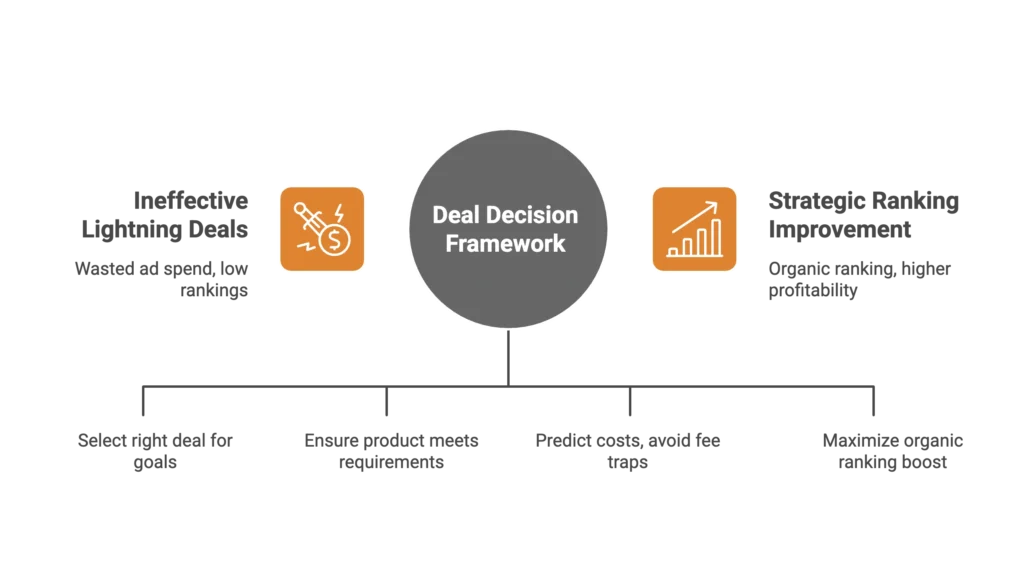
In this guide, you’ll learn the Amazon Lightning Deals “Deal Decision Framework” I use with clients—how to choose the right deal type, set up proper eligibility, model fees accurately, and time everything for maximum organic impact. No generic advice—just the proven Amazon Lightning Deals system that works whether you’re doing $500K or $5M annually.
The Amazon Deal Landscape: Why Most Sellers Choose Wrong
The Critical Distinction Most “Experts” Miss
Amazon’s deal structure isn’t random—it’s designed around different seller goals and inventory patterns. Yet most content treats all deals the same, leading to costly mistakes.
From managing multiple $700K/month accounts, here’s what I’ve learned: Lightning Deals are like doing a giveaway for one day—they create a boost but don’t make a big dent. Best Deals (7-Day) have much better impact for sustained growth. But if you don’t have Best Deal eligibility, Lightning is better than nothing.
The three-tier system works like this:
Lightning Deals: The Sprint Duration of 4-12 hours (Amazon-controlled) with limited inventory quantities. These create quick boosts but minimal long-term benefit. Best for fast inventory movement and testing conversion rates on new listings.
7-Day Deals: The Marathon Multiple days of sustained exposure with generally unlimited inventory. These deliver significant organic ranking improvements and are ideal for building momentum on established listings.
Price Discounts: The Event Play Event-specific duration (Prime Day, Black Friday) with flexible inventory based on the event. Perfect for capturing high-traffic periods with proper badge visibility and merchandising.
The key insight most sellers miss: these aren’t interchangeable tactics. Each serves a specific strategic purpose in your ranking and inventory management system.
The Deal Decision Operating System
Step 1: Eligibility Preflight Check
Before choosing any deal type, run through this eligibility framework:
Professional Seller Status Requirements:
- Active Professional selling plan
- Review average ≥4.0 stars
- Featured Offer eligibility (Buy Box control)
- Sufficient inventory levels for deal duration
Here’s an insider tip for your Amazon Lightning Deals from years of client management: Once you lock in a deal, Amazon won’t remove it, but they might tell you to adjust pricing. I don’t fix errors until the last minute because often they’ll let you raise prices while still keeping your Amazon Lightning Deals active and profitable.
Technical Setup Validation: Your backend keywords must be optimized for target terms, main image and A+ content finalized, price strike-through properly configured, and inventory distribution verified across fulfillment centers.
Step 2: Deal Type Selection Matrix
Choose Lightning Deals When: You need quick inventory movement, are testing conversion rates on new listings, lack Best Deal eligibility, or need a short-term ranking boost.
Choose 7-Day/Best Deals When: You’re building sustained organic momentum, have Best Deal eligibility (always prioritize this), want significant long-term ranking impact, or can sustain deeper margins for extended periods.
Choose Price Discounts When: You’re targeting specific Amazon events, need event badge visibility, have coordinated external marketing campaigns, or when Prime-exclusive positioning makes strategic sense.
The decision tree is straightforward: Best Deals first (if eligible), Lightning Deals second, Price Discounts for events. Most sellers reverse this priority and wonder why their results are mediocre.
The Hidden Fee Traps Destroying Your Margins
Q4 Fee Complexity Most Sellers Miss
Here’s where most sellers get burned. The fee structure during peak season creates a triple hit that destroys profitability if you’re not modeling correctly:
- Holiday Peak Fulfillment Fees (October 15 – January 14)
- Low-Inventory Level Fees (when stock runs thin)
- Inbound Placement Fees (varies by shipping strategy)
From managing accounts through multiple Q4 seasons: “You have to model fees and inventory to protect contribution margin during Q4. Most people don’t realize how peak fees, low-inventory penalties, and placement fees stack up.”
Fee Modeling Framework: Calculate your base deal discount impact, add holiday peak fulfillment surcharges, factor in low-inventory penalties if stock projection is tight, include inbound placement costs for reorder timing, then compare total impact against expected ranking lift.
Inventory Planning for Deal Success
The 90-Day Rule: Based on client management experience: “I tell people to send in 90 days worth of stock at all times per child. There’s delays already, plus October Prime Day, Black Friday, Cyber Monday, Christmas—it’s busy season.”
This isn’t just about avoiding stockouts; it is a core part of your Amazon Lightning Deals strategy. Your inventory distribution across Amazon’s fulfillment network directly impacts your conversion rates and organic rankings during Amazon Lightning Deals. When customers in certain regions see longer delivery times, your conversions drop, and Amazon reduces your organic visibility accordingly.
Strategic inventory considerations include deal timing versus reorder lead times, regional fulfillment center distribution, and how shipping time impacts conversions and rankings.
Pre-Deal Optimization: The MYE Strategy
Why Most Deals Fail
Product detail pages that aren’t A/B-tested or “frozen” pre-event fail to convert traffic from deal pages at maximum rates. You’re driving high-intent traffic to unoptimized listings.
The MYE → Freeze → Schedule Process:
4-6 Weeks Before Deal: Launch Manage Your Experiments tests on title variations, test main image alternatives, and A/B test A+ content sections. This gives you time to achieve statistical significance.
2 Weeks Before Deal: Analyze MYE results, implement winning variations, and freeze all listing content changes. No more tweaking—you want consistency during your deal period.
1 Week Before Deal: Final eligibility verification, inventory level confirmation, and price strike-through validation.
From client optimization work: “You want to make sure your listing is beautiful—beautiful images. It can’t just be the same as competitors. You have to try to outdo them because if you’re getting traffic and not converting, Amazon won’t want to show you for those words.”
Deal Setup Walkthrough: Getting It Right
Lightning Deal Configuration
Navigate to Advertising → Deals in Seller Central, select Lightning Deal option, choose your target event window, set discount percentage (typically 20-30%), define quantity limits, and submit for Amazon review.
Critical Settings to Optimize: Discount depth should balance conversion improvement with margin protection. Quantity limits create urgency—though Amazon recently locked the ability to adjust inventory during deals, which used to be a powerful conversion tactic.
Previously, we could start with low quantities and increase availability throughout the deal to maintain 80-90% claimed status. This created continuous urgency. Now you need to set optimal quantities upfront.
7-Day Deal and Price Discounts Setup
For 7-Day Deals, focus on Best Deal opportunities first to maximize your Amazon Lightning Deals. These require deeper discount tolerance but provide sustained impact and better inventory planning for your overall Amazon Lightning Deals strategy throughout the extended duration.
Price Discounts replaced the old Prime-Exclusive Discounts with an updated workflow. Access Price Discounts under Promotions, select event-specific targeting, configure Prime member exclusivity, and set badge display preferences.
Badging Optimization: Ensure proper event badge display, verify Prime exclusivity settings, and test badge visibility on product detail pages. The badge is what drives the click-through from search results.
Advanced Deal Strategies for Serious Sellers
The Sequential Deal Strategy
Here’s an advanced technique most sellers don’t know: “If you have a Best Deal and you don’t want to do unnecessary discounts, there’s no need to do the Lightning Deal. But if you do them both together, the discount won’t overlap—one will pause while the other runs.”
This lets you layer Lightning Deal for initial boost with automatic transition to longer Prime-exclusive pricing, creating sustained momentum throughout event periods without discount stacking.
Strategic Layering Process: Set up both Lightning Deal and Price Discount for the same period. The Lightning Deal runs for its 4-12 hour window, then automatically transitions to your Price Discount for the remainder of the event. You capture the Lightning Deal exposure plus sustained event pricing.
Measuring Deal Impact: Beyond Surface Metrics
Organic Ranking Impact Tracking: Monitor keyword ranking improvements during and after deals, organic unit sales increase post-deal, conversion rate maintenance after deal ends, and long-term ranking stability.
From podcast discussions on ranking strategy: “You have to track where you are for different keywords. If you’re not tracking, you can’t see how anything is affecting anything. Amazon rewards listings that maintain strong conversion rates.”
Tools and Tracking Methods: Use Helium 10 for keyword position monitoring, native Amazon reports for organic versus paid units, and custom dashboards for deal performance analysis.
True ROI Calculation: Factor in deal discount impact on margins, fee additions during peak periods, long-term organic ranking value, and reduced PPC costs from improved positions. The real value isn’t the deal sales—it’s the sustained ranking improvement and reduced advertising dependency afterward.
Strategic Deal Planning for Q4 and Beyond
Lock In Deals Early
“Lock in deals as soon as they become available, often 2-3 months before major events. You can always cancel before the deal starts if needed, but popular time slots fill up quickly.”
Set up everything: Black Friday, Cyber Monday, back to school, Prime Day deals. Even if you’re unsure about some products, create the deals and cancel later if needed. You can cancel right up until the deal starts without getting charged.
The Event Priority Hierarchy: Best Deals are most important—if you only have Best Deal eligibility, that’s usually sufficient. Lightning Deals are much weaker but better than nothing if Best Deals aren’t available.
Portfolio Management Approach
Coordinate deals across related products, sequence launches to maximize cross-selling, balance inventory allocation across SKUs, and maintain account-level profitability targets.
Use deals to introduce new products to existing customers, create halo effects for non-deal listings, build brand recognition during high-traffic events, and establish pricing anchors for premium products.
Your Deal Strategy Action Plan
Amazon deals aren’t just about moving inventory—they’re strategic tools for building long-term organic dominance. But only when used with precision and proper planning.
The difference between sellers who thrive and those who struggle isn’t the size of their ad budget or how many deals they run. It’s understanding the Amazon ecosystem deeply enough to use every tool strategically.
Your immediate next steps:
- Audit your current deal eligibility across all ASINs
- Map out Q4 inventory needs using the 90-day framework
- Set up MYE tests for your top-performing listings
- Lock in available deal slots for upcoming major events
Remember: Amazon rewards listings that convert consistently and maintain customer satisfaction. Deals are accelerators, not crutches. Build strong foundations first, then use deals to amplify what’s already working.
The sellers who master this system don’t just survive Amazon’s increasing competition—they dominate their categories while their competitors burn through ad budgets without sustainable results.
Frequently Asked Questions
When should I choose Lightning Deals over 7-Day Deals?
Choose Lightning Deals when you need quick inventory movement, lack Best Deal eligibility, or want to test conversion rates. However, 7-Day Deals (especially Best Deals) provide much better long-term organic ranking impact and should be prioritized when available.
How do I avoid the fee traps during Q4 deal seasons?
Model all fees upfront: holiday peak fulfillment (Oct 15-Jan 14), low-inventory penalties, and inbound placement costs. Plan inventory 90 days ahead and factor these costs into your discount depth decisions to maintain profitability.
Should I run ads during my Lightning Deal?
Ads can complement deals but aren’t always necessary. Focus on ensuring your listing converts well organically first. If you run ads, monitor that the combined cost doesn’t destroy margins while providing meaningful ranking improvement.
What’s the difference between Price Discounts and the old Prime-Exclusive Discounts?
Price Discounts replaced Prime-Exclusive Discounts in Amazon’s promotion toolkit. The setup process moved locations in Seller Central, but core functionality of creating Prime-member-exclusive pricing remains with improved event badge display.
How far in advance should I set up deals for major events?
Lock in deals as soon as they become available, often 2-3 months before major events. You can cancel before the deal starts if needed, but popular time slots fill up quickly, especially for Black Friday and Prime Day events.
Ready to implement a strategic deal approach that builds lasting organic rankings? The key is treating deals as part of your broader ranking system, not isolated discount tactics. Master this approach, and you’ll build sustainable competitive advantages while others burn through ad budgets.

