
Your listing just dropped from page 1 to page 3, but you’re still in stock. Your ads are running fine. What happened?
I’ve been selling on Amazon for over 12 years, and I’ve seen this scenario play out countless times. Most recently, it happened with my own clothing brand that’s currently doing $400,000 per month in sales. One day, I noticed my organic rankings dropping in certain regions, even though I had inventory and wasn’t making any major changes to my campaigns; I realized I was once again a victim of the Amazon Fulfillment Center Lottery. This invisible distribution hurdle can sideline even the most successful brands by tethering visibility to the physical location of stock rather than the quality of the listing.
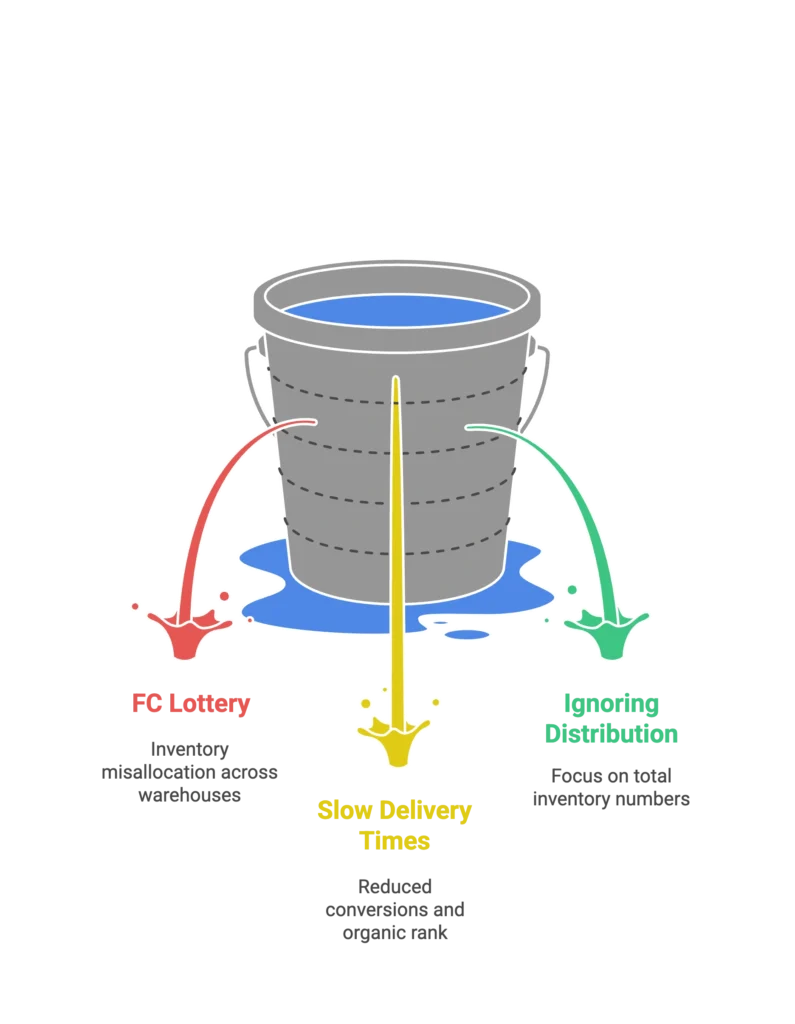
The culprit? Amazon’s fulfillment center distribution—what I call the “FC lottery.”
Some of my sizes weren’t completely out of stock, but Amazon didn’t have enough inventory to place them in every warehouse. The result was devastating: customers in certain states saw four to five-day delivery times, which lowered conversions and hurt my organic rank. This had nothing to do with my ads or listing optimization. It was pure inventory distribution—a classic example of how Amazon fulfillment centers are sabotaging your sales.
Most sellers focus on total inventory numbers but completely ignore how Amazon distributes that inventory across their fulfillment network. That’s a costly mistake that’s silently killing conversions and rankings every single day.
The FC Lottery: Understanding Amazon’s Regional Game
Amazon operates hundreds of fulfillment centers across the United States, each serving specific geographic regions. When you send inventory to Amazon, they decide where to place it based on factors like historical demand, shipping efficiency, and—critically—how much you’re willing to pay in inbound placement fees. If you don’t pay for premium distribution, you are essentially entering the Amazon Fulfillment Center Lottery, where your stock might sit in a single warehouse. This creates a massive disadvantage, as winning or losing the Amazon Fulfillment Center Lottery directly determines whether a customer in California sees a “Next Day” delivery promise or a 5-day delay that kills your conversion rate.
Here’s what most sellers don’t understand: Amazon’s default “minimal splits” option saves you money upfront but often results in your inventory sitting in just one or two fulfillment centers. This means customers in distant regions get slower delivery promises, which directly impacts your conversion rates and organic rankings.
I learned this lesson the hard way. After building a custom tool using ChatGPT to map my inventory distribution by ZIP code, I could visualize exactly where my stock gaps were. The results were eye-opening—entire regions of the country were showing 4-5 day delivery times while other areas had same-day or next-day delivery; it was a clear map of the Amazon Fulfillment Center Lottery in action. Seeing those delivery delays laid out geographically made it obvious why my organic rankings were tanking in high-demand zones despite my overall inventory levels looking healthy.
The conversion impact is real. When customers see slower delivery times, they’re less likely to buy from you. Amazon’s algorithm notices this drop in conversion rate and responds by showing your listing to fewer people. It’s a downward spiral that starts with poor inventory distribution.
This isn’t theory—it’s what I’ve observed across my own brand and dozens of clients over the years. Fast delivery promises aren’t just nice to have; they’re essential for maintaining competitive positioning on Amazon.
The 7-Step FC-Lottery Diagnostic
Based on my experience managing inventory distribution challenges, I’ve developed a systematic approach to diagnose and fix these issues. Here’s the exact framework I use:
Step 1: Pull Your Inbound Placement Service Fee Report
Start in Seller Central by navigating to the Inbound Placement Service Fee report. This shows you exactly how Amazon is splitting your shipments and what you’re paying for distribution.
Look for SKUs where you’ve chosen “minimal splits” to save on fees. These are your highest-risk products for regional coverage gaps. Amazon’s “optimized” placement costs more upfront but often delivers better regional distribution.
The key insight: that extra placement fee might be the best marketing investment you never realized you were making.
Step 2: Map Regional In-Stock Percentage
Next, check your regional in-stock rates across major metropolitan areas. I use a combination of Seller Central data and my custom ZIP code mapping tool to identify coverage gaps.
Focus on major markets like New York, Los Angeles, Chicago, and Houston. If customers in these areas are seeing delivery times longer than 2-3 days, you’re likely losing conversions to competitors with better regional coverage.
Step 3: Analyze Your Shipping Settings Automation
Review your Shipping Settings Automation (SSA) configuration. While automation can help optimize delivery promises, it sometimes works against strategic inventory placement.
If you’re using SSA, make sure it’s not defaulting to overly conservative delivery promises that hurt your competitiveness and trigger a losing Amazon Fulfillment Center Lottery scenario. Sometimes manual control over shipping settings gives you better results than letting Amazon’s automation handle everything. By taking back control, you ensure your regional shipping speeds remain fast enough to win the Amazon Fulfillment Center Lottery in high-volume zip codes where your inventory is actually stocked.
Step 4: Check Your OTDR Requirements
Your On-Time Delivery Rate (OTDR) needs to stay above 90% if you want to qualify for programs like Seller Fulfilled Prime. Regional OTDR variations can affect your backup fulfillment options when FBA inventory runs low.
Monitor OTDR by region, not just overall performance. A single region with poor delivery performance can disqualify you from beneficial programs.
Step 5: Review Restock Inventory Recommendations
Amazon’s restock recommendations are based on their algorithms, but they don’t always align with your business strategy. This gap is often where you lose the Amazon Fulfillment Center Lottery, as the system might suggest restocking levels that trigger low-inventory-level fees or create regional distribution problems. To avoid losing the Amazon Fulfillment Center Lottery, you must manually override these suggestions with a 90-day inventory plan that ensures your hero variations are distributed across all major regions.
I’ve found that maintaining 60-90 days of inventory works better than the common 30-day approach. When you’re constantly running low on stock, Amazon can’t distribute your inventory effectively across their network.
Step 6: Make the AWD vs. Higher Split Fees Decision
Amazon Warehousing and Distribution (AWD) can be a game-changer for inventory distribution. Instead of paying higher inbound placement fees for multiple splits, you can send pallets to AWD and let Amazon auto-replenish your FBA inventory as needed.
AWD works especially well for products with steady demand and longer-term storage needs. The cost of AWD storage plus auto-replenishment often beats paying premium placement fees for every shipment.
Step 7: Track Featured Offer Win Rates
Finally, monitor how inventory distribution improvements affect your Featured Offer win rate. Better regional coverage should translate to higher Featured Offer eligibility and better organic visibility.
Connect your operational improvements to business outcomes. If you’re investing in better placement but not seeing improved Featured Offer performance, you might need to adjust your strategy.
Strategic Inventory Management: Beyond the Basics
After 12 years of doing this, I’ve learned that proper inventory management goes way beyond avoiding stockouts. It’s about strategic positioning for maximum market coverage.
The 60-90 Day Rule: Most sellers restock when they have 30 days or less of inventory remaining. That’s a mistake. By the time you’re down to 30 days, Amazon can’t spread your incoming inventory effectively across their network. I recommend maintaining 60-90 days of stock to give Amazon’s distribution algorithm room to work.
New Listing Strategy: When launching new products, don’t send just 100 units and hope for the best. Insufficient initial inventory limits Amazon’s ability to distribute your product effectively, which hurts your launch momentum. Plan for adequate stock levels from day one.
Seasonal Planning: Q4 is especially critical for inventory positioning. Amazon’s placement fees increase during peak season, but the cost of poor regional coverage during high-demand periods is even higher. Plan your Q4 inventory strategy in advance, considering both placement costs and revenue opportunity.
Advanced Tactics: AWD Integration
Amazon Warehousing and Distribution (AWD) has become one of my favorite tools for solving inventory distribution challenges. Instead of gambling with placement fees every shipment, AWD lets you store inventory in Amazon’s network and auto-replenish FBA as needed.
Here’s how I use AWD strategically: I send bulk inventory to AWD for long-term storage, then set up auto-replenishment to maintain optimal FBA levels across regions. This approach often costs less than paying premium placement fees while delivering better regional coverage.
AWD also provides flexibility for multi-channel fulfillment. If you’re selling on other platforms or direct-to-consumer, AWD can serve as a central inventory hub that feeds multiple fulfillment channels.
The key is understanding when AWD makes sense versus traditional FBA placement. For products with predictable demand and longer shelf life, AWD often wins. For fast-moving seasonal items, strategic placement fees might be more effective.
Measuring Success: KPIs That Actually Matter
Don’t just track total sales and inventory levels. Monitor metrics that reveal how inventory distribution affects your business:
Regional Delivery Promise Consistency: Are customers across major markets seeing similar delivery times? Significant regional variations indicate distribution problems.
Featured Offer Win Rate by Geography: Track Featured Offer performance across different regions. Poor inventory distribution often shows up as lower Featured Offer eligibility in specific markets.
Conversion Rate Correlation with Shipping Speed: Monitor how conversion rates vary with promised delivery times. This data helps you quantify the ROI of better inventory distribution.
Use Seller Central reports like the Inbound Placement Service Fee Report and Restock Inventory Report to track your distribution efficiency over time. These aren’t just operational reports—they’re strategic tools for understanding how inventory affects your market position.
Implementation: Your Next 30 Days
Week 1: Assessment Run through the 7-step diagnostic framework. Identify your biggest regional coverage gaps and calculate what poor distribution might be costing you in lost sales.
Week 2: Strategy Development Decide whether AWD integration makes sense for your products. Plan your next inventory shipment with strategic placement in mind, even if it costs more upfront.
Week 3: Implementation Execute your new placement strategy. If you’re testing AWD, start with a subset of SKUs to understand how it works for your business.
Week 4: Monitoring Track early results. Look for improvements in delivery promise consistency and Featured Offer win rates. Adjust your approach based on what the data tells you.
Making the FC Lottery Work for You
Amazon’s fulfillment network is incredibly sophisticated, but it’s not magic. Understanding how the Amazon Fulfillment Center Lottery determines your regional inventory distribution is the first step toward stabilizing your sales. When you lose the Amazon Fulfillment Center Lottery, your delivery promises stretch from 2 days to 5 days in key markets, which directly tanks your conversion rates and organic rankings. This gives you a competitive advantage that most sellers ignore because they only look at total stock, not where that stock actually sits.
The sellers who win on Amazon long-term are those who understand these operational details and optimize for them systematically. Inventory distribution isn’t just about logistics—it’s about market positioning and customer experience.
After building and selling brands on Amazon and currently managing my own $400,000 per month business, I can tell you that mastering the FC lottery is one of the highest-impact optimizations you can make. It’s not sexy, but it works.
Amazon rewards listings that maintain strong conversion rates and fast shipping. The fulfillment center lottery isn’t really a lottery at all—it’s a strategic game where the best operators consistently win by understanding the rules and playing them intelligently.
Stop leaving your inventory distribution to chance. Start treating it as the strategic lever it actually is.

