 Skip to content
Most Amazon sellers are stuck in an expensive hamster wheel—throwing more money at ads, hiring more agencies, launching more SKUs—while their core Amazon Efficiency Maximization metrics keep declining. They’re playing the wrong game entirely.
After 12+ years of Amazon selling experience and currently building my own brand that’s doing $400,000 per month on a single listing, I’ve learned something most sellers miss: Amazon isn’t a pay-to-play advertising platform—it’s a ranking game.
Most sellers treat Amazon like Google Ads instead of understanding it’s an ecosystem where organic ranking is everything. If you have to keep feeding ads to make sales, you’re not growing—you’re paying rent.
Recently, I worked with a client that went from $23 million to $45 million in sales with a 2-year goal of hitting $100 million. The breakthrough wasn’t spending more money—it was optimizing every efficiency lever in what I call the “Do-More-With-Less Efficiency Stack.”
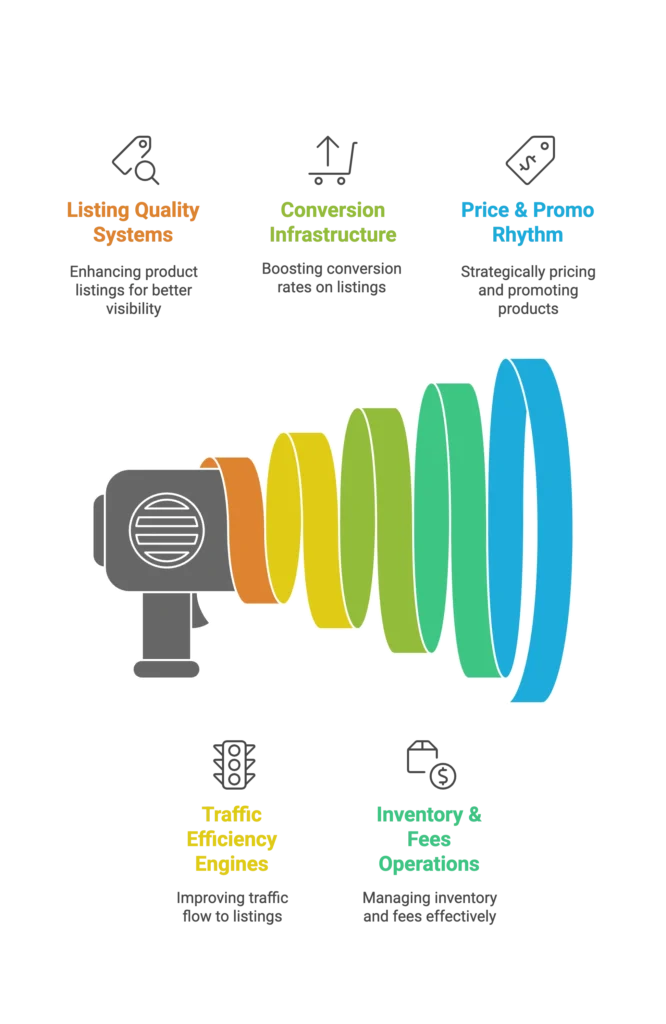
This framework addresses five critical levers that most sellers either ignore or optimize in isolation: Listing Quality Systems, Traffic Efficiency Engines, Conversion Infrastructure, Inventory & Fees Operations, and Price & Promo Rhythm. By aligning these pillars, you move away from reactive selling and toward a controlled, scalable growth model.
The Hidden Cost of Amazon Inefficiency
The biggest efficiency killer I see? Sellers flying blind on what actually drives their growth.
I recently worked with a brand that was all-in on PPC, driving solid sales through ads—but they had no idea where those sales were actually coming from. Every time they saw a sales spike, they were left guessing whether it was due to a specific ad keyword or if their organic ranking was quietly boosting visibility.
This is where most sellers fall short. Without tracking your organic ranking alongside PPC, you’re operating in the dark. If you have a big sales month, you should be able to pinpoint why. Was it all ads? Or did a high-ranking keyword finally start pulling in organic traffic?
The 2025 reality makes this even more critical. Rising inbound placement service fees, new capacity constraints, and increasing competition for the same keywords are driving up costs across the board. You can’t just throw money at the problem anymore.
Here’s what inefficiency actually costs you: When your inventory is spread incorrectly across fulfillment centers, customers in certain states see four to five-day delivery times instead of two days. This lowers conversions and hurts your organic rank—which then requires more ad spend to maintain the same sales levels.
That’s exactly what happened with one of my listings. Some sizes weren’t completely out of stock, but Amazon didn’t have enough inventory to place them in every warehouse. Customers in some regions saw long shipping times, which slowed down sales. This had nothing to do with my ads—it was pure inventory distribution inefficiency.
The Do-More-With-Less Efficiency Stack
Amazon rewards listings that maintain strong conversion rates and fast shipping. Ads are just one piece of the puzzle. Here’s my five-lever system that addresses the real drivers of sustainable growth:
Lever 1: Listing Quality System (2025 Standards)
Your listing has to convert before anything else matters. If you’re getting traffic and not converting, Amazon notices and stops showing you for those keywords.
Mobile-first optimization is non-negotiable in 2025. Most shoppers never scroll past the title on mobile, so your main image and title need to sell the product in five seconds.
I don’t believe in having thousands of mediocre listings. You can have a few very good listings that each do over a million dollars a year. I have listings that hit those numbers through Amazon Efficiency Maximization, and there’s no secret—it’s about looking at the data and doing the right work.
Backend keyword expansion is a huge missed opportunity. Amazon has expanded character limits, yet many sellers haven’t touched their backend fields in years. These updates boost PPC performance, improve conversion rates, and ultimately strengthen organic rank.
Lever 2: Traffic Efficiency Engine
This is where most sellers go wrong. They focus on keeping ACOS low instead of using ads strategically to build organic ranking.
I always start listings with auto campaigns because when I’m optimizing a listing, I put in longtail keywords, short tail, Spanish keywords, misspellings—everything. Auto campaigns feed off this and show me terms I might never have thought of.
Here’s the key insight: If my conversion rate on a term is high, I should be spending heavily on it because it’ll bring up my organic rank. It’s an investment in your listing’s future, not just immediate sales.
Auto campaigns let Amazon’s algorithm decide what to test based on your listing content. Amazon doesn’t just want to make money from ads—they want happy customers. When you convert well on their tests, they reward you with better organic placement.
Lever 3: Conversion Infrastructure
Beautiful images aren’t enough—they need to make people want to click and buy. I use Amazon Efficiency Maximization tactics like A/B testing on click-through rates to ensure that when people search our keywords, they choose our listing over competitors.
Your price has to be competitive, but it doesn’t have to be the cheapest. You want to hit that sweet spot where the image makes them click, the price doesn’t scare them off, and the bullets and infographics drive Amazon Efficiency Maximization by converting traffic into sales.
Reviews matter, but quality trumps quantity. It’s more important to have a good review average than thousands of reviews. Focus on getting genuine feedback from satisfied customers as part of your long-term Amazon Efficiency Maximization strategy rather than gaming the system.
Lever 4: Inventory & Fees Operations
This is the efficiency killer most sellers never see coming. For true Amazon Efficiency Maximization, I maintain 60 to 90 days worth of stock at all times per child ASIN because Amazon’s algorithm hates when you’re low on stock.
Think of it like a regular retail store—if you’re wholesaling goods to a retailer and something is running low, they’re not going to put it on the front shelf. Amazon Efficiency Maximization works the same way; visibility follows availability.
When you have only a week’s worth of stock, Amazon keeps it in one fulfillment center. Someone in one state gets two-day shipping, but someone in another state gets five-day shipping. That customer might need it for the weekend, won’t buy it, and your Amazon Efficiency Maximization efforts fail as your conversion rate drops.
The child ASIN impact is devastating. If you’re selling clothing with multiple colors and sizes, and you sell out of your MVP variation, the whole listing crashes. Your main child might be ranked very high, but without Amazon Efficiency Maximization in your supply chain, the next variation might show up on page two for the same search term.
Lever 5: Price & Promo Rhythm
Amazon’s promotional tools are underutilized goldmines for Amazon Efficiency Maximization. I recently helped a client generate $4,800 in additional sales with only $400 in discounts using targeted promotions.
Different engagement types work for different products—cart abandoners, brand followers, or high-potential new customers. The key is testing multiple promotions simultaneously to find the highest Amazon Efficiency Maximization for your specific niche.
Strategic pricing during launch phases can make or break your momentum. You don’t want to be the cheapest, but you also can’t be the most expensive when you’re building the initial traction required for Amazon Efficiency Maximization.
The Organic vs. Paid Balance: My 90-Day Experiment
Let me share something most consultants won’t—complete transparency about what happened when I turned off all my ads to test the limits of Amazon Efficiency Maximization.
I paused all ads on one of my non-branded listings on November 27th. Ninety days later, with $0 in ad spend, the listing was still ranking top 5 for competitive keywords, sitting at a 4,000 BSR, and generating thousands of organic sales.
But here’s what made this possible: Years of strategic ad spend focused on building rank, not just chasing low ACoS. I never let stock drop below 30 days. I maintained strong conversion rates through proper Amazon Efficiency Maximization and listing optimization.
This doesn’t work for everyone. You can’t just shut off ads and expect magic. It depends on your history of Amazon Efficiency Maximization:
- Were you building organic rank on main keywords or just chasing clicks?
- Were you running strategic promotions or avoiding discounts?
- Did you maintain proper stock levels, or were you constantly running low?
The bigger lesson: Amazon success isn’t just about ad optimization. It’s about understanding that PPC, organic strategy, inventory management, and conversion optimization all fuel Amazon Efficiency Maximization.
Implementation: Your Efficiency Action Plan
Start with an inventory audit. Use tools to map where your inventory sits by ZIP code. If customers in different states are seeing wildly different delivery times, you’ve found a leak in your Amazon Efficiency Maximization.
Audit your backend keywords. Most sellers haven’t touched these fields since 2020, missing out on Amazon’s expanded character limits. Add longtail terms and Spanish keywords that your auto campaigns can discover to boost Amazon Efficiency Maximization.
Track TACoS trends, not just campaign ACoS. Total Advertising Cost of Sale gives you the real picture of whether your ads are building sustainable growth or just burning your Amazon Efficiency Maximization budget.
The Efficiency Mindset Shift
The fundamental shift is moving from ad-spend focused to ranking-focused, from quantity to quality in catalog management, and from reactive to proactive in inventory planning. This is the core of Amazon Efficiency Maximization.
Don’t get stuck in the hamster wheel of constantly feeding more money into ads. Build listings that convert, maintain inventory that supports consistent delivery promises, and use advertising strategically to climb organic rankings.
When you get the Amazon Efficiency Maximization fundamentals right, sales come to you. That’s the difference between building a sustainable Amazon business and just paying rent for temporary visibility.

