 Skip to content
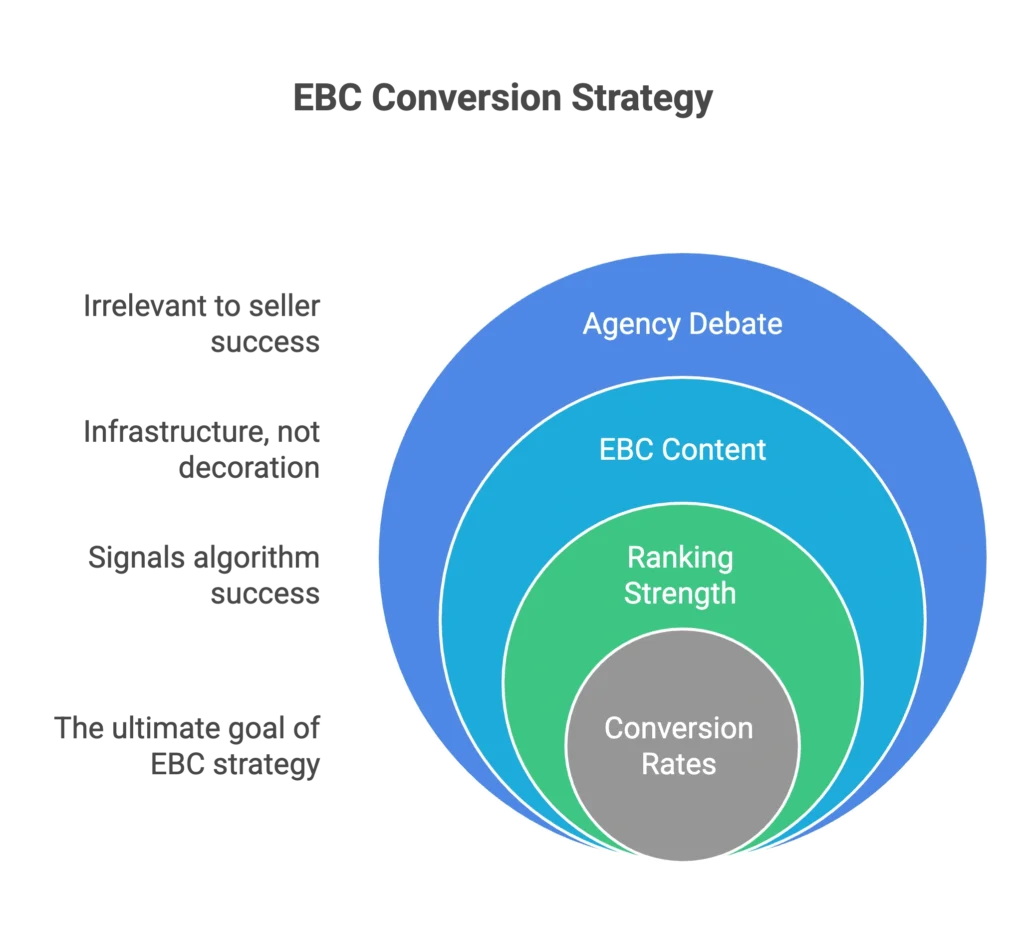
Most sellers think Amazon EBC is about pretty pictures. They’re wrong—and it’s costing them rankings.
After optimizing Enhanced Brand Content for hundreds of listings over 12+ years of hands-on Amazon experience, I’ve discovered that Amazon EBC optimization isn’t decoration—it’s infrastructure. While agencies debate whether EBC content gets indexed, successful sellers focus on what actually moves the needle: conversion rates that signal ranking strength to Amazon’s algorithm.
Most sellers leave massive opportunities on the table because they treat EBC as an afterthought. They miss critical alt text optimization, ignore mobile-first design principles, and fail to connect EBC performance to their organic ranking strategy. Even worse, with Amazon’s AI (Rufus) now reading images and text, the stakes have never been higher.
This guide reveals the real relationship between EBC and rankings, plus the systematic approach to optimization that builds sustainable organic growth—without depending on endless ad spend. Because here’s the truth: Amazon isn’t a pay-to-play advertising platform. It’s a ranking game where conversion strength determines long-term success. If you are tired of paying for results that don’t last, it might be time to look into Amazon agency alternatives that focus on building actual asset value rather than just managing monthly spend.
The EBC Ranking Truth: Conversion Over Indexing
Let’s settle the indexing debate once and for all. Yes, there’s conflicting information about whether Amazon indexes EBC content for search. Some sources claim it’s not indexed, others hedge, and a few insist it is. But here’s what I’ve learned after managing accounts that generate over $1M per SKU: the indexing question is the wrong question.
The real EBC ranking connection happens through conversion rate improvement, not direct keyword indexing. When your Enhanced Content helps more visitors convert, Amazon’s algorithm notices. Higher conversion rates signal to Amazon that your listing deserves better organic positioning because it satisfies customer intent.
Amazon doesn’t just want your ad dollars—they want their FBA fees. They profit most when you make sales, which means they’re incentivized to show listings that convert. When your EBC increases conversion rates, you’re telling Amazon’s algorithm that your product deserves visibility.
This creates the ranking chain reaction I’ve observed across hundreds of optimizations:
Better EBC → Higher Conversion Rates → Improved Sales Velocity → Better Organic Rankings → Reduced Ad Dependency
The mobile reality makes this even more critical. Most Amazon traffic now happens on mobile devices, where customers make purchase decisions within seconds. Your EBC needs to convert in that crucial 5-second window when someone first sees your listing.
If your Enhanced Content looks pretty but doesn’t drive conversions—especially on mobile—you’re actually hurting your ranking potential. Amazon notices when people click your listing but don’t buy, and that sends negative signals that can suppress your organic visibility over time.
The Alt Text Revolution: Why Amazon’s AI Changes Everything
Here’s where most sellers are leaving money on the table: alt text optimization for EBC images. I use a Chrome extension to audit competitors’ backend alt text, and the results are shocking. Most sellers either leave it completely blank or repeat the same words over and over.
Amazon gives you 100 characters per image for alt text. That’s 100 characters of additional keyword data that Amazon’s algorithm can read—and now that Rufus AI is integrated, it’s reading this content for customer queries too.
The Rufus Reality Check
Amazon’s AI assistant Rufus now reads both your alt text and the actual content within your images. When customers ask questions like “Is this size appropriate for toddlers?” or “What materials is this made from?”, Rufus scans your EBC content to provide answers. If your images contain clear text that Rufus can’t read, or if your alt text is empty, you’re missing opportunities to satisfy customer queries.
I’ve tested this extensively. Upload your product images to ChatGPT or another AI tool and ask what it sees. If the AI can’t clearly identify your product benefits, materials, or use cases, neither can Amazon’s algorithm. This is especially critical for images with text overlay—if the font isn’t clear enough for AI to read, that information might as well not exist.
The Strategic Alt Text Approach
In my optimization workflow, alt text gets the “leftover” keywords after we’ve optimized title, bullets, and backend search terms. It’s not the highest priority, but it’s also not optional. Here’s the hierarchy I use:
- Title (most important ranking factor)
- Bullet points (high conversion impact)
- Backend search terms (2,000 characters of indexing opportunity)
- Alt text (additional ranking signals plus AI optimization)
For alt text, I recommend using descriptive language that includes relevant keywords naturally. Instead of keyword stuffing, write like you’re describing the image to someone who can’t see it. For example: “plush faux leather white accent chair perfect for lounge office bedroom” rather than repeating “accent chair accent chair modern chair”.
The goal is giving Amazon’s algorithm additional context about your product while preparing for the AI-driven future of search.
Mobile-First EBC Architecture: Converting in 5 Seconds
Most EBC fails because it’s designed for desktop browsing, but most customers shop on mobile. When someone searches for your product on their phone, you have about 5 seconds to convince them your listing is worth clicking—and another 5 seconds after they land to convince them to buy.
Your EBC needs to work within this reality.
The Mobile Conversion Hierarchy
I’ve developed a systematic approach to EBC architecture that prioritizes mobile performance:
Visual Impact First: Your hero module needs to communicate value before customers read a single word. Use lifestyle images that immediately show the product in use, or clear benefit-focused graphics that work at small screen sizes.
Scannable Benefits Second: Mobile users don’t read paragraphs. They scan. Your second module should highlight 3-4 key benefits using icons, short phrases, or bullet points that are readable without zooming.
Trust Signals Third: Social proof, certifications, or brand credentials that reduce purchase hesitation. This could be customer testimonials, quality certifications, or brand history that builds confidence.
Clear Differentiation Fourth: Why your product versus competitors. Comparison charts work well here, but only if they’re mobile-optimized and focus on benefits rather than overwhelming technical specs.
Action Triggers Last: Elements that create urgency or address final objections. This might be warranty information, return policies, or bonus offers that push toward purchase.
The 5-Second Test
Before approving any EBC design, I do a mobile test. Show the content to someone for 5 seconds on a phone screen, then ask what they understood about the product. If they can’t immediately grasp the main benefit and why they should care, the design fails.
This isn’t just about aesthetics—it’s about sending strong conversion signals to Amazon. When more mobile visitors convert, Amazon notices and rewards your listing with better organic positioning.
Strategic EBC Testing: Using Amazon’s Manage Your Experiments
Most sellers set up EBC once and never touch it again. That’s leaving money on the table. Amazon provides Manage Your Experiments specifically for testing content variations, but few sellers use it systematically for EBC optimization.
The Testing Framework
I approach EBC testing like building a ranking engine, not just improving aesthetics. Every test should connect back to conversion rate improvement and organic ranking gains.
High-Impact Test Ideas:
Hero Module Messaging: Test benefit-focused headlines (“Sleep Better Tonight”) against feature-focused ones (“Memory Foam Construction”). Monitor conversion rates and organic ranking changes over 30-60 days.
Comparison Chart Strategy: Test including competitor comparisons versus focusing only on your product features. Some products benefit from direct comparison, others perform better with feature grids that avoid choice overload.
Mobile Module Order: Test different content hierarchies for mobile users. Sometimes leading with lifestyle imagery works better, other times technical specifications convert higher—it depends on your audience and product type.
Lifestyle vs Technical Positioning: For products that could appeal to different buyer segments, test emotional positioning against specifications-focused content.
Connecting Tests to Rankings
The key is tracking both conversion rate changes and organic ranking movement. When I optimize EBC and see conversion rates improve, I expect to see organic ranking gains within 30-60 days. If conversion improves but rankings don’t, there might be other listing issues (inventory, pricing, reviews) that need attention.
Use Amazon’s own tools to track this. The Manage Your Experiments data combined with organic ranking tools like Cerebro or Jungle Scout gives you the complete picture of how your EBC changes impact business results.
Premium A+ Content: Beyond Basic EBC
Premium A+ Content offers advanced modules like Brand Story and enhanced video capabilities, but eligibility can be frustrating. Many sellers meet the stated requirements but still don’t have access.
The Qualification Reality
Official requirements include Brand Registry enrollment, professional product photography, and adherence to content policies. But the unstated requirement is demonstrating listing quality and conversion strength across your catalog.
I’ve noticed that accounts with consistently high-converting listings get Premium A+ access faster than accounts with mediocre performance, even if they technically meet eligibility criteria. Focus on optimizing your existing content first, then pursue Premium features as an advanced strategy.
Strategic Implementation
When you do get Premium A+ access, avoid the temptation to use every available module. More content isn’t better content—strategic content is better content. Use Brand Story placement thoughtfully, especially on mobile where module order affects viewing experience.
Video integration can enhance conversions for certain product types, but it can also slow page load speeds or distract from purchase decisions. Test video modules systematically rather than assuming they improve performance.
Premium A+ works best as part of a holistic optimization strategy, not as a standalone solution. If your basic listing elements (title, bullets, images, pricing) aren’t optimized, Premium content won’t fix fundamental conversion problems.
FAQ: Your EBC Questions Answered
Does Amazon actually index Enhanced Brand Content for search?
The evidence is mixed, but focusing on indexing misses the real opportunity. EBC impacts rankings primarily through conversion rate improvements, which send stronger signals to Amazon’s algorithm than potential keyword indexing. Optimize for conversion first, include descriptive alt text for AI readability, and let the ranking benefits follow.
How much should I invest in EBC if I’m already running profitable ads?
EBC optimization supports your ad strategy by improving conversion rates, which lowers your TACoS over time. The goal isn’t to spend more on content—it’s to build listing strength that reduces ad dependency. Better converting listings need less ad spend to maintain rankings.
What’s the biggest EBC mistake sellers make on mobile?
Designing for desktop first. Most Amazon traffic is mobile, and if your EBC doesn’t convert in the first 5 seconds of mobile viewing, you’re losing sales and sending weak conversion signals to Amazon. Test every EBC design on actual mobile devices before implementation.
Should I optimize EBC alt text if my team doesn’t do keyword research?
Something is better than nothing. Even basic, descriptive alt text helps with Amazon’s AI and potential image search. Use leftover keywords from your main optimization or write descriptively about what’s actually in the image. Don’t leave these fields blank when Amazon provides them.
How do I know if my EBC is actually helping rankings?
Track conversion rates before and after EBC changes, monitor organic ranking positions for main keywords, and watch for TACoS improvements over 30-60 day periods. Use Amazon’s Manage Your Experiments to A/B test changes and connect results to ranking movement.
The EBC Optimization Reality Check
Enhanced Brand Content isn’t about making listings prettier—it’s about building conversion strength that supports sustainable organic growth. While others obsess over indexing theories, smart sellers focus on mobile-first optimization, strategic alt text, and systematic testing.
Every day you delay EBC optimization is another day competitors gain conversion advantages that compound into ranking dominance. With Amazon’s AI now reading image content and text, the sellers who optimize holistically will dominate those who don’t.
The Amazon game is changing. Sellers who understand that EBC is ranking infrastructure—not just visual decoration—will build the sustainable businesses that thrive regardless of ad costs or algorithm changes.
Ready to stop treating EBC as decoration and start using it as ranking infrastructure? Let’s build Enhanced Content that actually enhances your bottom line, not just your product page aesthetics. Because in Amazon’s ecosystem, everything connects—and EBC optimization is the missing link between ad spend and organic dominance.
Bonus: The EBC Optimization Checklist
Pre-Launch Audit
- [ ] Alt text completed for all EBC images (100 characters each, descriptive language)
- [ ] Mobile preview tested on actual devices (5-second conversion test)
- [ ] Conversion-focused hierarchy confirmed (benefit → trust → differentiation)
- [ ] Integration with main listing keywords verified (no competing with title/bullets)
- [ ] Rufus readability tested (upload images to AI tool for clarity check)
Testing Priority Framework
High Impact Tests:
- Hero module messaging (benefit vs. feature focused)
- Comparison charts (competitor comparison vs. feature grid)
- Mobile module order (lifestyle vs. technical first)
Medium Impact Tests:
- Lifestyle vs. technical positioning
- Video placement and length
- Trust signal placement and type
Low Impact Tests:
- Color schemes and fonts
- Minor copy adjustments
- Icon styles and graphics
Monthly EBC Performance Review
- Conversion rate trends (target improvement month-over-month)
- Organic ranking changes for main keywords
- TACoS movement (should decrease as organic improves)
- Customer questions in reviews (signals for missing EBC content)
Remember: EBC optimization is never “done.” Amazon’s algorithm evolves, customer behavior shifts, and competitor strategies change. The sellers who treat EBC as dynamic ranking infrastructure—not static decoration—build the businesses that scale sustainably beyond ad dependency.

