 Skip to content
After 12 years of selling on Amazon and building brands that generate hundreds of thousands monthly, I’ve learned that most sellers treat Amazon customer feedback like a necessary evil. They’re missing the biggest opportunity hiding in plain sight. Real growth doesn’t come from just avoiding negatives; it comes from leveraging the voice of the customer to refine your product and outpace the competition.
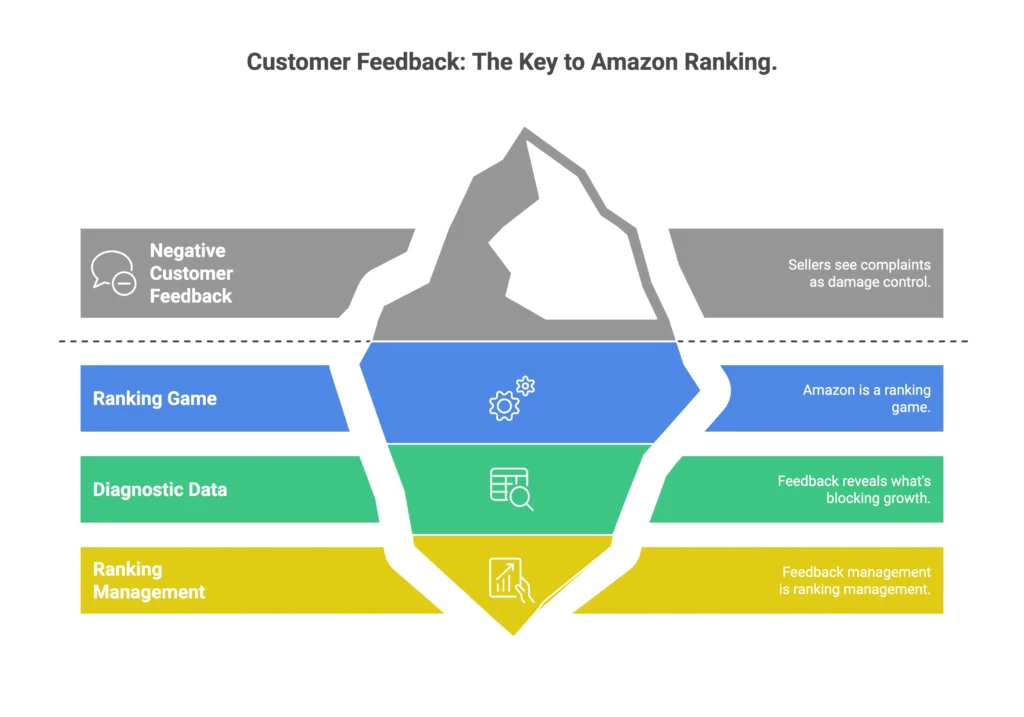
Here’s the truth: Amazon isn’t just a marketplace—it’s a ranking game. Everything connects in a chain reaction that most sellers never see. Ads affect rank, rank affects reviews, reviews affect conversion, and conversion affects ad efficiency. When you understand this ecosystem, tracking Amazon customer feedback stops being a problem and becomes your roadmap to organic dominance. By treating Amazon customer feedback as a data-driven signal rather than just a rating, you can systematically engineer a listing that out-converts the competition in 2026.
Most sellers see complaints as damage control. I see them as diagnostic data that reveals exactly what’s blocking your path to sustainable growth. Every negative review, every return, every piece of seller feedback is Amazon’s algorithm telling you precisely what needs to change to climb the rankings.
This isn’t theory. I’ve built my own clothing brand from zero to doing over $400,000 monthly with no ads, raised prices, and still thriving. I manage accounts pulling in millions monthly. The difference isn’t luck—it’s understanding that feedback management is actually ranking management in disguise.
The Feedback Ecosystem Most Sellers Misunderstand
Product Reviews vs Seller Feedback—Know the Difference or Pay the Price
The first mistake most sellers make is treating all feedback the same. Product reviews and seller feedback are completely different systems with different rules, different impacts, and different management strategies.
Product reviews appear directly on your listing and reflect the item itself. They influence organic ranking through Amazon’s A9 algorithm, affect conversion rates, and stay permanently attached to your ASIN. These reviews can merge across variations when your catalog structure is set up correctly—but here’s where most sellers shoot themselves in the foot.
Seller feedback reflects your service quality and appears in your seller profile. It impacts Buy Box eligibility, account health, and customer trust. Unlike product reviews, seller feedback can sometimes be removed if it violates Amazon’s guidelines.
The critical connection most sellers miss is catalog architecture. When your browse nodes are inconsistent across variations, Amazon customer feedback won’t merge properly. I’ve seen sellers with identical products split across multiple parent ASINs, fragmenting their Amazon customer feedback and destroying their organic potential. One consolidated listing with 500 reviews will always outrank five separate listings with 100 reviews each.
The Chain Reaction Effect—Why Every Complaint Matters
Amazon’s algorithm doesn’t just count stars—it measures customer satisfaction signals across every touchpoint. A spike in returns signals quality issues. Declining seller feedback suggests service problems. Poor Voice of the Customer scores indicate fundamental listing or product flaws.
When I was scaling my clothing brand, I noticed organic rankings dropping even though I had inventory. The problem wasn’t my product—it was stock distribution. Amazon couldn’t promise fast delivery to certain regions, which lowered conversions and hurt organic rank. This had nothing to do with the product quality, but everything to do with customer experience.
The moment stock distribution improved, organic ranks and sales picked right back up. That’s the chain reaction in action: inventory management affects shipping promises, shipping promises affect conversion rates, conversion rates affect organic ranking.
Mastering Amazon’s Native Feedback Tools (The Real Playbook)
Feedback Manager—Your Central Command Dashboard
Feedback Manager isn’t just a place to respond to complaints—it’s your early warning system for algorithmic penalties. The dashboard reveals patterns that predict ranking drops before they happen.
Monitor your feedback trends weekly. A sudden spike in negative feedback, even on a small percentage basis, signals systematic issues that need immediate attention. The response workflow isn’t just about customer service—it’s about demonstrating to Amazon’s algorithm that you actively manage customer satisfaction.
When requesting feedback removal, understand the rules. Amazon will consider removal for feedback that contains product information instead of service feedback, uses inappropriate language, or addresses issues not related to seller performance. What they won’t remove is legitimate service criticism, even if it’s harsh. Mastering the nuances of Amazon customer feedback management means knowing when to fight for a removal and when to use a negative comment as a tool for improvement.
I track feedback patterns across all client accounts. When I see recurring themes—shipping delays, packaging issues, product discrepancies—those become immediate action items. Each complaint becomes data that guides listing optimization, operational improvements, and inventory management decisions.
Voice of the Customer—Reading Amazon’s Quality Signals
Voice of the Customer scores are Amazon’s internal quality ratings, and they directly influence your organic visibility. When products show “Poor” or “Very Poor” ratings, Amazon’s algorithm actively suppresses their ranking potential.
The key is connecting VoC data to specific improvements. If packaging receives poor scores, that’s not just a customer service issue—it’s a ranking problem. If product quality scores drop, that affects both organic visibility and ad efficiency.
I use VoC trends and Amazon customer feedback to prioritize catalog fixes. A declining VoC score on a high-volume ASIN gets immediate attention because the ranking impact compounds quickly. Fix the root cause based on Amazon customer feedback, monitor the recovery, then document what worked for future optimization.
Returns and Return Insights—The Goldmine Most Sellers Ignore
Return data is the most actionable feedback you’ll get, but most sellers treat it as a cost center instead of an intelligence source. Top return reasons become your listing optimization roadmap.
“Wrong size” returns point to size chart issues or unclear product descriptions. “Not as described” returns reveal gaps between customer expectations and product reality. “Defective” returns indicate quality control problems or packaging failures.
When managing my clothing brand, return data shaped every major decision. High return rates on certain sizes led to size chart improvements and more detailed fit descriptions. Damage-related returns drove packaging upgrades that reduced returns by identifying weak points in the supply chain.
Each return reason connects to specific listing elements. Size issues require bullet point clarification and enhanced A+ content. Quality complaints need image updates and material descriptions. Packaging problems demand operational changes that reduce both returns and negative feedback.
Product Opportunity Explorer’s Customer Review Insights
Customer Review Insights reveals what customers actually say about products in your category. This isn’t just about your listings—it’s competitive intelligence that guides positioning and messaging.
Mining review themes creates FAQ content that addresses common concerns before they become returns. Seasonal patterns in customer feedback reveal timing opportunities for product launches and promotional strategies.
The real value is understanding category-wide Amazon customer feedback. When customers consistently use specific terms to describe problems or benefits, those terms belong in your listing copy. It’s not just keyword optimization—it’s using Amazon customer feedback to speak the language your customers already use.
The Compliant Review Generation System
Request a Review—Timing is Everything
Amazon’s “Request a Review” feature is the only compliant way to solicit reviews, but timing makes the difference between success and wasted opportunities. The 5-30 day window isn’t arbitrary—it’s based on customer experience patterns and delivery confirmation.
Request too early, and customers haven’t fully evaluated the product. Request too late, and the purchase experience fades from memory. The sweet spot is typically 7-14 days after delivery for most product categories.
I automate review requests across all managed accounts, but never with incentives or manipulation. The request must be neutral and generic. Amazon’s enforcement on review manipulation has intensified, and account suspension isn’t worth the short-term review boost.
Building Review Velocity Without Breaking Rules
Early review velocity drives organic ranking more than total review count. A product with 50 reviews in its first month will outrank a product with 200 reviews accumulated over two years.
My launch strategy starts with pricing psychology and Vine enrollment. Launch at a lower price point to encourage early purchases and Vine reviews. The combination of competitive pricing and legitimate review sources creates momentum that sustains even after price increases.
Proper catalog structure amplifies this effect. When reviews merge correctly across variations, each individual sale contributes to the collective review score, accelerating the velocity that Amazon’s algorithm rewards.
The Complaint-to-Resolution Framework
Phase 1—Capture (Centralize All Feedback Inputs)
Create systematic monitoring across all feedback sources. Feedback Manager for seller performance, VoC scores for quality insights, return reasons for product issues, and review themes for positioning opportunities.
The goal isn’t just collection—it’s pattern recognition. Individual complaints might be random, but patterns reveal systematic issues that impact rankings.
Phase 2—Classify (Organize by Root Cause)
Not all feedback requires the same response. Product quality issues need supplier communication and potentially product changes. Listing clarity problems require copy updates and enhanced images. Fulfillment issues need operational improvements.
Classification determines priority and resource allocation. A product quality issue affecting 10% of orders demands immediate attention. A listing clarity issue affecting conversion rates needs fast implementation but different expertise.
Phase 3—Correct (Systematic Issue Resolution)
Implementation must be trackable and measurable. Update product specifications based on quality feedback. Revise listing copy to address clarity concerns. Improve packaging to reduce damage complaints. Enhance inventory management to prevent stock-out situations that hurt rankings.
Each correction connects to ranking factors. Better product quality improves reviews and reduces returns. Clearer listings increase conversion rates. Improved fulfillment enhances customer satisfaction scores.
Phase 4—Close (Measure and Monitor Recovery)
Track improvements across all metrics. VoC score recovery indicates quality improvements are working. Reduced return rates confirm product or packaging changes are effective. Improved review sentiment validates listing optimizations.
The feedback loop continues because Amazon’s algorithm constantly evaluates performance. Consistent improvement in feedback metrics translates directly to organic ranking gains and reduced advertising dependency.
Advanced Feedback Strategies for Scale
When and How to Request Feedback Removal
Understanding Amazon’s removal criteria prevents wasted effort and manages expectations. Feedback qualifies for removal when it violates content policies, contains product information instead of service feedback, or addresses issues outside seller control.
What doesn’t qualify: legitimate service criticism, harsh but truthful feedback, or complaints about Amazon’s policies. Removal requests should be strategic, not desperate attempts to eliminate all negative feedback.
Using Feedback Data for Competitive Intelligence
Competitor feedback patterns reveal market opportunities. Categories with consistent complaint themes across multiple sellers indicate unaddressed market needs. Seasonal feedback trends show timing opportunities for product launches and improvements.
This intelligence guides positioning strategy. If competitors consistently receive complaints about durability, emphasize your product’s construction quality. If sizing issues dominate category feedback, invest in detailed size guides and fit information.
Frequently Asked Questions
How quickly should I respond to negative seller feedback?
Response timing affects both customer perception and removal success rates. Responding within 24 hours demonstrates commitment to customer service and can influence future customer decisions. Based on managing multiple high-volume accounts, quick responses also improve the success rate of removal requests for qualifying feedback.
Can I incentivize customers to leave positive reviews or remove negative ones?
Absolutely not. Amazon’s policies prohibit any incentives, conditional refunds, or manipulation attempts. Enforcement has increased significantly, and violations risk account suspension. The only compliant approach is using the “Request a Review” button within the proper timeframe with neutral language.
What’s the difference between product reviews that can’t be removed and seller feedback that sometimes can be?
Product reviews reflect the item itself and remain permanently attached to the ASIN. Seller feedback reflects service quality and can sometimes be removed if it violates Amazon’s guidelines—such as containing product feedback instead of service criticism, inappropriate language, or issues unrelated to seller performance.
Should I focus on getting more positive reviews or removing negative ones?
Focus on root causes first. Addressing the systematic issues that generate complaints naturally improves your review profile and prevents future problems. Removal requests should be secondary and only for feedback that genuinely violates Amazon’s policies.
Your Next Steps
Customer feedback isn’t noise—it’s signal. After 12 years of building brands and managing accounts that generate millions monthly, the pattern is unmistakable: sellers who treat Amazon customer feedback systematically create the customer satisfaction and conversion rates that fuel organic dominance. Prioritizing Amazon customer feedback transforms raw data into a competitive advantage.
Those who see feedback as damage control stay trapped in expensive advertising cycles. Those who use it as diagnostic data build sustainable competitive advantages.
The tools exist in Seller Central. The framework works at scale. The only question is whether you’ll treat feedback as a problem or embrace it as your roadmap to ranking domination.
Ready to transform your Amazon feedback ecosystem from a headache into a competitive advantage? Every complaint is telling you exactly what needs to change to climb the organic rankings. The question is whether you’re listening.

