 Skip to content
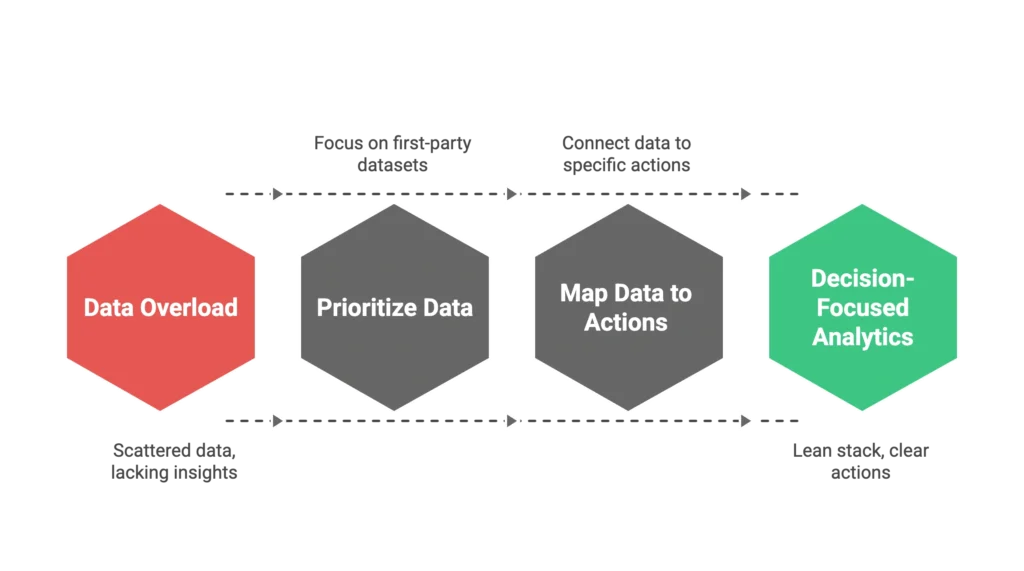
Most Amazon sellers are drowning in data but starving for insights. You check Seller Central’s Business Reports, peek at Brand Analytics, monitor your ads dashboard, and somehow still feel like you’re flying blind. Sound familiar?
Here’s the problem: Amazon’s first-party data is scattered across multiple dashboards, and most sellers have no systematic way to connect the dots between what they’re measuring and what decisions they should make.
After building and managing Amazon brands for over 12 years—including my own clothing brand that currently does hundreds of thousands per month with minimal ad spend—I’ve learned that successful sellers don’t just collect data. They master Amazon analytics and tracking to build what I call an “Amazon Analytics Operating System,” ensuring every decision is backed by a sophisticated approach to Amazon analytics and tracking rather than guesswork.
This isn’t about collecting every possible metric or using the fanciest third-party tools. It’s about creating a lean, decision-focused analytics stack that prioritizes Amazon’s first-party datasets and maps each data point to a specific action you can take.
In this guide, you’ll discover:
- How to build a streamlined analytics stack using Amazon’s native reporting tools
- Which metrics actually drive decisions (and which ones are just vanity numbers)
- The specific framework I use to track organic rank improvements alongside PPC performance
- How to leverage hourly data from Amazon Marketing Stream for better ad decisions
- A practical decision cadence that turns data into consistent growth
Let’s stop collecting data for data’s sake and start building an analytics system that actually drives results.
The Reality Check: Why Most Amazon Analytics Strategies Fail
I’ve worked with brands doing over $23 million annually who were completely flying blind. They had sophisticated third-party tools, detailed dashboards, and mountains of data—but when sales spiked or dropped, they couldn’t tell you why.
The fundamental problem isn’t lack of data. It’s the fragmentation problem.
“Your performance data lives in Business Reports. Your keyword insights hide in Brand Analytics. Your ad metrics scatter across the Amazon Ads console. Meanwhile, third-party tools create their own data silos that may or may not align with Amazon’s actual numbers.”
I recently consulted with a brand where 82% of their sales were attributed to marketing. Think about that—only 18% organic sales despite having established products and good reviews. They were stuck in what I call the “expensive hamster wheel,” failing to use proper Amazon analytics and tracking to identify why they were constantly feeding ads just to maintain sales. Without a more granular approach to Amazon analytics and tracking, they were essentially flying blind while their profit margins evaporated.
The real issue? They had no systematic way to track whether their ads were actually building organic strength or just buying temporary visibility.
The Hidden Cost of Fragmented Analytics
When your data lives in silos, you miss the connections that matter most. Amazon’s ecosystem is built on chain reactions—ads affect rank, rank affects reviews, reviews affect conversion, and conversion affects ad efficiency. If one part breaks, everything suffers.
Here’s what happens when you don’t connect the dots:
- You spend on ads without knowing if they’re improving organic rank
- You optimize listings without understanding search behavior patterns
- You make inventory decisions without considering ranking implications
- You chase vanity metrics while missing actual growth opportunities
Amazon’s First-Party Data Goldmine: Your Analytics Foundation
Amazon provides incredibly powerful native tools that most sellers either ignore or misuse. The key is understanding which tool answers which question and how they work together.
Business Reports: Your Conversion Truth Teller
What it tracks: Sessions, page views, unit session percentage, buy box percentage
Best for: Understanding traffic quality and conversion funnel performance
Decision driver: Listing optimization and conversion improvements
Amazon analytics and tracking through Business Reports shows you what happens after someone finds your listing. If your session percentage is low, you have a conversion problem. If page views are high but sessions are low, customers are browsing but not engaging deeply; mastering these Amazon analytics and tracking metrics is essential for diagnosing why shoppers are dropping off before the purchase.
Brand Analytics: Search Query Performance (SQP)
What it tracks: Query-level search volume, click share, conversion share
Best for: Keyword prioritization and search term optimization Decision driver: Understanding which keywords to target and how you’re performing against the market
SQP reveals the search terms customers actually use and how your products perform for those searches compared to competitors. This is goldmine data for both listing optimization and PPC targeting.
Brand Analytics: Search Catalog Performance (SCP)
What it tracks: Catalog-level funnel analysis from search to purchase Best for: Diagnosing where customers drop off in the buying process
Decision driver: Finding specific bottlenecks in your customer journey
Amazon analytics and tracking tools like Search Query Performance (SQP) show you the complete funnel from search impression to purchase. If customers are clicking but not adding to cart, you have a detail page problem. However, if they’re adding to cart but not purchasing, it might be a pricing or trust issue that requires deeper Amazon analytics and tracking to identify exactly where the friction occurs.
The SQP vs. SCP Decision Framework
Many sellers don’t understand when to use Search Query Performance versus Search Catalog Performance. Here’s the breakdown:
Use SQP when you need to:
- Identify new keyword opportunities
- Understand search volume trends
- Compare your click share to market performance
- Prioritize which terms to target in PPC campaigns
Use SCP when you need to:
- Diagnose conversion issues
- Understand why traffic isn’t converting
- Identify catalog-level optimization opportunities
- Track funnel performance improvements
Amazon Marketing Stream: Your Hourly Advantage
Most sellers make ad decisions based on yesterday’s data, but mastering Amazon analytics and tracking requires a more real-time approach. Amazon Marketing Stream gives you hourly granularity that can transform your advertising strategy through more precise Amazon analytics and tracking of your peak conversion hours
I’ve seen sellers struggle with budget pacing, wondering why their ads stop spending after 5 PM when customers are browsing on their phones. With hourly data from Marketing Stream, you can identify these patterns and adjust accordingly.
Critical applications include:
- Dayparting optimization: Identifying peak performance hours and adjusting bids
- Budget pacing: Ensuring spend distribution aligns with conversion patterns
- Real-time adjustments: Making bid changes based on hour-by-hour performance data
The difference between daily reporting and hourly insights is the difference between knowing what happened and being able to influence what’s happening.
The Organic Rank Tracking System That Actually Works
Here’s something most sellers get wrong: they check their rankings once a day and panic when they see fluctuations. Rankings change every hour on Amazon. What matters is the trend direction, not daily volatility.
For my own brand and client accounts, I track organic rankings for 40+ high-volume keywords that our main competitors rank for. Using tools like Helium 10’s “rocket ship” feature, I monitor these keywords hourly to understand true ranking patterns.
The key insight: If you’re advertising for a keyword and your organic rank improves over time, your ads are working correctly. If you can maintain those rankings when you reduce ad spend, you’ve built real organic strength.
I recently turned off ads completely for one of my listings after running low on inventory. Despite what many “gurus” predicted, my organic rankings not only held—they improved. Why? Because the foundation was already there. The ads had done their job of building momentum.
Why Rankings Change Every Hour (And Why That’s Normal)
Amazon’s algorithm constantly tests and adjusts rankings based on real-time performance data. A keyword might rank 8th at noon and 13th at 3 PM, then jump to 6th by evening. This isn’t a problem—it’s the system optimizing based on conversion data.
What you should watch for:
- Weekly trends: Is the average position improving over time?
- Competitive movement: Are you gaining or losing ground to specific competitors?
- Inventory correlation: Do ranking drops coincide with low stock levels?
Stock distribution matters more than most people realize. If Amazon can’t promise fast delivery in certain regions, your rank will suffer even if you have inventory. I’ve seen this firsthand—some sizes weren’t completely out of stock, but Amazon didn’t have enough inventory distributed across warehouses. The result? Extended delivery times in some regions, which killed conversions and hurt organic rank.
The 4-Layer Analytics Operating System
Instead of randomly checking different dashboards, build a systematic approach that maps data to decisions:
Layer 1: Discover & Prioritize
- Tools: Product Opportunity Explorer, Search Query Performance
- Decisions: Market gap identification, keyword prioritization
- Frequency: Monthly strategic reviews
Layer 2: Optimize On-Amazon Performance
- Tools: Business Reports, Search Catalog Performance
- Decisions: Listing optimization, conversion improvements
- Frequency: Weekly performance reviews
Layer 3: Scale Advertising
- Tools: Marketing Stream, campaign performance data
- Decisions: Bid adjustments, budget allocation, dayparting
- Frequency: Daily tactical adjustments
Layer 4: Measure Off-Amazon Impact
- Tools: Amazon Attribution
- Decisions: External marketing optimization, channel investment
- Frequency: Monthly attribution analysis
This framework ensures every piece of data you collect serves a specific purpose in your growth strategy.
Amazon Attribution: Closing the Off-Amazon Loop
If you’re driving traffic to Amazon from external sources—social media, email, Google Ads—Amazon Attribution shows you exactly how that traffic converts on Amazon.
Essential setup elements:
- Proper channel tagging and naming conventions
- Attribution links for each traffic source
- Regular monitoring in the Amazon Ads console
Without proper attribution tracking, you’re making external marketing decisions blind. You might be spending money on Facebook ads that generate Amazon sales, but if you can’t measure it, you can’t optimize it.
Common Analytics Mistakes That Kill Amazon Growth
Mistake 1: Chasing Vanity Metrics
I see sellers obsessing over impressions and clicks while ignoring the metrics that actually matter: organic rank improvements and conversion rates. If your ads are generating clicks but your organic position isn’t improving, you’re just buying traffic, not building a business. Masterful Amazon analytics and tracking requires looking beyond the dashboard to see how ad spend influences your long-term visibility. Without a proper system for Amazon analytics and tracking, you risk spending your entire margin on temporary traffic rather than sustainable growth.
Mistake 2: Ignoring the Inventory-Rank Connection
Understocking doesn’t just cost you sales today—it costs you rankings and long-term momentum. Amazon’s algorithm favors listings that can deliver fast, and if you can’t maintain proper stock distribution, your competitors will pass you in the search results.
Mistake 3: Ad Attribution Blindness
Many sellers can’t tell you which sales come from ads versus organic performance. This makes it impossible to know whether your advertising is building sustainable growth or just creating expensive dependency.
Mistake 4: Disconnected Tool Usage
Using multiple analytics tools without connecting insights across platforms leads to decision paralysis. Every metric you track should map to a specific action you can take.
The Decision Cadence That Drives Consistent Growth
Weekly Performance Review:
- Organic rank trends: Are your target keywords moving in the right direction?
- Conversion analysis: How is traffic quality changing?
- Ad efficiency assessment: Is ad spend building organic strength?
- Inventory check: Are stock levels affecting performance?
Monthly Strategic Review:
- Market opportunity assessment: What new keywords or products should you target?
- Competitive analysis: How are your positions changing relative to competitors?
- Attribution review: Which external channels are driving Amazon growth?
- Strategic adjustments: What long-term optimizations should you prioritize?
This cadence ensures you’re making decisions based on trends and patterns, not daily fluctuations or gut feelings.
Advanced Analytics: Automation and Efficiency
Amazon has made significant improvements to their Reports API, including adding SQP and SCP data in 2025. This means you can now automate much of your data collection and focus on analysis and decision-making.
Implementation strategy:
- Start manual: Build understanding with native tools first
- Identify patterns: Determine which reports provide consistent value
- Automate gradually: Begin with most time-consuming reports
- Scale systematically: Expand automation based on decision impact
The goal isn’t to automate everything, but to free up time for strategic thinking and optimization work that actually moves the needle.
From Data Collection to Decision Making
The difference between successful Amazon sellers and those stuck in expensive cycles isn’t access to data—it’s the systematic approach to turning that data into decisions.
Amazon provides incredibly powerful analytics tools through Business Reports, Brand Analytics, Marketing Stream, and Attribution. The key is building a framework that connects each data point to specific actions you can take to improve your listings, optimize your advertising, and build sustainable organic growth.
Your next steps:
- Audit your current setup: Which tools are you using and which decisions are they driving?
- Implement the 4-layer framework: Start with discovery and optimization layers
- Establish your decision cadence: Set up weekly and monthly review processes
- Connect the dots: Ensure each metric you track maps to a specific action
Remember, Amazon isn’t a pay-to-play advertising platform—it’s a ranking game. The sellers who understand this and build their analytics accordingly are the ones who achieve sustainable, profitable growth.
The data is there. The tools are available. The only question is whether you’ll use them systematically or continue collecting numbers without direction.

