 Skip to content
Most wholesalers treat Amazon FBA for wholesalers like another distribution channel—ship inventory, upload listings, and wait for sales. That’s exactly why they fail. After 12 years of building Amazon brands and managing accounts for manufacturers across NY/NJ, I’ve seen the same pattern repeatedly: successful wholesalers assume Amazon works like traditional retail. They’re wrong.
After 12 years of building Amazon brands and managing accounts for manufacturers across NY/NJ, I’ve seen the same pattern repeatedly: successful wholesalers assume Amazon works like traditional retail. They’re wrong; a high-performance Amazon FBA for wholesalers model requires real-time data monitoring and logistics agility that traditional retail simply doesn’t demand. In this environment, your Amazon FBA for wholesalers strategy must pivot from simple bulk distribution to active Buy Box management and automated inventory replenishment to stay competitive.
Amazon isn’t a warehouse with a website. It’s a ranking ecosystem where organic visibility determines long-term success, not just advertising spend. The wholesalers who understand this difference are capturing market share from competitors stuck in the old distribution model. This shift requires moving away from basic advertising metrics and mastering TACoS vs ACoS for Amazon growth, which allows you to measure how your total sales—both organic and paid—are actually scaling as your brand authority grows.
The reality: Amazon FBA isn’t about moving inventory—it’s about building digital shelf space that customers find organically. While your competitors burn cash on ads without strategy, you can build sustainable growth through proper catalog architecture, honeymoon period execution, and inventory positioning that most wholesalers never consider.
This isn’t theory. I’ve transitioned multiple wholesale businesses from traditional distribution to dominant Amazon positions. The framework I’ll share has helped brands move from failed launches to consistent organic growth, turning Amazon from a question mark into their fastest-growing channel.
If you’re a manufacturer or wholesaler still debating whether Amazon FBA is worth it, or if you’ve tried and failed, this breakdown will show you exactly what you’re missing—and how to fix it.
Why Traditional Distribution Thinking Kills Amazon Success
The Fatal Wholesale Mindset
The Distribution vs. Amazon FBA debate isn’t just about shipping; it’s about a fundamental shift from volume placement to conversion optimization. In 2026, where Amazon has phased out certain prep services and increased inbound placement fees, wholesalers must act like private label brands—optimizing for the “Halo Effect” where every sale builds permanent organic rank.
Here’s the fundamental disconnect: traditional wholesale focuses on volume placement while Amazon FBA for wholesalers rewards conversion optimization. In wholesale distribution, you succeed by getting your products into as many locations as possible. However, on Amazon FBA for wholesalers, you succeed by making one listing perform better than your competitors to capture the Buy Box.
Think about how traditional retail works. You have relationships with buyers who make decisions based on past performance, margins, and personal connections. Your success depends on maintaining those relationships and ensuring consistent supply.
Amazon’s algorithm doesn’t care about your relationships. It cares about data: conversion rates, click-through rates, customer satisfaction scores, and delivery speed. Because Amazon FBA for wholesalers depends so heavily on winning the Buy Box, the algorithm makes decisions hundreds of times per day about which listings to show customers. It’s completely ruthless about performance, making it essential to master Amazon FBA for wholesalers if you want to maintain consistent visibility and sales.
Most wholesalers fail because they apply brick-and-mortar thinking to a digital ecosystem. They upload basic listings with minimal optimization, expecting their product quality to speak for itself. Then they wonder why their expensive ads aren’t converting or why they can’t gain organic visibility.
The hidden costs of the “upload and hope” strategy are massive:
Weak listings that can’t convert traffic from ads make every PPC dollar wasteful. You’re paying Amazon to send traffic to listings that don’t sell, which hurts your conversion rate and teaches the algorithm that customers don’t want your products.
Missing honeymoon period opportunities creates challenges that are nearly impossible to overcome later. Amazon gives new listings a ranking boost during their first 90 days, making Amazon FBA for wholesalers a high-stakes race against the clock. Wholesalers who don’t understand this window often launch with basic setups and waste this critical advantage; however, mastering the nuances of Amazon FBA for wholesalers ensures that this initial momentum translates into long-term profitability.
Catalog structure errors limit scalability from day one. Unlike wholesale catalogs organized by product codes, Amazon requires parent/child relationships that match how customers search and shop. Getting this wrong affects both organic discoverability and advertising efficiency.
Inventory management mistakes hurt organic rank through delivery time impacts. When you run low on stock, Amazon can’t promise fast delivery to customers in all regions. This hurts your conversion rate and signals to the algorithm that your listing isn’t reliable.
The Amazon Ecosystem: What Wholesalers Don’t Understand
It’s a Ranking Game, Not a Sales Game
Amazon isn’t a pay-to-play advertising platform—it’s a ranking game. Most sellers are stuck in an expensive hamster wheel because they treat Amazon like Google Ads instead of understanding it’s an ecosystem where organic ranking is everything.
Here’s what I mean: when you run ads on Google, you’re renting visibility. The second you stop paying, your traffic disappears. Amazon ads work differently. They should be building organic rank while generating immediate sales.
Every time someone clicks your ad and buys your product, Amazon’s algorithm learns that customers want what you’re selling for that keyword. This data helps your organic ranking for that term. Done correctly, your ads create a snowball effect where organic sales increase while advertising costs decrease over time.
I proved this with my own clothing brand recently. After running strategic ads to build organic rankings for key terms, I turned off all advertising for my main listing. Sales kept rolling in. Organic rank held strong. Why? Because the ads weren’t propping up the listing—they built its foundation.
Most wholesalers do the opposite. They run ads hoping for immediate ROI without understanding the relationship between advertising data and organic visibility. In Amazon FBA for wholesalers, this mistake is very common because sellers focus only on short-term ad performance. They focus on ACoS (Advertising Cost of Sales) instead of TACoS (Total Advertising Cost of Sales). However, in Amazon FBA for wholesalers, long-term growth depends on understanding how advertising supports organic ranking. They’re optimizing for the wrong metrics.
The mobile reality makes this even more critical. Most Amazon customers shop on mobile devices and make purchase decisions within 5 seconds of seeing a listing. If your title, main image, and price don’t immediately communicate value, you lose the sale—regardless of how much you’re spending on ads.
The Honeymoon Period: Your 90-Day Window
Every new listing on Amazon gets what’s called a “honeymoon period”—roughly 90 days when the algorithm gives your products extra visibility to test market response. Most wholesalers waste this advantage because they don’t know it exists.
I believe the honeymoon period is strongest during the first 90 days, but it doesn’t end abruptly—it gradually weakens over time. The longer you wait to optimize, the harder it gets. Think of it like compound interest in reverse.
During this window, proper pricing strategy matters more than long-term margins. I’ve helped wholesale clients launch products slightly below their target price points to maximize conversion rates during the honeymoon period. Once organic rankings are established, prices can be optimized for profitability.
The key is coordinating every element: listing optimization, pricing strategy, inventory levels, and advertising spend all need to work together from day one. Miss this window, and you’re fighting an uphill battle against established competitors with strong organic rankings.
I recently relaunched one of my own listings that was over a year old—well past its original honeymoon period. By treating it like a fresh launch with coordinated optimization across all levers, we successfully ranked into top positions for main keywords with search volumes exceeding 387,000 monthly searches. This proves that while the honeymoon period is ideal, strategic execution can still drive results later.
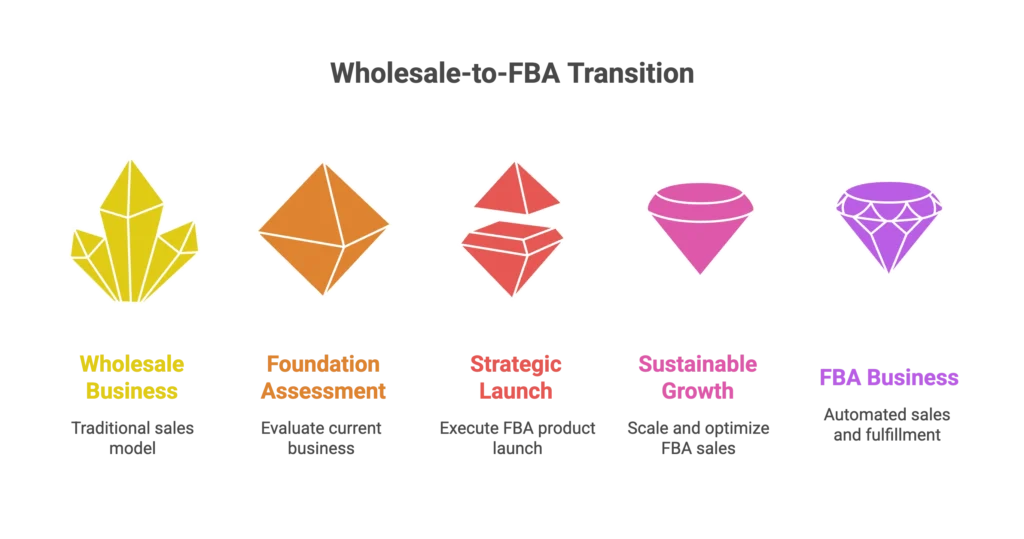
The Wholesale-to-FBA Transition Framework
Phase 1: Foundation Assessment
Before launching any products on Amazon, you need to audit your approach through Amazon’s lens, not traditional wholesale thinking.
Catalog Architecture is everything. Your parent/child relationships need to match how customers search and shop, not how you organize inventory internally. A clothing manufacturer might organize by style numbers, but Amazon customers search by “men’s pajama sets” or “women’s sleepwear.” Your catalog structure needs to reflect customer behavior.
Backend keyword optimization using Amazon’s expanded character limits is crucial but often ignored. Many wholesalers set up listings years ago and never updated their backend keywords when Amazon increased the character limits. These hidden fields directly impact your organic discoverability and PPC performance.
Inventory strategy planning separates successful wholesalers from failed ones. You need to maintain 90 days of stock per variation at the child ASIN level. When you run low on stock, Amazon can’t promise fast delivery to customers in all regions. This hurts conversion rates and teaches the algorithm that your listings aren’t reliable.
Consider using AWD (Amazon Warehousing & Distribution) as a bulk hub while maintaining FBA inventory for fast customer fulfillment. This hybrid approach gives you the inventory depth needed for consistent performance without tying up cash in FBA storage fees.
Phase 2: Strategic Launch Execution
The honeymoon period demands coordination across every element. Your pricing, advertising, and inventory levels all need to support maximum conversion rates during those critical first 90 days.
Start with auto campaigns for keyword discovery. When I’m building a listing, I make sure to include longtail keywords, short tail keywords, Spanish variations, and even common misspellings in the backend. Auto campaigns feed off this data and discover relevant terms I might not have considered.
Auto campaigns let Amazon’s algorithm test your listing against different search terms and show you what resonates with customers. Once you identify high-converting keywords with decent search volume, you can invest more heavily in manual campaigns for those specific terms.
Monitor conversion rates religiously. If you’re getting clicks but not sales, your listing needs optimization before you scale advertising spend. Throwing more money at a low-converting listing just teaches Amazon that customers don’t want your products.
Phase 3: Sustainable Growth & Scaling
The goal is moving from ad-dependent to organic-strong listings. I track this by monitoring organic sales growth while optimizing TACoS over time. If organic sales are increasing and TACoS is decreasing, you’re building sustainable growth.
Inventory positioning becomes critical as you scale. Even small stock level drops can impact performance. I learned this firsthand when my own brand’s organic rankings started dropping—not because of competition or algorithm changes, but because low inventory levels increased delivery times in certain regions.
When Amazon can’t promise fast delivery, conversion rates drop. Lower conversion rates signal to the algorithm that customers don’t prefer your listing. It’s a vicious cycle that starts with something as simple as inventory planning.
This is why I maintain 90-day stock levels and use AWD for bulk inventory management. It prevents the stop-start cycles that kill momentum and ensures consistent performance across all regions.
Advanced Strategies: Beyond Basic FBA Setup
The Speed-to-Conversion Connection
Fast shipping badges aren’t just nice-to-have features—they directly impact organic rankings through improved conversion rates. Customers prefer products that arrive quickly, especially for time-sensitive needs.
AWD serves as your bulk inventory hub while FBA ensures fast customer delivery. This hybrid approach optimizes both cost efficiency and customer experience. You’re not paying FBA storage fees on excess inventory, but you always have enough stock positioned for fast delivery.
Inbound placement fees require strategic planning in 2025. Amazon’s new fee structure means you need to optimize your shipment timing and fulfillment center distribution. Random, reactive inventory management now costs significantly more than strategic planning.
Regional delivery strategy affects conversion rates more than most wholesalers realize. A customer in California seeing 5-day delivery while a customer in New York sees 2-day delivery will impact your overall conversion rate and organic ranking potential.
Common Wholesale-to-FBA Pitfalls (And How to Avoid Them)
The “Multiple Agency” Trap
Most wholesalers hire separate vendors for listings, ads, and account management without connecting strategies. In Amazon FBA for wholesalers, this fragmented approach often leads to missed growth opportunities. One team optimizes listings without considering advertising implications. Another team runs ads without understanding listing conversion potential. A third team monitors account health without connecting it to overall performance. This lack of coordination is a common challenge in Amazon FBA for wholesalers, where success depends on aligning listing optimization, advertising strategy, and account management.
This fragmented approach kills results. Amazon is a chain reaction engine—ads affect rank, rank affects reviews, reviews affect conversion, conversion affects ad efficiency. When one element is optimized in isolation, the entire system suffers.
My approach treats every account holistically. Listing optimization considers mobile-first presentation and advertising keyword targeting. PPC strategy builds organic rank while generating immediate sales. Inventory management ensures consistent performance across all customer regions.
Catalog Structure Mistakes
Backend keyword neglect when Amazon expanded character limits is costing wholesalers visibility and sales. Many listings were set up with minimal backend optimization and never updated. These hidden fields directly impact organic discoverability and PPC performance.
Category misclassification affects organic reach because Amazon shows products to customers browsing specific categories. Getting placed in the wrong category limits your visibility to relevant shoppers, regardless of your advertising spend or listing quality.
Wrong variation setups limit scalability from launch. If you set up parent/child relationships incorrectly, you can’t easily add new variations later without creating catalog confusion. This structural foundation affects long-term growth potential.
Your Amazon FBA Decision Framework
The wholesale businesses winning on Amazon aren’t the ones with the biggest inventory or the most SKUs. They’re the ones who understand that Amazon is a ranking ecosystem, not a distribution channel.
Ask yourself these critical questions:
Are you thinking like a wholesaler or an Amazon seller? If you’re still focused primarily on volume placement and relationship management, you’re missing the data-driven optimization that Amazon requires.
Does your catalog have the foundation for Amazon success? Parent/child relationships, backend optimization, and mobile-first presentation aren’t optional—they’re requirements for sustainable growth.
Do you have the expertise needed for strategic execution? Amazon success requires specialized knowledge that most wholesalers don’t have internally. The learning curve is steep, and mistakes during the honeymoon period are costly.
The transition from traditional distribution to Amazon dominance requires precision execution across multiple specialized areas. Listing optimization, advertising strategy, inventory management, and catalog architecture all need to work together from day one.
If you’re ready to transition from traditional distribution to Amazon dominance but need guidance from someone who’s actually built brands on Amazon, not just consulted, the framework exists. The question is whether you’ll implement it strategically or continue treating Amazon like another distribution channel.
The wholesalers who understand this difference are building sustainable competitive advantages while their competitors burn cash on ineffective advertising. The choice is yours.
90-Day Wholesale-to-FBA Quick Start Checklist
Pre-Launch (Days 1-30)
- Catalog architecture audit: Ensure parent/child structure matches customer search patterns
- Backend optimization: Update keywords using expanded character limits
- Mobile-first listings: Optimize titles and bullets for 5-second mobile decisions
- Inventory planning: Calculate 90-day supply needs per variation
- Fulfillment strategy: Plan AWD/FBA hybrid approach for cost and speed optimization
Launch Phase (Days 31-60)
- Honeymoon pricing: Strategic pricing below long-term targets for maximum conversion
- Auto campaigns: Launch for keyword discovery and market testing
- Conversion monitoring: Daily tracking and listing optimization based on performance data
- Organic ranking: Weekly assessment of keyword position improvements
Growth Phase (Days 61-90)
- TACoS optimization: Focus on decreasing total advertising cost while growing organic sales
- Inventory positioning: Maintain stock levels that support fast delivery across all regions
- Long-term pricing: Gradually optimize prices as organic rankings strengthen
- Performance analysis: Document learnings and refine strategy for continued growth
The key is treating this as a coordinated system, not isolated tasks. Every element affects every other element in Amazon’s ranking ecosystem.

