 Skip to content
Most Amazon sellers think they’re running their listings well. They’re focused on keeping ACoS low. They’re running the same “safe” campaigns on autopilot. They’re watching the dashboard and hoping for the best, completely ignoring the massive potential of the Amazon honeymoon period. While they play it safe, they miss the 90-day window where the algorithm is most responsive to new data, allowing aggressive sellers to lock in organic rankings that last for years.
But here’s the truth about the honeymoon period: It’s not about staying safe. It’s about unlocking your brand’s true potential.
After 12+ years selling on Amazon and building my own brands to $400K/month with zero ads, I’m sharing the exact Amazon honeymoon period strategy that separates winners from the 90% who fail. This isn’t theory from someone who’s never risked their own money—I practice what I preach, actively launching and scaling brands while managing select clients. Understanding the Amazon honeymoon period is the difference between a product that stays buried on Page 10 and one that dominates the top of the search results.
Day 90. Still at $0 in ad spend. Still ranking. Still selling.
That’s what happened when I paused all ads exactly 90 days ago on one of my listings. Today marks 90 days with zero ads, still ranking top 5 for competitive keywords, sitting at 4,000 BSR with thousands of organic sales.
This only worked because I understood something most sellers miss: Amazon isn’t a pay-to-play advertising platform—it’s a ranking game.
What 99% of Sellers Get Wrong About Amazon Honeymoon Period
The Expensive Hamster Wheel Most Sellers Are Stuck In
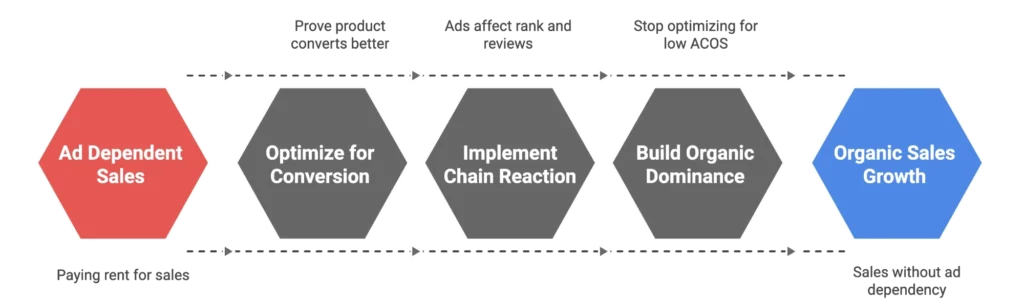
I see it constantly in my client audits: sellers who think Amazon success means feeding the ad machine forever. If you have to keep feeding ads to make sales, you’re not growing. You’re paying rent.
The conventional wisdom says “honeymoon period equals easy rankings.” Sellers launch thinking Amazon gives them a free 90-day boost, then wonder why everything crashes after day 90. This misunderstanding of the Amazon honeymoon period is why many brands fail to scale, as they treat it as a “free pass” rather than a high-stakes performance review that dictates their long-term Amazon honeymoon period success.
Here’s what’s really happening: The honeymoon period isn’t a guaranteed boost—it’s Amazon’s test to see if your listing deserves permanent real estate.
Amazon doesn’t care about your profit margins during launch—they care about proving your product converts better than competitors. If you’re not converting at 15%+ during week one, you’re already behind the 87% of listings that never reach page 1 organically. Navigating the Amazon honeymoon period is about one thing: the conversion signal you send to the algorithm while it’s giving you the “benefit of the doubt.”
Why Amazon’s Algorithm Actually Rewards Aggressive Strategy
Most agencies look at Amazon as a collection of tasks. They offer listing optimization, or they run ads, or maybe they monitor your account—but no one is pulling all the threads together.
Amazon is a chain reaction engine. Ads affect rank. Rank affects reviews. Reviews affect conversion. Conversion affects ad efficiency. If one part is off, it all suffers.
I recently worked with a client who was stuck at $500K annually, spending $40,000+ monthly on ads just to maintain position. Within 60 days of implementing proper honeymoon strategy on their new launches, they had three listings generating organic sales without ad dependency.
The difference? We stopped optimizing for low ACOS and started building for organic dominance.
The Real 90-Day Honeymoon Period Breakdown

Days 1-30: The Foundation Phase (Where Everything Goes Together)
This is when Amazon’s algorithm is most aggressive about testing your listing. Most people treat this like traditional retail—big mistake.
Inventory Distribution Strategy Nobody Talks About: You need minimum 60 days of stock, but here’s what kills most launches: Amazon needs to distribute your inventory across fulfillment centers. I’ve seen sellers with 500 units tank because everything was sitting in one warehouse.
When customers in California see “5-day shipping” while customers in New York see “2-day shipping,” your conversion rates suffer geographically. Amazon notices this pattern and deprioritizes your listing immediately.
The Aggressive Pricing Secret: Start 30-50% below your target price. Yes, you’ll lose money per unit initially. But you’re buying market position.
One of my recent launches: Started at $24.99, target was $39.99. Week 1 results: 847 units sold, 18.3% conversion rate, ranking page 2 for main keyword. Investment mindset, not profit mindset.
Amazon Vine Strategy Most People Mess Up: Enroll in Vine immediately, but here’s the critical part—enroll at your aggressive launch price, not your target price. Vine reviewers still judge value for money. Give them a no-brainer and watch the five-stars flow.
Days 31-60: The Momentum Phase (When Rankings Accelerate)
By now, Amazon has enough data to start making permanent decisions about your listing’s future. This is where organic rank acceleration kicks in—if you’ve done the foundation right. Mastering the Amazon honeymoon period is the only way to bypass years of slow growth, as the algorithm uses this window to decide if you are a “Category King” or just another generic listing. If you miss this Amazon honeymoon period, you’ll be fighting an uphill battle against established competitors for the rest of the year.
Strategic Price Increases: Begin raising prices gradually, testing conversion impact at each level. I typically do 4-6 increases over this period, watching organic rank closely. Week 4 results from that same launch: First price increase to $27.99, conversion dropped to 16.1% but stabilized. Ranking improved to position 12.
PPC for Rank Building, Not Profit: High ACOS isn’t the enemy if ads are driving sales and building organic rank. I’ve spent $50,000 in a single month on one listing because those clicks were translating to organic position improvements.
The moment you start optimizing for low ACOS instead of rank building, you’re thinking short-term.
Days 61-90: The Transition Phase (Preparing for Independence)
Week 8 results: Hit $32.99 pricing, ranking positions 4-8 for primary keywords with 200,000+ monthly search volume.
Day 90 status: $39.99 target price achieved, ranking top 5 for competitive keywords.
Here’s where most sellers crash: Amazon’s algorithmic support gradually decreases. If you’ve built strong organic positions, you’ll maintain momentum. If you’ve been carried by algorithmic boost alone, you’ll fall apart.
Stock levels become absolutely critical during this phase. Any shortage will destroy months of ranking progress. I maintain 90+ days of inventory specifically to avoid algorithmic penalties.
Case Study: How I Built Sustainable $400K/Month Revenue
The Pre-Launch Investment
I invested $400,000 in initial inventory—not because I’m reckless, but because I understand the math. Undercapitalized launches fail 90% of the time.
The Complete Strategy:
- Mapped out 12-week price progression with specific conversion rate thresholds
- Tracked 40 high-volume keywords but focused on 8 primary terms
- Secured inventory distribution across multiple fulfillment centers
- Prepared for 6-month runway without profitability pressure
Post-Honeymoon Reality Check
Here’s where it gets interesting: On day 91, I paused all advertising. Complete ad spend shutdown.
90 days later (today): Still ranking top 5, still growing sales, zero ad dependency.
Wait, why am I not doing this? That’s the reaction I want when sellers see these results.
This only worked because ads weren’t propping up the listing—they were building its foundation. Most sellers’ rankings collapse the second ads stop because they never built organic strength.
The 7 Deadliest Honeymoon Period Mistakes That Kill Listings

Mistake #1: Starting at Target Price
Why It Fails: No conversion incentive during critical testing phase Real Cost: 87% of listings that launch at target price never reach page 1
Mistake #2: Treating Each Variation Equally
Why It Fails: Amazon ranks child ASINs individually—your red size large might rank #3 while blue size medium sits on page 4 Solution: Identify your MVP variation and protect its stock at all costs
Mistake #3: Running Out of Stock (Even Partially)
Why It Fails: Destroys fulfillment center distribution and tanks conversion rates Client Example: One client lost 40% of organic traffic when they went to 15 days inventory
Mistake #4: Optimizing for Low ACOS Too Early
Why It Fails: Prioritizes short-term profitability over long-term positioning Reality Check: Accept 40-60% ACOS during honeymoon if it’s building rank
Mistake #5: Poor Mobile Optimization
Why It Fails: 70%+ of Amazon traffic is mobile, but most listings are optimized for desktop Client Insight: We rebuilt one client’s mobile experience and saw 23% conversion improvement
Mistake #6: Fragmented Strategy Execution
Why It Fails: One agency for ads, one freelancer for listings, another for images—no coordination My Approach: We handle the chain reaction. Everything connects or nothing works.
Mistake #7: No Post-Honeymoon Plan
Why It Fails: Algorithmic support ends but strategy doesn’t evolve Critical Insight: Plan for day 91 before day 1
Hidden Issues Sellers Never Think to Check
Inventory Location Sabotaging Rank
I built a custom tool to track exactly where my inventory sits across Amazon’s fulfillment centers. You can have 500 units in stock, but if they’re sitting in one fulfillment center, customers in other regions see 5-day shipping and don’t convert.
I’ve documented conversion rate differences of 8-12% based purely on shipping speed promises. When my main listing was showing 4-day delivery in certain zip codes, organic rankings dropped 15% within a week—even though I had plenty of inventory.
Keywords Degrading When Not Maintained
Most sellers optimize once and forget. Keywords need constant maintenance. Backend search terms get buried. Competitors start targeting your successful terms. Category classifications drift.
Real client example: Found a $2M seller whose main listing had lost 60% of its searchable keywords over 18 months. Nobody was watching. Rankings slowly declined. Sales stagnated.
The Mobile-First Reality Nobody Optimizes For
Most people never even scroll past the title on mobile. Yet most listings are still optimized for desktop viewing.
We restructure listings mobile-first: shorter titles that work on small screens, bullet points that scan quickly, images that tell the story in the first frame. Customer psychology—how to build listings that sell in 5 seconds.
What Really Happens After Day 90
The Transition Most Sellers Miss
The sellers who thrive post-honeymoon built sustainable competitive advantages during their 90-day window. The ones who crash were carried by algorithmic boost alone.
Leading indicators of post-honeymoon success:
- Organic sales increasing as percentage of total sales
- Keyword rankings stable without ad support
- Conversion rates maintaining 12%+ levels
- Review velocity continuing naturally
Red flags that indicate upcoming crash:
- Sales dropping immediately when ads pause
- Organic rankings declining week-over-week
- Increasing dependency on deals and promotions
Your Honeymoon Period Action Plan
Ask yourself:
- How have you been using your ad spend? Chasing low ACOS or building organic rank?
- Were you running deals, or avoiding them because you didn’t want to offer discounts?
- Did you make sure you never ran out of stock on strong variations?
- Were you being cheap with ads and afraid to scale during the critical window?
Every decision matters. All these factors make a huge difference.
The Amazon honeymoon period isn’t a participation trophy—it’s a 90-day audition for permanent market position. Most sellers waste this critical window treating Amazon like traditional retail or optimizing for vanity metrics.
The winners understand it’s an ecosystem play. Everything connects: pricing affects conversion, conversion affects rank, rank affects review velocity, reviews affect long-term sustainability.
If you’re serious about building a dominant Amazon presence—not just surviving but thriving—the honeymoon period is where it all begins. But it’s also where most sellers lose the game before they even know they’re playing it.
Ready to dominate your honeymoon period instead of wasting it? The next 90 days will determine whether you build a sustainable Amazon business or join the 90% who plateau and struggle.
Stop paying rent on Amazon. Start building real estate.


