 Skip to content
Most established wholesalers treat Amazon for wholesalers like another retail channel—upload your catalog, set competitive prices, and wait for orders. That approach might work with traditional buyers, but Amazon’s algorithm doesn’t care about your distributor relationships or retail track record. To win in this space, you have to stop thinking like a distributor and start thinking like a brand owner, mastering the Amazon catalog architecture that actually dictates visibility and organic rank in a saturated marketplace.
After 12+ years selling on Amazon, I’ve seen countless wholesalers burn through budgets because they applied retail logic to an ecosystem that operates more like a search engine than a storefront. The platform rewards listings that understand its ranking mechanics, not just good products with fair pricing.
This isn’t about abandoning what you know—your supply chain expertise and established products are valuable assets. But success on Amazon requires a fundamental shift in how you think about catalog architecture, pricing strategy, and customer acquisition.
The reality: Amazon is a ranking game disguised as a marketplace. Master the ranking mechanics, and your wholesale advantages become unstoppable. Ignore them, and you’ll struggle regardless of how good your products are or how established your business is.
The Fatal Mistakes Wholesalers Make on Amazon
The biggest mistake I see from established wholesalers is thinking Amazon operates like traditional B2B sales. In wholesale, relationships drive everything—your track record, personal connections, and established distribution networks matter most. On Amazon, the algorithm doesn’t care about any of that.
Here’s what typically happens: A successful wholesaler uploads their entire 200+ product catalog, prices competitively based on their traditional margins, and waits for the orders to roll in. Three months later, they’re frustrated with minimal sales despite having great products and fair prices.
Why this fails: Amazon rewards depth, not breadth. I’d rather have 5 dominant listings doing $1M+ each than 50 mediocre ones fighting for scraps. The platform’s ranking algorithm needs concentrated signals—sales velocity, conversion rates, and review accumulation on specific parent listings—to understand which products deserve visibility.
Most wholesalers also completely miss the honeymoon period mechanics. Those first 90 days after launching a new listing are when Amazon’s algorithm is most receptive to ranking new products. Launch without a strategic approach during this window, and you’ll spend years trying to recover lost ground.
The other critical mistake: running ads without understanding their relationship to organic ranking. Traditional marketing is about immediate ROI. Amazon advertising should build organic ranking first, sales second. If your sales collapse the moment you pause ads, you’re not growing—you’re paying rent.
The Amazon Wholesaler’s Operating Framework
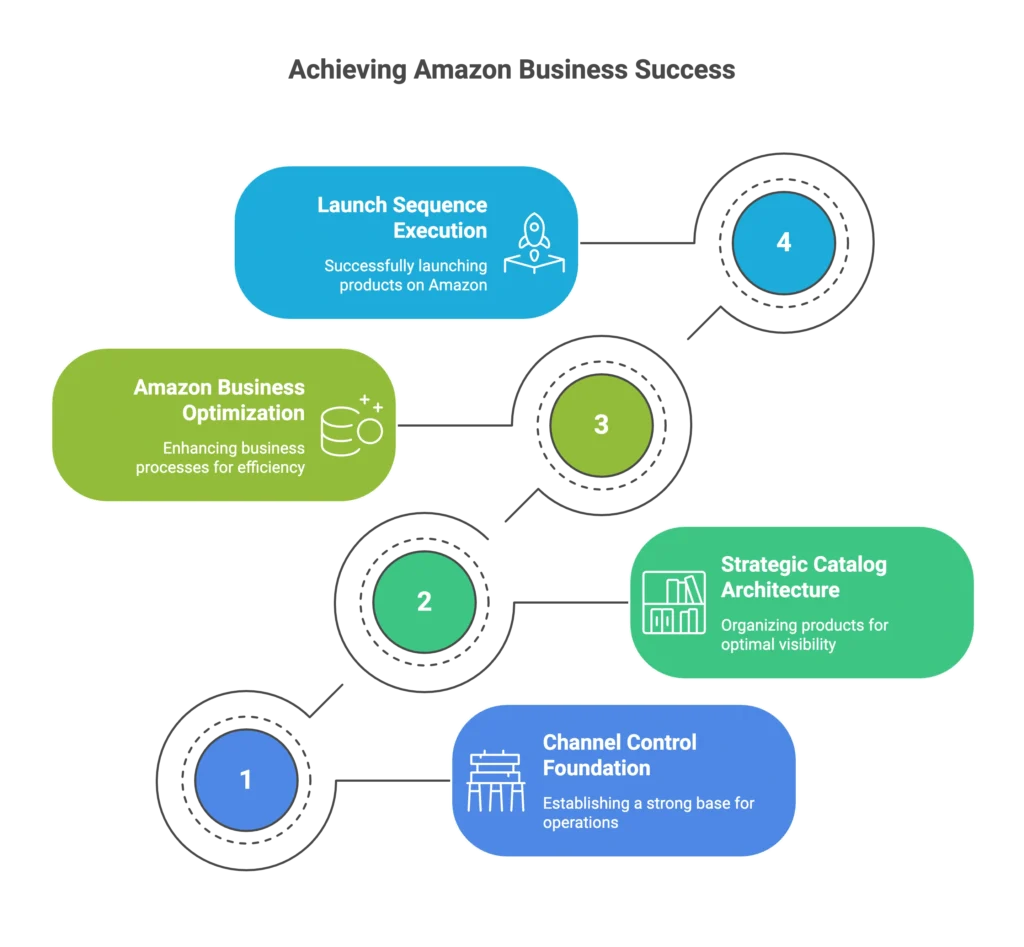
Success on Amazon requires a systematic approach that addresses four critical phases in the right sequence.
Phase 1: Channel Control Foundation
Before you list a single product, secure brand control. This isn’t optional for serious wholesalers—it’s essential protection against unauthorized resellers and price erosion.
Start with Brand Registry enrollment. This gives you powerful tools for brand protection, enhanced content options, and advertising features unavailable to generic sellers. But here’s what most people miss: the role assignments matter. If you’re working with agencies or partners, understand the difference between brand owner and agent permissions.
Once enrolled, implement a MAP (Minimum Advertised Price) enforcement system using the Report-a-Violation tool. I’ve seen wholesalers lose 30% margins because they didn’t control unauthorized sellers racing to the bottom on price. Set up monitoring systems for your key products and establish documentation workflows for pricing violations.
Phase 2: Strategic Catalog Architecture
This is where wholesale experience becomes a massive advantage—if you apply it correctly. Your existing product knowledge helps you identify which SKUs have the best potential for Amazon dominance.
Focus on parent-child structure optimization. Instead of treating each SKU as a separate listing, group related products under strategic parent ASINs. This consolidates review authority and SEO power while making inventory management cleaner.
For example, if you sell apparel, don’t create separate listings for every color and size combination. Build one parent listing with all variations as children. This concentrates ranking signals and customer reviews, making each individual variation stronger than it would be alone.
The key is variation theme selection by category. Amazon has specific rules about how products can be grouped, and choosing the wrong theme can limit your expansion options later. Get this foundation right, and scaling becomes much simpler.
Phase 3: Amazon Business Optimization
Here’s where wholesalers have a built-in advantage that most private label sellers can’t replicate: legitimate B2B functionality.
Amazon Business offers quantity pricing, business-only products, and enhanced features specifically designed for B2B buyers. Set up tiered pricing structures that reward bulk orders while maintaining competitive pricing for individual consumers.
This dual-channel approach is powerful. You can capture individual consumer sales through regular Amazon while serving your traditional wholesale customer base through Amazon Business features. The same inventory, two different buyer experiences, maximum market coverage.
Implement rules-based automation for pricing updates. When you’re managing multiple price tiers across different customer types, manual updates become impossible at scale. Feed-based pricing systems let you maintain consistency across your entire catalog while responding quickly to market changes.
Phase 4: Launch Sequence Execution
The honeymoon period is your 90-day window of maximum opportunity, but it requires precise timing and coordination.
Weeks 1-2: Focus on inventory positioning and pricing strategy. Make sure your stock is distributed across Amazon’s fulfillment network properly. Poor inventory distribution can kill conversion rates before you even start advertising, as some customers will see extended delivery times.
Weeks 3-6: Enroll in Amazon Vine at strategically low pricing. Yes, you’re giving products away free, but pricing still matters for review quality. Vine reviewers judge value based on the displayed price, even though they’re not paying. Price too high, and you’ll get nitpicky four-star reviews about “expensive for what it is.”
Weeks 7-12: Launch A+ Content and Brand Story. These enhanced content features improve conversion rates and provide additional keyword opportunities. Combined with early Vine reviews, you’re building the foundation for strong organic performance.
Month 2-3: Begin TACoS-driven advertising scale. Notice I said TACoS, not ACoS. Total Advertising Cost of Sale includes organic sales in the calculation, giving you a clearer picture of advertising effectiveness. High ACoS isn’t the enemy if it’s building organic ranking that drives long-term sales.
Advanced Strategies That Agencies Miss
Most Amazon agencies focus on tactics instead of ecosystem thinking. They’ll optimize your listings or manage your ads, but they miss the connections between different elements that drive real growth.
Inventory Intelligence for Ranking Stability
Stock levels affect more than just availability—they impact organic ranking directly. When you drop below 30 days of inventory on any child ASIN, Amazon starts deprioritizing that entire parent listing in search results.
But here’s what’s even more subtle: inventory distribution matters as much as total stock levels. If your inventory isn’t properly spread across Amazon’s fulfillment centers, customers in certain regions will see longer delivery times, which hurts conversion rates and ultimately organic ranking.
I learned this firsthand when running my own brand. Some sizes weren’t completely out of stock, but Amazon couldn’t promise fast delivery everywhere. Customers in certain states saw four- to five-day delivery times instead of two-day Prime, which slowed sales and hurt rankings until inventory distribution improved.
TACoS-Driven Growth Beyond ACoS Obsession
Most sellers get trapped monitoring ACoS in isolation. They see 20% ACoS and panic, or achieve 8% ACoS and think they’re winning. Both reactions miss the bigger picture.
TACoS includes organic sales in the calculation, showing you the true relationship between ad spend and total business growth. During my brand’s launch phase, I ran some keywords at 50%+ ACoS because they were building organic ranking for high-volume terms. Within 90 days, those keywords were generating significant organic sales with zero ad spend.
The key is tracking organic ranking progression alongside advertising metrics. If organic rank is improving, higher ACoS can be justified as an investment. If organic rank is stagnant despite consistent ad spend, you’re stuck in the pay-to-play hamster wheel.
Implementation Roadmap for Established Wholesalers

Month 1: Foundation Setting
Start with a catalog audit focused on opportunity identification. Don’t try to launch everything at once—identify your 5-10 highest-potential products based on margin, replenishment capability, and competitive landscape. This is the first step in building a strong Amazon for wholesalers approach.
Complete Brand Registry setup and channel control systems. This includes training your team on MAP enforcement procedures and setting up monitoring workflows for unauthorized sellers. Proper setup is crucial for anyone doing Amazon for wholesalers successfully.
Optimize your Amazon Business account configuration. Set up quantity pricing tiers, business-only products where appropriate, and enhanced features for B2B buyers. These backend optimizations are essential in Amazon for wholesalers operations.
Month 2: Strategic Implementation
Reconstruct your priority listings with proper catalog architecture. This means optimizing titles for mobile-first browsing (most customers never scroll past the title on mobile), building compelling bullet points that address purchase objections, and structuring backend keywords for maximum search coverage—key tactics in Amazon for wholesalers.
Implement parent-child architecture for your product families. Group related SKUs strategically to consolidate ranking power while maintaining clear differentiation for customers. Understanding variation structure is one of the most overlooked aspects in Amazon for wholesalers strategies.
Launch Amazon Vine enrollment and A+ Content creation for your hero products. These enhanced features improve conversion rates and provide additional opportunities for keyword optimization—another essential component of Amazon for wholesalers.
Month 3: Growth Phase
Begin TACoS-driven advertising campaigns focused on organic ranking development rather than immediate profitability. Monitor organic ranking progression weekly and adjust ad spend based on ranking improvements, not just cost-per-acquisition metrics. This is how high-performing Amazon for wholesalers sellers sustain long-term growth.
Establish inventory planning workflows that maintain 90+ days of stock across all variations while optimizing for fulfillment center distribution. Stock-outs during this growth phase can set you back months in ranking recovery, something critical in Amazon for wholesalers operations.
Implement performance review systems that track the metrics that actually matter: organic ranking progression, TACoS trends, and long-term profitability rather than short-term ACoS targets. Metrics-driven management is a hallmark of professional Amazon for wholesalers execution.
Ready to Transform Your Wholesale Business on Amazon?
Amazon isn’t just another sales channel—it’s an opportunity to build a dominant brand presence with your existing wholesale advantages. But only if you approach it with the right Amazon for wholesalers strategy from day one.
The framework outlined above represents 12+ years of hands-on Amazon experience, tested with wholesalers who’ve successfully made the transition from traditional retail to Amazon dominance. Currently, I operate my own brand that generates $400,000 monthly from a single listing with zero ad spend, proving that organic ranking mastery creates sustainable, profitable growth—an outcome any serious Amazon for wholesalers can achieve.
The difference between success and failure isn’t your product quality or pricing—it’s understanding Amazon’s ecosystem and working with its mechanics rather than against them. Most wholesalers try to force their traditional retail approach onto Amazon’s algorithm. The ones who succeed adapt their wholesale advantages to Amazon for wholesalers ranking requirements.
Instead of managing multiple agencies hoping they coordinate properly, you need a partner who understands both the wholesale business model and Amazon’s unique ecosystem requirements. Someone who’s actually built and scaled brands on the platform, not just managed campaigns from the sidelines. This is what separates successful Amazon for wholesalers from those who plateau.
The opportunity is massive, but the window for easy wins is closing as competition increases. Wholesalers who master Amazon’s ranking mechanics now will dominate their categories for years. Those who continue treating it like traditional retail will find themselves permanently dependent on expensive advertising just to remain visible—something every Amazon for wholesalers wants to avoid.
Your wholesale experience is an asset, not a liability. Your established supply chains, product expertise, and inventory management capabilities become competitive advantages when applied correctly to Amazon for wholesalers. The question isn’t whether you should be on Amazon—it’s whether you’ll approach it strategically or let competitors establish dominance while you’re still figuring out the basics. Mastering Amazon for wholesalers today ensures you stay ahead tomorrow.

