 Skip to content
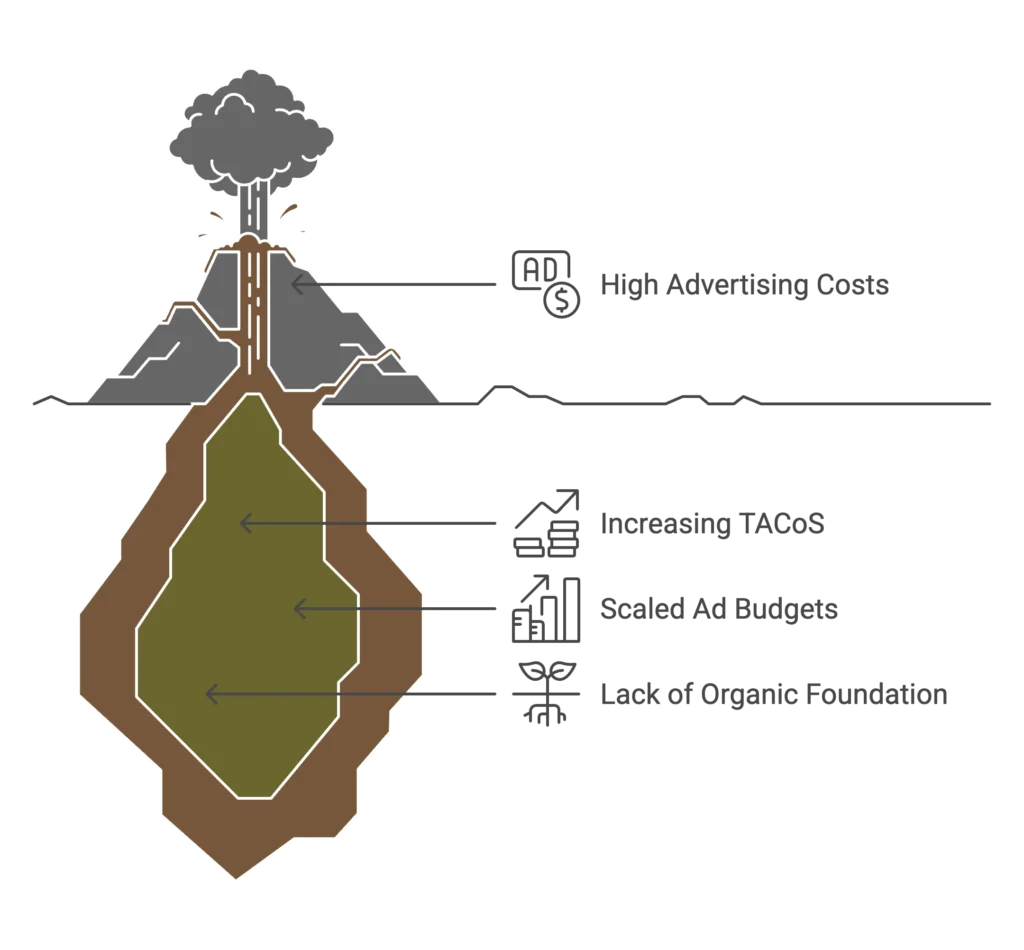
If your sales tank the moment you pause ads, you don’t have a business—you’re paying Amazon rent.
Most Amazon sellers are trapped in an expensive cycle. They obsess over keeping ACoS low while their TACoS creeps higher every month. They scale ad budgets thinking “spend more, grow more,” but without a proper Amazon ad strategy for rankings, they never build the organic foundation that creates real ROI.
After 12 years of selling on Amazon and building multiple brands, I’ve seen this backwards approach destroy otherwise solid businesses. My own clothing brand hit $400K in monthly sales with zero ad spend because we focused on the ranking game, not the advertising game. I’ve also managed client accounts doing $700K in two weeks at just 7% TACoS while other agencies struggle with 82% attributed sales—meaning barely any organic momentum. The secret lies in scaling Amazon PPC profitably by ensuring every dollar spent actually pushes your organic needle forward rather than just buying one-off sales.
This isn’t another “lower your ACoS” guide. This is about understanding why ads should fuel organic growth, not replace it—and how to measure real ROI using metrics that actually predict long-term success.
You’ll learn the ROI→Rankings framework that separates businesses from “budget burns,” why TACoS trends matter more than ACoS snapshots, and how to use Amazon’s native tools to diagnose where your funnel actually breaks.
The Fatal Flaw in Most Amazon Ad Strategies
The “Rent vs. Own” Problem
Here’s the brutal truth: most sellers are paying Amazon rent for visibility instead of building assets they own.
I recently paused all ads on my personal brand for 90 days—not by choice, but because of stock issues. Most sellers assume this would destroy organic rankings and tank sales. Instead, sales kept growing and organic rank held strong. Why? Because ads weren’t propping up the listing; they had built its foundation.
The real equation isn’t Ads = Sales. It’s Ads = Rankings.
If you’re constantly spending just to maintain sales, your ads aren’t working—they’re buying temporary placement. You’re stuck in a pay-to-play cycle where competitors can outbid you tomorrow and destroy your visibility overnight.
Recently worked with a brand where 82% of sales were attributed to marketing—a staggeringly low organic percentage that screams “ad dependency trap”. Compare that to accounts I manage that maintain 5-7% TACoS with strong organic momentum. The difference? One approach builds assets; the other rents traffic.
The ACoS Obsession Trap
Here’s where most sellers go wrong: they treat ACoS like the ultimate success metric. But ACoS is a lagging indicator, not a leading one.
High ACoS isn’t the enemy if the ad drives sales and improves your rank. If you shut off ads for a keyword you’re not ranking organically? Expect a drop. The key is understanding when high ACoS is building future profitability versus when it’s just burning budget.
Before scaling any campaign, your conversion foundation must be solid. Most agencies focus on bid optimization while ignoring that their client’s listing doesn’t convert. On mobile—where most shopping happens—customers don’t scroll past the title if it doesn’t grab them immediately.
Understanding True Amazon ROI: TACoS vs. ACoS Decoded
The Metrics That Actually Matter
TACoS Governance Model:
Declining TACoS + Growing organic sales = Healthy growth This is your target state. Ads are successfully building organic rankings that reduce future ad dependency.
Stable TACoS + Stagnant organic = Ad dependency warning
You’re treading water. Ads generate sales but don’t improve your competitive position.
Rising TACoS + Declining organic = Strategy failure The worst scenario—increasing ad spend with deteriorating organic foundation.
The ROI→Rankings Framework
Phase 1: Foundation Building Before spending significant ad dollars, your conversion rate must be optimized. This means testing hero images, titles, and A+ content using Amazon’s Manage Your Experiments tool. Every CVR improvement compounds through both organic algorithm favor and improved ad efficiency.
Phase 2: Strategic Ad Deployment
The honeymoon period—your first 30-90 days—is critical. This is when Amazon pays closest attention to your sales velocity and conversion rates. Strategic ad spend during this window creates momentum that carries forward long after you reduce budgets.
Target organic rankings for keywords where you can realistically compete, not vanity terms that require unlimited budgets. Focus on building dominance in specific keyword clusters rather than spreading thin across hundreds of targets.
Phase 3: Organic Transition As rankings solidify, systematically reduce ad spend on keywords where you rank top 10 organically. Monitor the transition carefully—if sales drop immediately after reducing spend, you haven’t achieved true organic strength yet.
Amazon’s Native Diagnostic Tools (That Most Agencies Ignore)
Search Query Performance (SQP) – Your ROI Diagnostic Backbone
Most sellers waste money scaling campaigns without understanding where their funnel breaks. Search Query Performance shows you exactly what’s happening at each stage: Impressions → Clicks → Cart → Purchase.
High impressions, low clicks? Your creative or pricing needs work before increasing bids.
High clicks, low conversions? Fix your listing optimization before scaling spend.
Strong cart adds, poor purchase rate? You have a pricing or competitive pressure problem.
Use SQP weekly to decide whether poor performance requires more ad spend or better listing optimization. This single diagnostic prevents thousands in wasted budget allocation.
Manage Your Experiments (MYE) – Conversion Before Budget
Here’s the testing hierarchy that maximizes ROI impact:
- Hero image variants (biggest CTR impact)
- Title benefit framing (mobile-first optimization)
- A+ Content modules (conversion rate improvement)
- Backend keyword optimization (expanded character limits)
Testing costs pennies compared to scaling inefficient campaigns. A 20% CVR improvement from image testing delivers better ROI than doubling your ad budget on a poor-converting listing.
Category Listing Report & Backend Audits
Hidden ROI killers lurk in your backend setup. Browse node mismatches destroy organic visibility. Item type keyword inconsistencies confuse Amazon’s algorithm about where you belong in search results.
I’ve seen sellers lose thousands in sales because Amazon automatically “corrected” their backend fields incorrectly. Monthly audits using the Category Listing Report catch these issues before they crater your performance.
The Inventory-Ranking-ROI Connection
Stock Distribution Science
Here’s something most sellers don’t realize: having inventory in FBA doesn’t guarantee fast shipping promises to all customers.
If your stock isn’t properly distributed across fulfillment centers, Amazon shows longer delivery times to customers in certain regions. Someone in New York might see “2-day shipping” while a California shopper gets “5-day shipping.” That extra wait time kills conversions and signals Amazon that your listing isn’t competitive.
The 30-Day Rule: Below 30 days of inventory, Amazon deprioritizes your listing. Your organic rankings suffer, and ad efficiency drops because the algorithm knows you can’t fulfill demand consistently.
I learned this the hard way when some of my brand’s child ASINs dropped below 30 days of stock. Sales slowed not because we turned off ads, but because Amazon couldn’t promise consistent delivery times across regions.
Why Each Child ASIN Matters for ROI
Amazon treats each size or color like its own listing for ranking purposes. If one child ASIN ranks #3 for your main keyword but sells out, Amazon doesn’t automatically promote your other variations to that spot. You lose the ranking entirely, and your whole parent listing suffers.
This is why diversified inventory across all variations is crucial for ROI protection. One stockout can destroy weeks of ranking progress and force you back into expensive ad dependency.
Campaign Architecture for Long-Term ROI
Beyond Basic Campaign Types
After 12 years of building brands and managing accounts, here’s the strategic hierarchy that builds sustainable ROI:
Foundation Campaigns: Exact match campaigns on keywords where you’re already ranking organically. These defend your positions and provide baseline performance data.
Discovery Campaigns: Broad and phrase match campaigns that identify new keyword opportunities while building ranking momentum for promising search terms.
Acceleration Campaigns: Seasonal or promotional pushes designed specifically for ranking advancement during key windows.
The key difference? Every campaign has a specific ranking objective, not just an efficiency target.
The Attribution Challenge
Recently worked with a brand where every sales spike left them guessing—was it ads or organic momentum? Without tracking organic rankings alongside PPC, you’re flying blind.
When you have a big sales month, you should pinpoint exactly why. Clear attribution between paid and organic performance lets you optimize budget allocation and identify which ad dollars actually build long-term value.
TACoS Management Operating Model
Weekly TACoS Governance
Rising TACoS + Improved Rankings: Acceptable during rank-building phases. You’re investing in future organic strength.
Stable TACoS + Stagnant Organic: Warning sign. Ads are generating sales but not building competitive advantages.
Declining TACoS + Growing Organic: Target achievement. Your ads successfully built ranking assets that reduce future dependency.
Track these trends weekly, not daily. Short-term fluctuations don’t indicate strategy success or failure, but consistent trends reveal whether you’re building a business or just managing expenses.
Action Triggers and Thresholds
TACoS above 15% for 4+ weeks: Pause expansion and audit your conversion funnel. Something fundamental needs fixing before scaling spend.
Organic sales declining despite ad growth: Listing optimization becomes top priority. No amount of ad spend fixes a poor-converting listing.
Strong rankings but poor organic conversion: Investigate pricing pressure or competitive changes affecting your organic performance.
I maintain client accounts at 5% TACoS by following these triggers religiously. When metrics move outside acceptable ranges, we diagnose and fix rather than hoping more spend solves the problem.
Common ROI Mistakes That Kill Long-Term Growth
The “Low ACoS at All Costs” Trap
Sellers often kill future growth by obsessing over immediate ACoS efficiency. They miss ranking opportunities during critical growth windows because they won’t accept temporary efficiency decreases.
If your top keywords aren’t climbing organically while running ads, you’re just fueling Amazon’s revenue, not building your business. Sometimes accepting higher ACoS during strategic ranking pushes creates exponentially better long-term ROI.
Agency Red Flags
Most agencies manage campaigns in isolation without fixing underlying listing problems. They optimize bids while ignoring that your hero image needs testing, your backend keywords are outdated, or your inventory distribution is killing conversions.
Look for these warning signs: lack of organic ranking progress tracking, identical strategies across different brands, and no integration between listing optimization and ad management.
The “More SKUs” Fallacy
Many sellers think success means launching hundreds of products. Wrong approach. You’re better off with a few dominant listings doing significant volume than dozens of mediocre performers fighting for scraps.
My philosophy: build listings that do $1M+ annually rather than managing a catalog of small sellers. Resource allocation math favors focused strategies, and Amazon’s algorithm rewards consistent performance over catalog breadth.
FAQ: Amazon ROI Optimization
Q: What’s the difference between ACoS and TACoS, and which should I focus on?
ACoS shows advertising efficiency in isolation, while TACoS reveals how ads affect overall business profitability. Focus on TACoS trends—declining TACoS over time means ads are building organic rankings that reduce future ad dependency.
Q: How quickly should I see organic ranking improvements from PPC?
During the honeymoon period (first 30-90 days), expect ranking movement within 2-4 weeks of strategic ad spend. For established listings, allow 4-8 weeks of consistent advertising before significant organic improvements. If rankings aren’t improving after 60 days, your strategy needs fundamental changes.
Q: When is it safe to reduce ad spend without losing sales?
Only when you’ve achieved strong organic rankings for main keywords and maintain 60+ days of inventory. Test gradually by reducing spend on keywords where you rank top 10 organically. If sales hold steady, you’ve successfully transitioned from renting traffic to owning it.
Q: What TACoS percentage should I target?
Target TACoS varies by lifecycle stage. New launches might accept 20-25% TACoS during ranking phases. Mature products should trend toward 5-10% TACoS as organic sales dominate. The direction matters more than the absolute number.
Q: How do I know if listing problems or ad problems are limiting ROI?
Use Search Query Performance to diagnose funnel breakdowns. High impressions but low clicks indicate creative/pricing issues—fix your listing before increasing bids. High clicks but low conversions mean listing optimization is needed before scaling spend.
The Bottom Line
Amazon advertising ROI isn’t about finding the perfect ACoS—it’s about building a ranking asset that generates sales with or without ad spend. The brands winning long-term understand that ads are a tool for ranking, not a permanent cost of doing business.
The Real ROI Test: Turn off your ads for one week. What happens? If sales collapse, you’re not building a business—you’re renting Amazon’s traffic. If they hold or grow, you’ve cracked the code.
Scaling isn’t about spending more. It’s about spending smarter—fueling rank, profit, and sustainable growth that outlasts any competitor’s ad budget.
Ready to stop paying Amazon rent and start building ranking assets? The difference between ad dependency and organic dominance comes down to strategy, not budget size.
Weekly ROI Health Check
Print this diagnostic and review weekly:
TACoS Analysis:
- Is TACoS trending down week-over-week?
- Are organic sales growing as a percentage of total sales?
- Can I identify specific ranking improvements driving organic growth?
Conversion Foundation:
- Have I tested hero images in the past 60 days?
- Are backend keywords utilizing expanded character limits?
- Is inventory properly distributed across fulfillment centers?
Campaign Efficiency:
- Am I using Search Query Performance for budget allocation decisions?
- Are bid strategies aligned with ranking goals vs. just efficiency targets?
- Can I explain exactly why each campaign exists?
Long-Term Asset Building:
- What happens if I pause ads on my top 5 keywords?
- Which organic rankings have improved due to strategic ad spend?
- How much ad spend could I eliminate while maintaining 90% of current sales?
Stop chasing yesterday’s metrics. Start building tomorrow’s assets. Amazon rewards sellers who understand the ranking game—not just the advertising game.

