 Skip to content
Want to know? “Secret to Amazon Organic Rankings” After 12 years of selling on Amazon and building multiple seven-figure brands, I’ve learned that Amazon isn’t a pay-to-play advertising platform—it’s a ranking game. And 99% of sellers are playing it wrong.
In this article, I’ll show you:
- Why your ads aren’t building organic rank (and what to do instead)
- The mobile-first optimization strategy that changed everything
- How inventory distribution secretly controls your organic performance
- My exact framework for honeymoon period domination
- Real numbers from my own brand: $0 ad spend, still ranking top 5
By the end of this article, you’ll understand why treating Amazon like Google Ads is killing your business—and exactly how to build listings that sell while you sleep.
The Fundamental Misunderstanding About Amazon
Why Amazon Isn’t an Advertising Platform
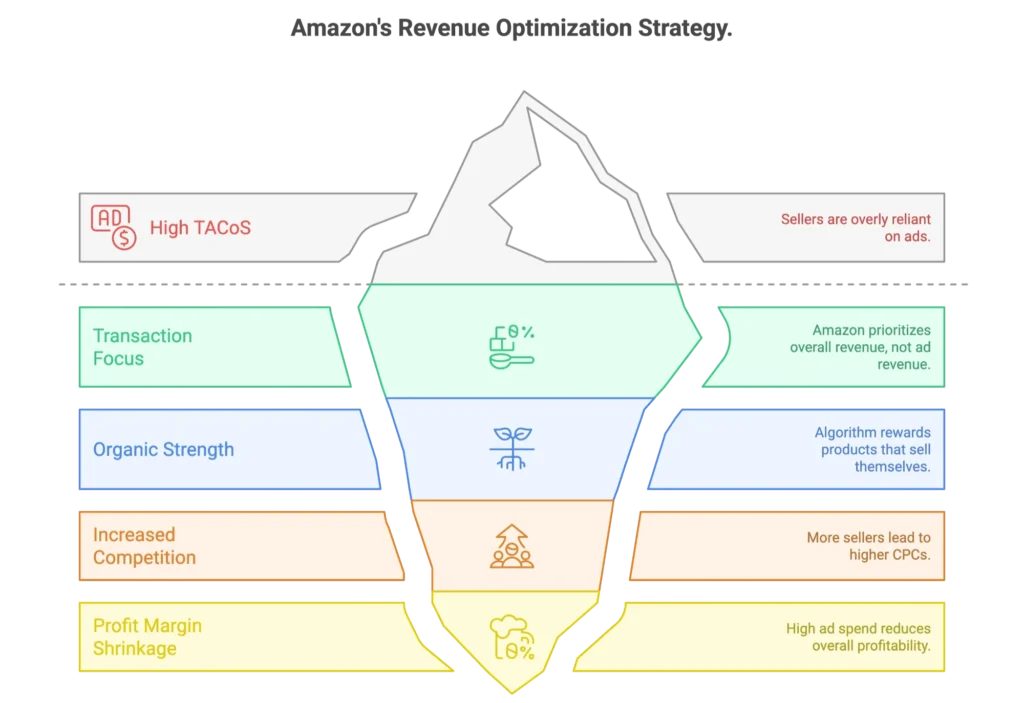
Here’s what most sellers get wrong: they think Amazon is in the advertising business. They’re not. Amazon is in the transaction business.
Think about it. Amazon makes approximately 8–15% on every sale through referral fees, and once you add in FBA and fulfillment fees, they are capturing a massive slice of the gross revenue. They make pennies on the dollar from your ad clicks. So what do you think they’re optimizing for? The answer is simple: Gross Merchandise Value (GMV). This realization is the ultimate Secret to Amazon Organic Rankings: Amazon doesn’t want your ad money as much as they want your successful, high-volume transactions.
Amazon’s algorithm has one primary goal: maximize revenue per search. Not ad revenue—total revenue. This means they want to show products that will:
- Convert at high rates
- Generate repeat purchases
- Minimize returns
- Create happy customers who keep shopping
When you understand this, everything changes. Amazon doesn’t want you dependent on ads. They want you to build products and listings that sell themselves. The algorithm rewards organic strength because it’s more profitable for them in the long run. Unlocking the Secret to Amazon Organic Rankings is essentially the process of aligning your business model with Amazon’s desire for high-margin, low-friction transactions.
The Real Cost of Ad Dependency
Let me paint you a picture of what’s happening to most Amazon sellers right now:
Year 1: TACoS at 15%, feeling good, scaling with ads Year 2: TACoS creeping to 20%, more competition, higher CPCs Year 3: TACoS at 25-30%, margins shrinking, considering raising prices Year 4: Stuck in the hamster wheel, afraid to turn off ads because sales would collapse
I recently worked with a client spending $43,000 per month on PPC for a single listing. Their organic rank? Page 3 for their main keywords. Their TACoS? 35%. They were essentially paying rent to Amazon for visibility, with no equity to show for it. This scenario is the complete opposite of the Secret to Amazon Organic Rankings, which focuses on using advertising to build permanent ranking power rather than just keeping a listing on life support.
This is the vicious cycle:
- More sellers enter your space
- CPCs increase due to competition
- You need more volume to maintain profit
- You spend more on ads
- Your competitors do the same
- The cycle continues until only Amazon wins
There’s a better way.
The Organic Ranking Ecosystem (Not Just Keywords)
Building sustainable organic rankings isn’t about keyword stuffing or gaming the system. It’s about understanding and optimizing the entire ecosystem that influences Amazon’s algorithm.
The Five Pillars of Organic Dominance
After analyzing hundreds of successful listings (including my own), I’ve identified five critical pillars that determine organic ranking success:

1. Mobile-First Listing Architecture
Here’s a stat that should change how you think about Amazon: 70% of purchases now happen on mobile devices. Yet 90% of sellers still optimize for desktop.
On mobile, customers see:
- Your main image
- First 80 characters of your title
- Price and Prime badge
- Star rating
That’s it. You have 5 seconds to convert or lose the sale forever.
Mobile-first optimization means:
- Main image designed for tiny screens (bold, clear, simple)
- Title front-loaded with key benefits in first 80 characters
- Price positioning that looks attractive on mobile
- Reviews that display well in mobile format
I redesigned one client’s listing with mobile-first principles. Same product, same price, same ads. Conversion rate increased 47% in 30 days.
2. Honeymoon Period Orchestration
Amazon gives every new listing a 90-day honeymoon period. This is your chance to prove your product deserves organic visibility. Most sellers waste it.
The honeymoon strategy isn’t about going slow and steady. It’s about coordinated aggression:
- Pricing: Start 30-50% below target price
- Reviews: Vine enrollment at low price for guaranteed 5-stars
- Inventory: Full distribution across all fulfillment centers
- Ads: Heavy investment to drive conversion data
The goal isn’t profit in the first 90 days. It’s positioning for the next 2 years.
3. Inventory Intelligence
This is the secret nobody talks about: your inventory levels and distribution directly impact your organic rank.
I built a custom tool using ChatGPT that maps where your inventory sits across Amazon’s fulfillment network. What we discovered shocked me.
When you have less than 30 days of stock:
- Amazon won’t distribute to all fulfillment centers
- Some customers see 5-7 day delivery instead of 2-day
- Conversion rates drop 20-40%
- Organic rankings slide
I maintain 60-90 days of inventory at all times. Yes, it ties up capital. But it’s the difference between a listing doing $50K/month and $500K/month.
Here’s what happens with proper inventory distribution:
- Consistent 1-2 day delivery nationwide
- Higher conversion rates (up to 15% vs 8%)
- Better organic rankings
- Lower PPC costs (better quality score)
4. Conversion Rate Optimization Beyond A+ Content
During client calls, my team and I discovered something crucial: A+ Content matters far less than mobile optimization. One client spent weeks perfecting their A+ Content that maybe 10% of customers see, while ignoring mobile optimization that affects 70% of traffic. Prioritizing the smartphone experience is the real Secret to Amazon Organic Rankings, as the A10 algorithm tracks the high bounce rates caused by unreadable mobile listings and suppresses your visibility accordingly.
The biggest conversion drivers are:
- Price relative to value perception
- Review quantity and quality
- Image storytelling
- Title clarity
- Inventory availability
- Alt text in your images (yes, this affects ranking)
I track conversion rates religiously. A 2% improvement in conversion can mean:
- 30% reduction in PPC costs
- 5-10 spot improvement in organic rank
- Compound growth over time
The best part? Amazon tells you exactly what converts through your auto campaigns. Most sellers ignore this data.
5. Strategic PPC for Ranking (Not Sales)
Here’s my controversial take from years of managing client accounts: PPC should be temporary for most keywords.
In a recent team call, we discussed defensive brand campaigns versus generic keywords. The conclusion? It depends on your organic position. This strategic pivot is the Secret to Amazon Organic Rankings: knowing exactly when to stop paying for your own brand and start using that capital to conquer new, high-volume territory.
The right way to use PPC:
- Identify high-converting keywords through auto campaigns
- Drive aggressive traffic during honeymoon period
- Track organic ranking improvement weekly
- Graduate keywords from PPC to organic
- Reinvest savings into new keywords
Wrong way: Set it and forget it, paying for the same keywords forever.
I call this the “graduation strategy.” Once you’re ranking top 10 organically for a keyword, why pay for it? That budget should go toward conquering the next keyword. Mastering the Secret to Amazon Organic Rankings isn’t about maintaining the status quo; it’s about aggressively reallocating your capital to expand your footprint while your established positions generate “free” profit.
The Honeymoon Period Playbook
The first 90 days determine the next 900. Here’s my exact playbook for honeymoon domination:

Days 1-30: Foundation Phase
Week 1: Setup
- Launch at 50% below target price
- Enroll in Vine immediately (critical: at the low price)
- Activate auto campaigns with aggressive budget
- Set up daily rank tracking for top 50 keywords
Week 2-4: Momentum Building
- Monitor Vine review velocity
- Adjust auto campaign bids based on conversion data
- Ensure inventory is flowing to all fulfillment centers
- Start exact match campaigns for converting terms
Key Metrics to Track:
- Daily sessions (should be increasing)
- Conversion rate (aim for 15%+ at low price)
- Organic rank movement (check daily)
- Review velocity (3-5 per day from Vine)
Days 31-60: Momentum Phase
Scaling Strategy:
- Increase price 5-10% weekly (watch conversion rate)
- Launch sponsored brand campaigns
- Expand exact match to related keywords
- Start building external traffic (Google, social)
Critical Actions:
- Double down on keywords showing rank improvement
- Pause keywords with high spend, no rank movement
- Ensure inventory stays above 60 days
- A/B test main image for mobile optimization
Warning Signs:
- Conversion rate dropping below 10%
- Organic ranks stalling
- Review velocity slowing
- Inventory gaps in any region
Days 61-90: Domination Phase
Optimization Focus:
- Achieve top 10 organic for primary keywords
- Graduate successful keywords from PPC
- Price optimization for profitability
- Build defensive moat against competitors
Advanced Tactics:
- Launch variation strategy for keyword expansion
- Test premium pricing on ranked keywords
- Build subscribe & save following
- Create video content for listings
By day 90, you should have:
- 50+ reviews with 4.5+ stars
- Top 10 organic rankings for main keywords
- TACoS under 20% and dropping
- Profitable unit economics
Real Case Study: From $3M to $24M in Two Years
Let me share a case study that shows exactly how this works. I took a clothing company from $3 million to $24 million in sales in just two years. This exponential growth was fueled by the Secret to Amazon Organic Rankings: transitioning the brand from an ad-dependent “renter” of visibility to a category-dominating “owner” of organic real estate.
The Problem They Faced
This company was stuck in a cycle:
- Running out of stock on key variations
- Thinking other colors would compensate
- Not understanding that Amazon ranks each child ASIN separately
- Losing momentum every time a hero variation went out
They didn’t realize that when your main color (the MVP) sells out, your entire listing crashes. It doesn’t matter if you have other colors in stock. This occurs because the Secret to Amazon Organic Rankings is tied to the historical conversion data of your top-performing variation; when that anchor disappears, the algorithm loses the primary driver of the parent listing’s authority.
The Solution We Implemented
1. Air Freight Everything They were hesitant: “We’ll lose money on shipping!” I told them: “You’re losing more from stockouts.”
2. 90-Day Inventory Minimum We went from 30-day stock levels to 90 days across all variations.
3. Hero Variation Protection We identified the 20% of variations driving 80% of sales and never let them drop below 60 days.
4. Strategic PPC Investment Instead of spreading budget thin, we focused on ranking hero variations first.
The Results
- Year 1: $3M → $8M (167% growth)
- Year 2: $8M → $24M (200% growth)
- Organic percentage: 40% → 75%
- TACoS: 28% → 12%
The key? We stopped treating it like 50 different products and started treating it like one ecosystem.
My Personal Brand: Zero to $400K/Month
Now let me show you what I’m doing with my own brand. Full transparency with real numbers.
The Launch Strategy
Initial Setup:
- Only 2 parent listings (not 50 mediocre ones)
- $400,000 inventory investment
- 12 sizes, 5 colors (60 total SKUs)
- Mobile-first design from day one
Honeymoon Execution:
- Launch price: $12.99 (target price: $24.99)
- Vine enrollment: All 30 slots filled
- Initial PPC budget: $500/day
- Inventory: 90 days across all variations
The Growth Trajectory
Month 1: Building Foundation
- Sales: $80,000
- PPC Spend: $18,000
- TACoS: 22%
- Organic Units: 700 (out of 2,100 total)
- Profit: -$6,000 (expected)
Month 2: Momentum Building
- Sales: $223,000
- PPC Spend: $43,000
- TACoS: 19%
- Organic Units: 2,500 (out of 6,000 total)
- Profit: $22,000
Month 3: Approaching Domination
- Sales: $278,000
- PPC Spend: $31,000 (reduced due to stock concerns)
- TACoS: 11%
- Organic Units: 4,100 (out of 7,000 total)
- Profit: $46,000
Month 4: The Test – Zero PPC
- Sales: $241,000
- PPC Spend: $0
- TACoS: 0%
- Organic Units: 6,000 (all organic)
- Profit: $77,000
Current Status:
- Consistent $400K+/month
- Zero ad spend
- Planning to scale to $500K/month minimum
- All organic growth
Key Lessons from My Brand
1. Don’t Go Wide – Go Deep Most sellers launch 20-30 listings doing mediocre numbers. I believe in having listings that do minimum $100K/month. My worst-case scenario listing does $150K/month.
2. Stock Management is Everything We had to reduce PPC in month 3 because certain sizes were running low. This discipline led to discovering our organic rank was strong enough to sustain without ads.
3. The Power of Momentum Once you hit critical velocity, Amazon’s algorithm becomes your friend. We went from page 5 to page 1 for our main keyword (200,000 search volume) in 45 days.
The Post-Honeymoon Recovery System
What if you already wasted your honeymoon period? Or bought a listing that’s underperforming? Recovery is possible, but it requires strategic investment. Reclaiming the Secret to Amazon Organic Rankings on a stale listing is a battle against historical data, and you cannot win it by doing the bare minimum.

Diagnosing Ranking Problems
From my experience managing dozens of client accounts, here are the most common issues:
1. Backend Keyword Degradation Amazon’s bots love to “help” by changing your backend keywords. One client’s listing dropped from $100K to $30K/month because Amazon changed their item type from “Pajama Sets” to “Pajamas Sets.” One letter killed their rank.
2. Inventory Distribution Gaps Your Seller Central might show 1,000 units in stock, but if they’re all in California, East Coast customers see 5-day shipping. Conversion rate tanks, rankings follow.
3. Mobile Conversion Issues Beautiful desktop listing, terrible mobile experience. Since 70% of traffic is mobile, you’re essentially turning away 7 out of 10 customers.
4. Alt Text Missing in Images During a recent client call, we discovered their A+ Content had no alt text. This hidden factor affects both accessibility and ranking.
The Recovery Framework
Step 1: Full Mobile-First Audit (Week 1)
- Screenshot your listing on iPhone and Android
- Check first 80 characters of title effectiveness
- Verify main image clarity at small size
- Test add-to-cart flow on mobile
Step 2: Backend Cleanup (Week 1-2)
- Download category listing report
- Verify all backend fields match your category
- Fix any bot-generated errors
- Update keywords based on current data
- Add alt text to all images
Step 3: Inventory Rebalancing (Week 2-3)
- Create removal order for slow-moving inventory
- Redistribute to optimize fulfillment coverage
- Aim for 60+ days across all locations
- Monitor regional delivery promises
Step 4: Strategic Repricing (Week 3-4)
- Test 20% price reduction on struggling variations
- Use price as a lever to rebuild momentum
- Track conversion rate improvements daily
- Gradually increase as ranks improve
Step 5: Targeted Rank Recovery PPC (Week 4+)
- Focus only on keywords you previously ranked for
- Use exact match with aggressive bids
- Monitor organic rank weekly
- Graduate keywords as you recover position
Advanced Strategies Most Agencies Don’t Know
These are the tactics that separate $100K sellers from $10M sellers. I’ve learned these through years of testing and being part of the MDS (Million Dollar Sellers) mastermind.

The Penny Price Change Hack
How It Works: Every customer who added your product to their cart gets a notification when the price changes. Even by one penny.
Implementation:
- Set up automated repricing
- Change price by $0.01 up or down daily
- Alternate between increases and decreases
- Never go below your minimum threshold
Results:
- 15-20% of cart abandoners purchase within 48 hours
- No margin sacrifice (penny changes)
- Improved conversion metrics
- Better organic ranking signals
Child ASIN Ranking Manipulation
The Reality: Each variation (size/color) has its own ranking potential. Amazon doesn’t average them—each stands alone.
Strategic Approach:
- Identify your hero variations (usually 20% drive 80% of sales)
- Protect hero variation inventory at all costs
- Use underperforming variations for testing
- Price variations differently based on rank potential
Example:
- Black Medium ranking #1 for main keyword
- Blue Medium ranking #47 for same keyword
- Price Black Medium at premium
- Discount Blue Medium to build its rank
The Vine Price Strategy
Why It Works: Vine reviewers get products free but review based on perceived value. Launch at high price = “expensive for what it is” reviews. Launch at low price = “amazing value” reviews.
Tactical Implementation:
- Set price at 50% of target before Vine enrollment
- Keep price low until 20+ reviews post
- Raise price 10% weekly after review critical mass
- Monitor review sentiment during increases
Results with This Strategy:
- 4.7+ star average (vs 4.2 without strategy)
- Better review content mentioning “value”
- Stronger conversion during growth phase
- Higher sustainable price point long-term
Defensive vs. Generic Keyword Strategy
From recent strategy sessions with my ads team, here’s what we’ve learned about balancing defensive brand campaigns versus generic keywords: the true Secret to Amazon Organic Rankings lies in your ability to stop “defending” territory you already own and start “conquering” territory where you are currently invisible.
When to Use Defensive Campaigns:
- You’re already ranking top 5 organically
- Competitors are bidding on your brand terms
- Your ACoS is under 10% on these terms
When to Shift to Generic:
- You need to acquire new customers
- Organic rank is already dominant for brand terms
- TACoS is climbing due to defensive spend
The key insight: If customers searching for “your brand + product” would buy anyway, why pay for that click?
Building Your Organic Ranking Machine
Ready to break free from PPC dependency? Here’s your 90-day action plan:

Week 1-2: Foundation Audit
Mobile Optimization:
- Screenshot all listings on mobile devices
- Identify title truncation issues
- Redesign main images for small screens
- Test mobile purchase flow
Backend Health Check:
- Download category listing report
- Verify all hidden fields
- Update degraded keywords
- Fix bot-generated errors
- Add alt text to all images
Inventory Analysis:
- Map current distribution using inventory ledger
- Identify coverage gaps
- Plan rebalancing strategy
- Set 60-90 day minimums
Week 3-6: Launch Preparation
Honeymoon Strategy:
- Set aggressive launch pricing
- Prepare Vine enrollment
- Design auto campaign structure
- Create rank tracking system
Content Optimization:
- Rewrite title for mobile-first
- Update images for storytelling
- Strengthen bullet points
- Add video content
- Ensure alt text is keyword-optimized
Review Acceleration:
- Enroll in Vine program
- Set up review requests
- Create insert card strategy (for customer service, not reviews)
- Monitor sentiment daily
Week 7-12: Scale and Optimize
Ranking Push:
- Heavy PPC on target keywords
- Daily rank monitoring
- Conversion optimization
- Price testing
Graduation Strategy:
- Identify ranked keywords
- Reduce PPC on winners
- Reinvest in new targets
- Build organic momentum
Profit Optimization:
- Gradually increase prices
- Maintain conversion standards
- Build subscribe base
- Create variation strategy
FAQ Section
Can you really maintain sales without any PPC?
Yes, but only if you’ve built strong organic rankings first. My listing maintains $400,000/month with zero ad spend because we invested aggressively in ranking during the honeymoon period. We achieved top 5 organic positions for keywords with 200,000+ monthly searches. This isn’t possible for every listing—you need strong conversion rates, proper inventory distribution, and a product that genuinely satisfies customer demand. This outcome represents the true Secret to Amazon Organic Rankings: treating your initial ad spend as a capital investment in permanent digital real estate rather than a recurring operating expense.
How much should I budget for the honeymoon period?
Plan for 90 days of aggressive investment:
- Inventory: 90 days worth (biggest cost)
- PPC Budget: $10-50K depending on competition
- Price Sacrifice: 30-50% margin reduction
- Total Investment: Often $100-500K for serious launches
The payoff is 10-20x when done correctly. One strong listing doing $3M+ annually beats 50 listings doing $50K each.
What if I already wasted my honeymoon period?
Recovery is possible but requires more investment. Focus on:
- Complete mobile optimization overhaul
- Fix all backend technical issues including alt text
- Rebalance inventory distribution
- Strategic repricing to rebuild momentum
- Targeted PPC on previously ranked keywords
I’ve recovered listings that were “dead” for months using this framework. You have to budget 2–3x more than the honeymoon period for recovery, as you are fighting to overcome months of poor historical data to reclaim the Secret to Amazon Organic Rankings.
How do I know if my organic strategy is working?
Track these metrics weekly:
- Organic units: Should increase week-over-week
- TACoS: Should decrease as organic grows
- Keyword rankings: Top 10 for main terms
- PPC independence: Can you reduce spend without losing sales?
If these aren’t improving after 30 days, your strategy needs adjustment. Most failures come from poor mobile optimization or inventory issues. Mastering the Secret to Amazon Organic Rankings requires recognizing that the A10 algorithm evaluates real-time performance data; if your metrics are stagnant, the algorithm has likely flagged a friction point in your customer journey.
Why does mobile-first optimization matter so much?
Simple math: Simple math: 70% of Amazon purchases happen on mobile, but most sellers optimize for desktop. Mobile users see only the first few words of your title, the first couple of images, and almost none of your standard product description without scrolling. Mastering the Secret to Amazon Organic Rankings in 2026 means winning the “thumb-stop” war by ensuring your listing is surgically optimized for the mobile interface where the majority of conversion signals are actually generated.
- Your main image (tiny version)
- First 80 characters of title
- Price and shipping speed
- Star rating
You have 5 seconds to convert. If your listing isn’t optimized for this reality, you’re losing 7 out of 10 potential sales. I’ve seen mobile optimization alone increase conversion rates by 40-50%.
Conclusion: Your Next Move
Amazon success isn’t about who spends the most on ads—it’s about who builds the strongest organic foundation. While your competitors burn through PPC budgets to rent visibility, you can build listings that generate sales 24/7 without constant ad spend. Mastering the Secret to Amazon Organic Rankings is the only way to transform a product from a temporary trend into a permanent market leader.
The choice is yours:
- Keep playing the PPC hamster wheel game, watching your TACoS creep up and margins shrink
- Or build a real business with organic rankings that create sustainable, scalable growth
I’ve shown you exactly how I built a listing doing $400,000/month with zero ad spend. I’ve given you the framework, the strategies, and the specific tactics that separate the top 1% from everyone else. This high-level mastery is the ultimate Secret to Amazon Organic Rankings: moving beyond the “pay-to-play” model to own a permanent digital asset that generates profit while you sleep.
The question is: What are you going to do with it? Having the Secret to Amazon Organic Rankings in your hands is one thing; executing a framework that converts that knowledge into a $400,000/month asset is another. It requires a fundamental shift from viewing Amazon as a marketplace to viewing it as a conversion-weighted search engine.
Ready to Break Free from Ad Dependency?
I work with a select group of manufacturers, wholesalers, and established sellers who want to dominate their categories—not just participate. My boutique firm only takes on 2-3 new clients per quarter because we go deep, not wide. Our primary objective is to unlock the Secret to Amazon Organic Rankings by aligning your operational logistics with the A10 algorithm’s demand for sustained commercial performance.
Get Your Free Organic Ranking Audit
I’ll personally review your top ASIN and show you:
- Why you’re stuck in the PPC trap
- Your biggest mobile optimization misses
- Hidden inventory and backend issues killing your rank
- Missing alt text and technical problems
- Exact steps to build organic dominance
Warning: This isn’t for everyone. If you’re looking for quick tricks or magic bullets, we’re not a fit. But if you’re ready to build a real, sustainable Amazon business that generates wealth while you sleep, let’s talk. Understanding the Secret to Amazon Organic Rankings is about committing to a long-term architecture that prioritizes brand equity over short-term hacks.
Remember: Every day you wait is another day paying rent to Amazon instead of building equity in your business.
The honeymoon period for your next launch starts now.
Hymie Zebede has been selling on Amazon for 12 years and has built multiple seven and eight-figure brands. He currently manages select accounts for manufacturers, wholesalers, and established sellers while building his own brands using the exact strategies outlined above. He’s also an active member of the MDS (Million Dollar Sellers) mastermind where top sellers share advanced strategies.

How to Read Your Competitive Organic Rank — and What to Do When It Drops
Most sellers check their absolute rank position. Fewer check their competitive organic rank — where they sit relative to the top 3 organic results for a keyword, not just where they appear on the page.
The distinction matters because Amazon’s algorithm weights velocity signals against the field, not against an absolute threshold. If your rank drops from 8 to 12, that might be noise. If your two closest competitors both moved from 10 to 6 while you held at 8, that’s a structural shift worth acting on.
The three numbers you need to track weekly
- Your absolute organic position for each target keyword — pull this from Brand Analytics > Search Query Performance, filtering to organic clicks only.
- Your share of organic clicks for that query — SQP shows you click share as a percentage. If your rank holds but your click share drops, a competitor is taking more clicks per impression than you (usually a listing quality or price issue).
- The gap to position 3 — for any keyword where you’re at position 4–12, calculate how many units/day the gap represents. A page-one listing at position 3 in a 2,000-search/month keyword might see 40–60 organic clicks/day. If you’re at position 9, you’re seeing 8–12. That gap is the opportunity size.
What a meaningful competitive rank drop looks like
Here’s a concrete pattern: you’re at position 7 for a core keyword, holding steady for three weeks. Then over five days you slide to position 11. No listing changes, no price change. What happened?
Nine times out of ten it’s one of three things: (1) a competitor ran a deal or coupon that spiked their unit velocity, temporarily boosting their rank signal; (2) you had a partial stockout — even 18 hours of suppressed buybox visibility tanks your conversion signal; (3) a competitor added A+ content or improved their main image, lifting their CVR, which Amazon reads as a stronger relevance signal for that keyword.
The fix sequence: check your own inventory health first (IPI score, days of supply on your top-10 keywords’ leading ASINs). Then check competitor pricing and deal history via Keepa. Then look at their listing for recent changes. You’re ruling out causes in order of likelihood, not guessing.
The monitoring setup that takes 20 minutes a week
You don’t need expensive rank-tracking software to do this well. A simple spreadsheet with five columns — keyword, your position this week, position last week, your SQP click share, and a note column — covers 80% of what matters. Track your top 10 revenue-driving keywords. Set a rule: if any keyword drops more than 4 positions week-over-week, investigate that day, not at the end of the month.
For sellers managing 50+ ASINs, Helium 10’s Keyword Tracker or DataForSEO’s Amazon module can automate the pull. The output is the same — you want a weekly delta view, not a point-in-time snapshot.
If you’re not sure which keywords are your actual organic revenue drivers (as opposed to your ad-driven terms), start with SQP filtered to organic orders only, sorted by organic click share. Those are the keywords your rank actually depends on — and the ones where competitive shifts cost you real money.
If your competitive rank is slipping and you can’t isolate the cause, a free audit can identify the specific ranking leaks across your catalog before they compound.

